Wiring a 3-wire chandelier without mixing up the wires
This article is also available in French: Comment brancher un lustre à 3 fils : Guide complet et astuces

Switch off the breaker, check that there is no voltage, then identify three conductors: green-yellow for earth, blue for neutral, brown or black for live. Tighten the earth first, then the neutral, then the live, in the connector block. Switch the power back on: if the chandelier lights up steadily, the connection is correct.
How do you wire a 3-wire chandelier, step by step?
Switch off, identify, tighten in order: earth, neutral, live. A three-wire chandelier is always connected this way. A mix-up does not show straight away: the lamp comes on then flickers, or the residual current breaker trips after a few seconds.
In what order should you work, from the breaker to the connector block?
On a designer chandelier, the connection is prepared before fitting. The order of the steps matters more than how hard you pull.
- Breaker: switch off the lighting circuit, then check for no voltage with the tester on each conductor.
- Identification: photograph the terminal block of the old light before taking it down.
- Earth first: green-yellow tightened in the connector block, then the blue, then the live.
- Check: pull gently on each wire, no strand should slip.
A switched-off switch is not enough, the line is still live behind the box. On older circuits, where the live sometimes arrives in red and the neutral in grey, wiring a light step by step covers every configuration.
What should you check before switching the power back on?
Switch on. A steady light, without flickering, confirms the work. A slow blink or an immediate trip points to a mix-up or a loose connection.
A large-diameter living room chandelier often hangs from a single point: the hook carries the weight, never the connector blocks.
How do you identify live, neutral and earth on a 3-wire chandelier?
Green-yellow for earth, blue for neutral, brown or black for live. On the light's terminal block, the printed marking counts as much as the colour. When doubt remains, a multimeter on the continuity setting, or a clamp meter, settles it in seconds.
| Conductor | Usual colour | Marking on the terminal block |
|---|---|---|
| Earth | Green-yellow | Earth symbol |
| Neutral | Blue | N |
| Live | Brown, black or red | L |
And when all three wires are the same colour?
A common case on imported light fittings: three black conductors, or three white ones. The terminal block then becomes the only reference, with L, N and the earth symbol moulded into the plastic, sometimes hidden under the lamp holder label.
Without a readable marking, open the light. The earth is screwed to a metal part of the frame, the neutral goes to the lamp holder, the live passes through the switch. Wiring a ceiling light's wires shows this path on an open box.
How do you identify the live with a multimeter or clamp meter?
With the power on, carefully: about 230 V between live and earth, almost nothing between neutral and earth. That difference identifies the live unambiguously, even on a discoloured wire.
With the power off, continuity mode confirms the other end of a conductor. Wiring a light to the ceiling details this check when the colours match nothing familiar.
How many conductors does your chandelier have once the connector block is open?
If identifying the three conductors took you longer than expected, it is often because the chandelier itself is not the right model for your ceiling: browse the modern chandelier range selected by Designix, where the connections are described product by product, and our team answers your technical questions if any doubt remains.
A worn terminal block or a grey wire is sorted in five minutes with a photo: you can contact Designix to have the identification confirmed before tightening the last connector block.
What should you do when the ceiling has no earth wire?
The chandelier is then connected with two conductors: neutral and live. The green-yellow wire of the light stays isolated, folded neatly into a dedicated terminal or connector block. It is never cut flush with the sheath, and it is never connected to the neutral.
Does a class II chandelier do away with the earth?
Yes. A class II light carries a double square and requires no protective conductor: its insulation is doubled. A chandelier with an exposed metal frame, however, needs a real earth.
The technical data sheet settles it, and if you want to see what other buyers have installed in this configuration, the Designix customer reviews are public. A line without earth does not rule out the light, it requires the right model.
Does an earth terminal on the box replace the ceiling wire?
No. A terminal on the frame is used to connect the protective conductor when one already exists in the ceiling, not to create one. Without an earth wire in the installation, the green-yellow stays isolated, never bridged.
A glass light with a non-metal frame simplifies the connection, provided its class is checked before purchase.
Can you wire a 3-wire chandelier to a DCL box?
Yes, and it is the most convenient setup: the box provides earth, neutral and live on three accessible terminals, with a built-in hanging hook. The chandelier connects to it with connector blocks, without opening the ceiling or hunting for wires blind.
Do you need an adapter or connector blocks on a DCL?
- Three terminals: earth, neutral and live, marked in the box.
- A hook: it carries the weight of the light, the wires carry nothing.
- A connector block: each conductor of the chandelier meets its terminal.
The box takes a limited weight. Beyond that, a reinforced fixing point in the ceiling becomes necessary. Installing a chandelier on a DCL box details how the hook is connected.
Which chandelier should you choose when the DCL box is already in place?
A hanging, lightweight model whose canopy covers the box. That is the case for most of our collection: out of 250 references surveyed as of 29 September 2026, 94% state a hanging mount. In the same survey, the 2-year warranty and CE certification appear on every data sheet, and the collection had 3725 references on that date.
The ingress protection rating should also be checked before buying: 100% of the survey states IP20. A ceiling chandelier is therefore reserved for dry rooms, never above a shower. If your ceiling is low, an LED ceiling light connects to the same three terminals, with the same logic.
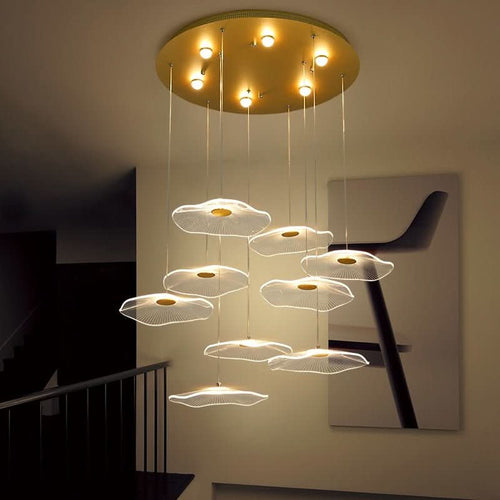
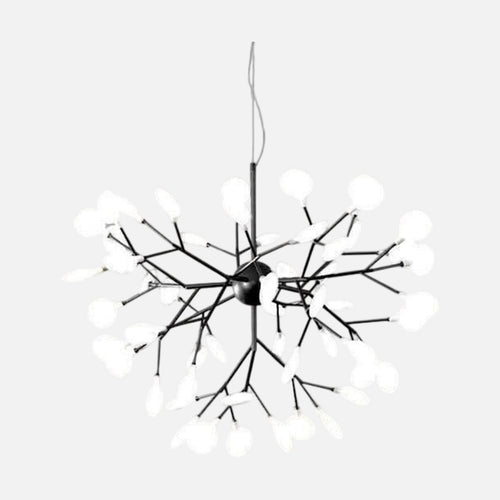
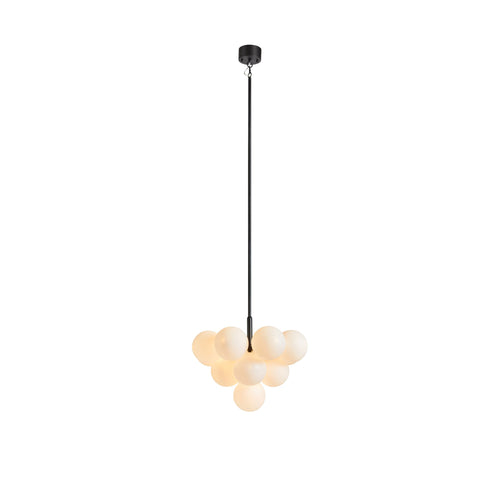
Chandeliers to wire, Designix selection


How do you fit the chandelier and avoid taking everything down again?
The hook or mounting plate is fixed into the ceiling support, never into plasterboard alone. The light is hung, adjusted to height, then connected. Fitting it before adjusting often means bringing it all down a second time.
At what height should you hang a chandelier above a table?
- Dining table: the bottom of the light about 75 cm from the tabletop, to light the plates without hiding faces.
- Kitchen island: 75 to 85 cm, to keep the view across the room clear.
- Hallway or corridor: keep more than 2.10 m under the light, nobody should brush against it.
These markers are checked standing up, tape measure in hand, before tightening the last connector block. Hanging a chandelier safely details how the hook is connected on a concrete slab as well as on plasterboard.
Which mistakes force you to take the chandelier down again?
- Wire too short: the connector block dangles, the canopy no longer covers anything.
- Canopy too small: the fixing hole stays visible, and the dust seal is lost.
- Lamp holder not tightened: the light flickers after fitting.
Three minutes of checking save an evening on the ladder. A well-chosen dining room chandelier hangs at the right level first time. And when the old model has to go, changing a chandelier yourself and hanging a chandelier from the ceiling give the two steps that save the most time.
In stock · shipping costs shown at checkout · up to 30% off in your cart
Ready to turn inspiration into reality?
Tell us about your room, your style and your budget, and we will show you the pieces that truly suit your project.
Get guidance in 30 seconds →