Replacing a halogen with an LED on a dimmer: the guide
This article is also available in French: Remplacer halogène par led avec variateur
First look for the words "dimmable" or "variable intensity" on the bulb, then the minimum load printed on the dimmer. If the bulb flickers at the bottom of its range, buzzes or stays faintly lit after switch-off, the dimmer is the cause, not the bulb. A correctly chosen dimmable LED replaces the halogen, with no other work in most cases.
Can halogen bulbs be replaced with LEDs?
Yes, as soon as the cap and the voltage match. A 12 volt halogen is replaced by a 12 volt LED, a 230 volt one by a 230 volt one. The point to watch is not the bulb but the circuit that drives it, dimmer or transformer included.
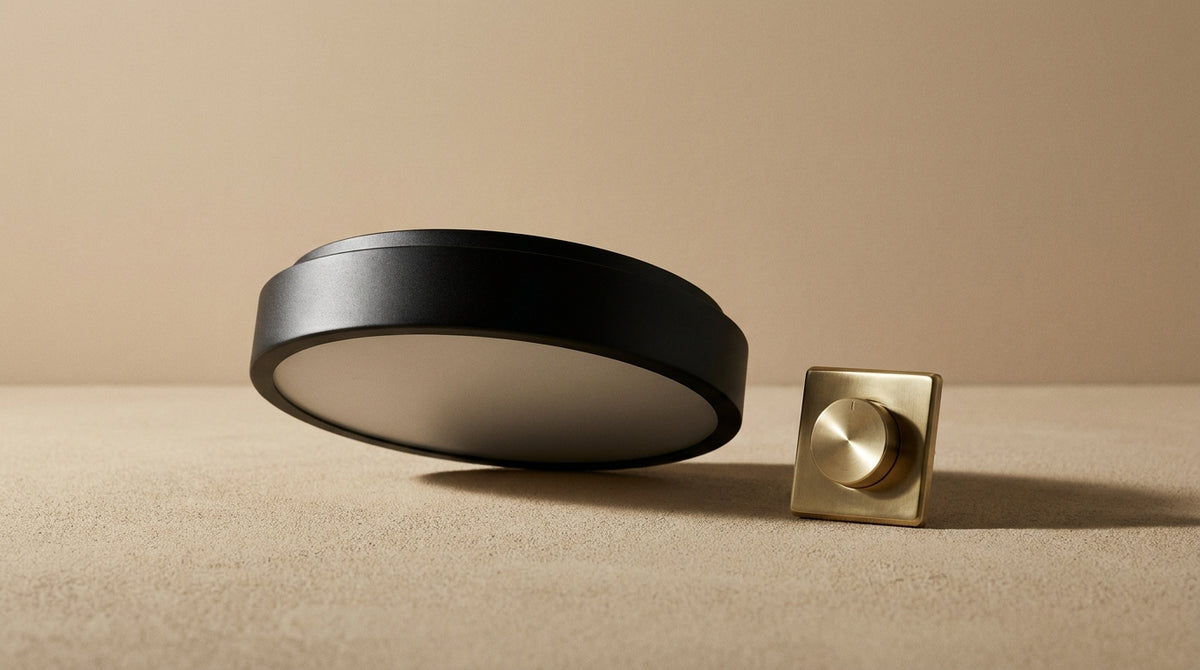
Some fixtures settle the question in advance: LED ceiling lights with a dimmer come with the bulb and its electronics built in, so there is no uncertainty at the time of purchase.
Why the stated wattage is no longer enough
A 40 W halogen really draws 40 W. The LED that produces the same light uses a fraction of that. The dimmer, however, was set up for that heavy load: it can no longer hold its minimum current, and dimming becomes unstable.
Three checks before ordering
- The cap: GU10 to clip in, E27 or E14 to screw in, G4 and G9 for small capsules
- The voltage: 12 volts on a transformer, 230 volts on the mains
- The dimmable wording: without it, the bulb will light but never accept dimming
The full method to replace a halogen bulb with an LED comes down to these three points.
Do LED bulbs work with a dimmer?
Yes, on one non-negotiable condition: the bulb must be stated as dimmable or variable intensity. A standard LED wired to a dimmer flickers, switches off in jumps or refuses to go lower. Dimmable bulbs contain the electronics that talk to the device.
Dimmable, variable, gradable: three words for one thing
Packaging mixes the terms, the capability is the same. What changes is the dimming range: some stop at a soft glow, others cut out abruptly. Our explainer on dimmable LED details these behaviours.
Minimum load, the real criterion
An old dimmer demands a minimum load far higher than what two or three LEDs provide. Below that threshold, it drops out. Knowing how to choose between a dimmable or variable bulb is therefore not enough: the dimmer's data sheet matters as much as the bulb's.
How do you know if a dimmer is LED compatible?
Switch off the power, remove the bulb, then read the dimmer's casing. Two pieces of information settle it: the "LED" wording and the minimum load in watts. Without the LED wording, treat the device as unsuitable and plan to replace it.
What the dimmer's data sheet must show
In a survey of 67 references of LED ceiling lights with a dimmer from our catalogue, as of 29 September 2026, 90 % state dimming capability and 10 % do not. In the same survey, 100 % use LED technology and 67 out of 67 data sheets carry the CE marking, which gives a reliable basis for comparison before ordering.
- Minimum load: the lower it is, the better the LED behaves
- LED wording: the device was designed for a low load
- Technology: phase-cut models remain the most tolerant
Identifying the right cap before ordering
A GU10 clips in, an E27 screws in, an E14 does too but is slimmer. Getting it wrong costs a parcel there and back for a cheap part, which is more annoying than the price. Our guide to identifying the right cap settles the question from a photo.
GU10 LED bulbs cover the most common recessed spotlights, while screw caps remain the majority on shaded fixtures.
Which room is the fixture you want to convert to dimmable LED in?
What problems come with replacing halogen bulbs with LEDs?
Four symptoms keep coming back: flickering at the bottom of the range, buzzing, residual glow after switch-off and stepped dimming. All come from a device designed for a halogen load. The LED bulb is rarely at fault, the control almost always is.
| Symptom | Likely cause | Decision |
|---|---|---|
| Flickering at the bottom of the range | Load below the dimmer's minimum | Change the dimmer |
| Buzzing | Poorly filtered current chopping | Change the dimmer or the bulb |
| Residual glow | Leakage current sufficient for an LED | Change the dimmer |
| Stepped dimming | Regulation unsuited to the load | Switch to a controlled fixture |
Is a halogen transformer compatible with LED lamps?
An old ferromagnetic transformer is not: it expects a load close to that of the halogen and starts to hum. An electronic model copes better, with no guarantee. Our article on wiring an LED transformer explains how to identify yours.
On a 12 volt recessed spotlight, replacement often means changing the driver as well as the bulb. LED spotlights ready for dimming avoid that step, as detailed on our page about the dimmable spotlight.
Should the dimmer be changed?
If the casing carries LED wording, keep it. If not, replace it with an LED model, or switch to a fixture that is already controlled. If your dimmer carries LED wording or a minimum load too high for your bulbs, the diagnosis takes five minutes: describe your setup and we will tell you whether to change the bulb or the device. You can ask an adviser with two photos of the installation.
Switching to LED without losing the atmosphere
LED does not make a room feel cold when the colour temperature is chosen well. Aim for 2700 K in a living room or bedroom, 3000 K in a kitchen. The real comfort is still in lowering the intensity in the evening, when the room shifts from work to conversation.
Colour temperature matters more than wattage
Two bulbs of the same wattage can make a room feel cold or warm. 2700 K leans towards amber, 4000 K towards office white. Indoors, warm white forgives materials and shades, cool white hardens them.
The evening gesture: dim rather than switch off
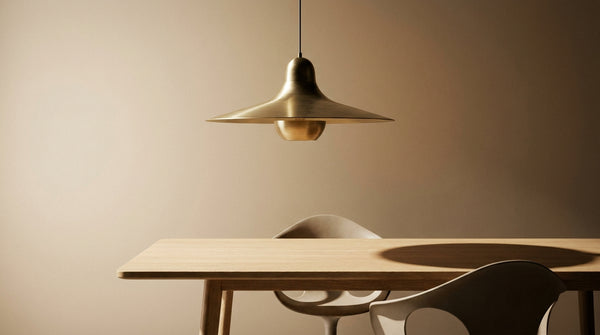
A well matched dimmer goes down to a standby glow, with no jump or cut-out. That is what separates considered lighting from lighting you put up with. Our selection of dimmable pendant lights covers dining rooms and kitchen islands.
Frosted glass softens that low light without glare, a common choice for glass fixtures placed above a table. An LED ceiling light suits rooms where you want to vary the light without hanging anything, and our guide to going all-LED helps you tackle the home room by room.
The LED ceiling lights with a dimmer collection has 2,131 references as of 29 September 2026. In the survey of 67 of them on the same date, the bedroom is stated on 94 % of the data sheets and the living room on 90 %, and the warranty splits between 2 years for 69 % and 5 years for 31 %.
LED ceiling lights with a dimmer: the selection


On the same subject
In stock · shipping costs shown at checkout · up to 30% off in your cart


Ready to turn inspiration into reality?
Tell us about your room, your style and your budget, and we will show you the pieces that truly suit your project.
Get guidance in 30 seconds →