Replacing a halogen spotlight with an LED: the foolproof guide
This article is also available in French: Remplacer spot halogène par led
Can you replace a halogen spotlight with an LED?
Yes, in almost every case, without rewiring the circuit. What decides it is not feasibility but two reference points: the base and the voltage. A 230 V setup can be replaced directly, a 12 V setup requires an LED-compatible transformer. Check these two points before opening the box.
The rest comes down to use. An LED shines more brightly at equal power, gives off very little heat and leaves the choice of white tone in your hands. Three tired spotlights are often the starting point for a complete living room renovation.
| Reference | 230 V setup | 12 V setup |
|---|---|---|
| Common base | GU10, E27 | GU5.3, G4 |
| What you replace | The bulb alone | The bulb, and sometimes the transformer |
| Difficulty | Immediate, no tools | A check before buying |
| Watch out for | Nothing | Minimum load of the transformer |
Replacing a halogen spotlight with a 230 V LED
Switch off the room's circuit breaker, let it cool, unclip the old bulb, fit the LED into the same base. Two minutes, no tools. The details of the process, clips included, are described in our guide to replacing a GU10 recessed spotlight.
On availability, the format is no longer a problem. From a survey of 249 listings in our LED spotlight collection as of 29 September 2026, 96% of the survey declares an LED base and 3% a GU10 base. For a bulb alone in an existing socket, everything is summarised in our article on replacing a halogen bulb with an LED.
Replacing a halogen spotlight with a 12 V LED
12 V adds one piece to the puzzle: the transformer, hidden behind the spotlight or set in the false ceiling. A halogen draws enough current to wake it up, an LED far less. Without enough load, it stays silent or makes the light point flicker.
The simplest solution is often to go back to 230 V when the false ceiling allows it. Otherwise, keep the transformer and adjust the number of spotlights switched on together.
With 1,575 references in our LED spotlight collection as of 29 September 2026, the right model is found by filtering on base, ingress protection and white colour rather than looking for a bulb at random.
Do you need to change the transformer for an LED spotlight?
Not systematically. A recent electronic transformer often accepts LEDs, provided the minimum load is reached. An older, heavier ferromagnetic model copes poorly with the low consumption of an LED. In that case, keep enough spotlights switched on together, or replace the transformer.
- Minimum load: an LED of a few watts will not wake up a transformer designed for several halogens.
- Number of points: multiplying spotlights brings the load back into the useful range.
- Electronic transformer: often compatible, a test on a single spotlight settles it in a minute.
- Ferromagnetic model: frequent buzzing and flickering, replacement recommended.
Replacing a recessed halogen spotlight with an LED
A recessed spotlight unclips from the ceiling from below. On a plasterboard false ceiling, you reach the connector through the cut-out, without removing the panel. On a series of spotlights to redo, the quickest approach is to handle the points by zones rather than all at once. Our trade area supports installers redoing complete series, point by point.
Replacing a halogen projector with an LED
Projectors with linear bulbs and rail-mounted models follow the same logic: read the voltage, note the base, check the space available in the light fixture body. A more compact model sometimes fits where the old one did not.
If your installation is 12 V and the transformer cannot keep up, the simplest thing is to talk to the team before ordering: ask the team, and we will tell you what to check on your setup.
What problems come with replacing halogen bulbs with LEDs?
Three cases come up: flickering when the load is too low, dimming that stutters with a dimmer designed for halogen, and residual heat from the old spotlight that has not had time to cool. None is a blocker, each has its solution.
- Flickering: load too low or unsuitable transformer, add light points.
- Dimming: the dimmer must be compatible with the LED load, otherwise the low range stutters.
- Heat: switch off and let it cool before touching, a halogen stays burning hot long after switching off.
- Buzzing: a sign of a ferromagnetic transformer to be replaced.
On dimming, everything depends on the dimmer and lamp pairing, a point detailed in our article on dimmers with LEDs. The notion of dimmable LED answers right after: it is the lamp's ability to dim without losing visual comfort.
Change the bulb or change the whole spotlight?
Change the bulb if the base is accessible and the holder sound. Change the whole spotlight if the socket is burnt, blackened, or if you want to lower the power while gaining in thickness. The price of the job is not the same, nor is the result.
- Sound socket: bulb alone, it is the least involved replacement.
- Blackened or brittle socket: complete spotlight, safety comes before saving.
- Low false ceiling: prefer an extra-flat model, the classic recessed one will not fit.
- Wanting to change the look: sometimes it is a new light fixture you need, not a bulb.
The details of the clips and springs are covered in our guide to changing the bulb of a recessed spotlight. If you are still hesitating between repairing and replacing, the Google listing for our business shows its up-to-date rating and reviews, with no fixed figure in this article.
Recessed and rail-mounted LED spotlights, by room


How many spotlights and what light for the room?
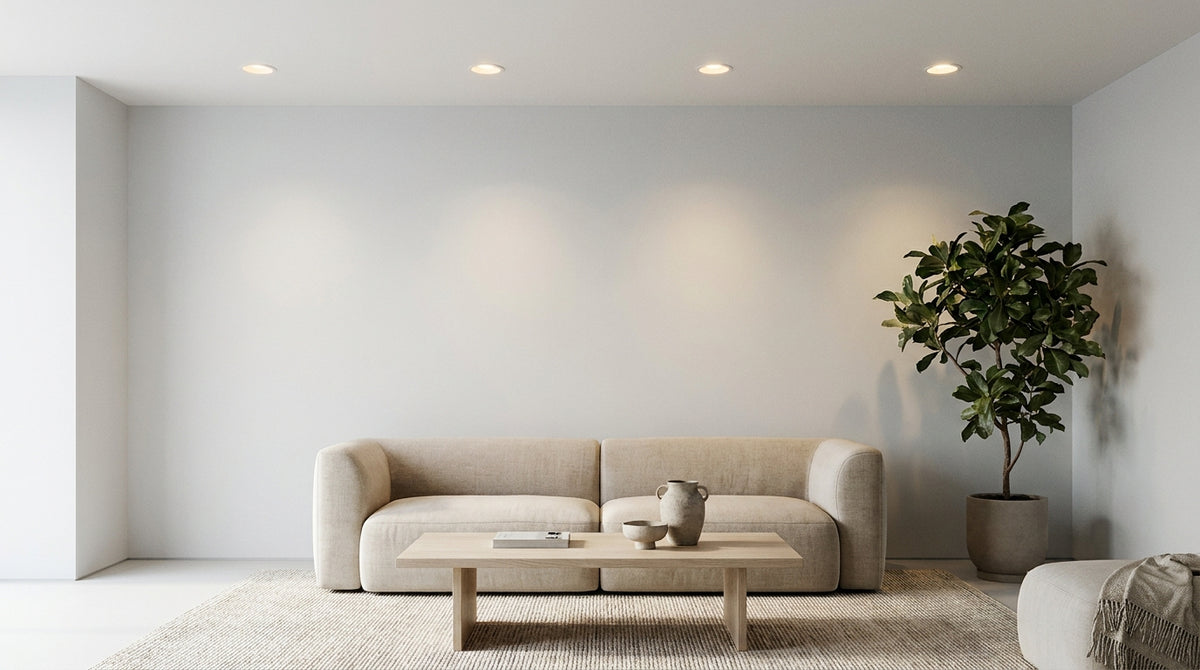
Two settings matter more than the number: colour temperature and layout density. A living room reads around 2700 K to 3000 K, a kitchen or hallway can take brighter. Density is calculated on the surface area and ceiling height, never by feel.
Which light, warm or cool, to choose?
Warm white relaxes, neutral white structures, cool white wakes up. In a living space, stay warm for relaxation areas and neutral white above the worktop. Our comparison warm or cool light helps you decide according to the room and the time of use.
How many spotlights per m² to plan?
Allow one point every one to one and a half metres for general lighting, more if you are aiming for a wall effect or a worktop. The full method is in our article on how many spotlights per m² to plan according to the surface area.
For a living room, it is better to spread them in a ring than to line them up in a grid, a point developed in our guide to recessed spotlights in a living room. In a kitchen and hallway, an LED ceiling light added as a complement avoids lining up six spotlights where two are enough. On protection, remember IP20 in dry rooms, IP44 minimum in wet rooms.
What does your installation look like today?
In stock · shipping costs shown at checkout · up to 30% off in your cart


Ready to turn inspiration into reality?
Tell us about your room, your style and your budget, and we will show you the pieces that truly suit your project.
Get guidance in 30 seconds →