Replacing a recessed spotlight with a pendant light: the step-by-step guide
This article is also available in French: Remplacer spot par suspension
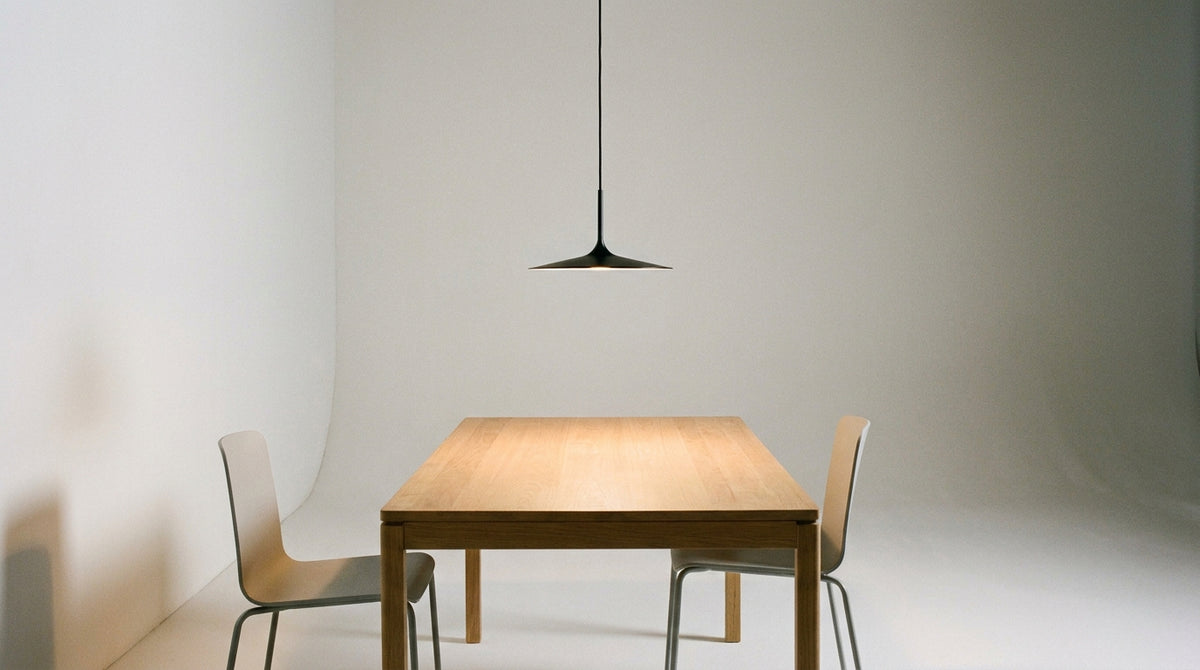
Switch off the circuit at the breaker, remove the spotlight and its springs, and fill the 68 to 90 mm hole left in the ceiling. Then hang a pendant light on a fixing suited to its weight and to the nature of the surface. The connection stays at 230 V, inside a closed box.
Is it possible to replace a spotlight with a pendant light?
Yes, in most setups, and without breaking the ceiling. The sticking point is not the current, it is load bearing. A spotlight weighs a few hundred grams, a pendant light several kilos, and it is the fixing that takes that difference.
The hole left by the spotlight is no longer needed once filled. The fixing goes beside it, or over it thanks to a finishing plate.
Can you replace a spotlight with a ceiling light?
Yes, provided you match the plug to the actual surface. That choice matters more than the weight printed on the box.
- Concrete slab or hollow-core slab: expansion plug, the most stable
- Plasterboard on a frame: toggle or Molly plug, never a plastic plug alone
- Suspended false ceiling: the rod goes through the plenum and anchors into the slab
- Old plaster ceiling: locate the joist before any drilling
When four or five spotlights were gridding a living room, the job becomes a full ceiling makeover: filling, plaster, paint. This type of work is detailed on our page about renovating the living room.
If choosing the model takes you longer than fitting it, the pendant light collection can be browsed by room and by style, with the sockets and materials listed on each product page.
How do you replace a recessed spotlight with a pendant light, step by step?
You switch off the circuit, free the spotlight, fill the hole, choose the fixing point, connect. Five steps, a screwdriver and pliers are enough. The only waiting time is the filler drying before drilling.
How do you remove a ceiling spotlight without damaging the plaster?
The spotlight is held by two springs pressed against the board. They compress as you pull downwards, without jerking: it is the sudden movement that cracks the plaster around the trim.
- GU10 or halogen spotlight: bulb removed first, the body then comes free
- Clip spotlight: the trim unclips from the side
- Spotlight stuck to the plaster: thin blade slipped around the edge, never a lever
A stuck bulb is freed by the socket, not by twisting the glass. The full method is described in our article on changing the bulb of a spotlight without clips.
What to do with the 12 V transformer of old spotlights?
It is removed. A 12 V or 24 V transformer has no use with a pendant light, which runs on 230 V. Leaving it in the plenum means keeping a component powered that heats up and ages for nothing.
- Remote transformer: located, disconnected upstream, removed
- Transformer built into the spotlight: it goes with the spotlight
- Dedicated LED driver: useless for the new light
The supply conductors, however, must stay accessible and protected in a closed box. A bare wire left in the plenum, and the job is not finished.
How do you fix the pendant light when the spotlight hole is too big?
A 68 to 90 mm hole never holds a fixing screw. Two options: a finishing plate that covers the opening, or a fixing offset a few centimetres beside the hole. Filling comes before fitting, and the filler must be dry before drilling.
A pendant light can be anchored without a hook or crossbar, depending on the nature of the surface. Any doubt about the surface or the final height is settled in five minutes with someone who has already seen the ceiling: simply describe your room to the team.
Pendant lights ready to take the place of your spotlights


Why is the spotlight cover mandatory?
Because an electrical connection must never stay bare in a plenum. The cover, or DCL box, closes the connection point, protects the terminal blocks and gives the light a clean support. It also serves as a marker when the ceiling is repainted.
What is a DCL box on the ceiling for?
It performs four functions that the spotlight hole does not provide.
- Protection: the conductors are enclosed, out of reach
- Accessibility: the connection stays removable without breaking the ceiling
- Support: the box holds a light fixture
- Finish: it hides an irregular cut
The full connection, from identifying the wires to fitting the socket, is detailed in our guide to installing a pendant light on a DCL box.
When the electrical supply is not in the right place
The spotlight lit a specific point. The pendant light, however, must hang above the table or in the centre of the room. The gap is bridged in three ways: surface trunking, a chased and filled channel, or an accessible junction box feeding an offset cable. For a light above a table, moving the fixing a few tens of centimetres is often enough, without touching the supply.
How do you choose a pendant light for each room?
First set the clear height under the shade, then the diameter, and only then the style. A pendant light too low in a passage gets knocked, one too small above a table gets lost.
| Room | Model to aim for | Common socket | Rating |
|---|---|---|---|
| Dining room | Large format, 70 to 80 cm above the tabletop | E27 | IP20 |
| Kitchen and island | Linear, aligned trio, fixed height | E27 or G9 | IP20 |
| Bedroom | Closed shade, enveloping light | E27 | IP20 |
| Bathroom | Compact format, short cable | E27 | IP44 |
| Entrance and hallway | Modest diameter, clearance at floor level | E27 | IP20 |
On a survey of 92 pendant lights in our catalogue as of 29 September 2026, 98% are suspended, 87% in metal and 71% in black. On the same date, the Pendant lights collection has 7608 references, filterable by room and by style. The E27 socket dominates, carried by 33% of the surveyed product pages, which leaves the choice of E27 bulb after purchase.
One point to watch on the same survey: 98% of the product pages are IP20 and 2% IP44. In a bathroom, therefore look for the mention explicitly, the bathroom pendant light collection carries it in its filters.
There remains the question of adjustment over time. A height-adjustable pendant light can be tweaked after fitting, by acting on the cable and the blocker, without removing the fixing. Useful when the table changes, or when a child grows up in the room.
For an island or a worktop, the kitchen pendant light collection gathers the formats designed to stay above the surface. For a living room with several light points, the living room pendant light combines with lower models. And if the project goes beyond the ceiling, a wall or floor light completes the set without touching the structure.
In which room are you replacing your spotlights with a pendant light?
How do you hang a pendant light with no electrical supply?
You start from an existing point instead of creating one. A switched socket, a cable outlet already in place, or a battery light: in all three cases, no chasing is needed.
Solutions without building work
- Switched socket: cable in trunking, pendant light plugged into it
- Existing cable outlet: direct replacement of the old ceiling light
- Battery light: rechargeable, placed or hung, with no connection
- Offset lighting: wall light and floor lamp replace the ceiling light
When the ceiling really cannot take anything, the light moves to the walls and to the floor. Our guide on lighting a room without a ceiling light details the combinations.
What you cannot do
- Hang from trunking: it bears no load
- Drill into a heated ceiling: risk of hitting the circuit
- Reuse a 12 V supply: the voltage does not match
- Run a line without protection: the connection must stay enclosed
A light of more than a few kilos requires going through the plenum to reach the slab. Below that, a toggle fixing is often enough, provided it is not placed in the filled hole.
On the same subject
In stock · shipping costs shown at checkout · up to 30% off in your cart


Ready to turn inspiration into reality?
Tell us about your room, your style and your budget, and we will show you the pieces that truly suit your project.
Get guidance in 30 seconds →