
Recessed ceiling light: choosing the right ceiling lighting
This article is also available in French: Plafonnier encastrable
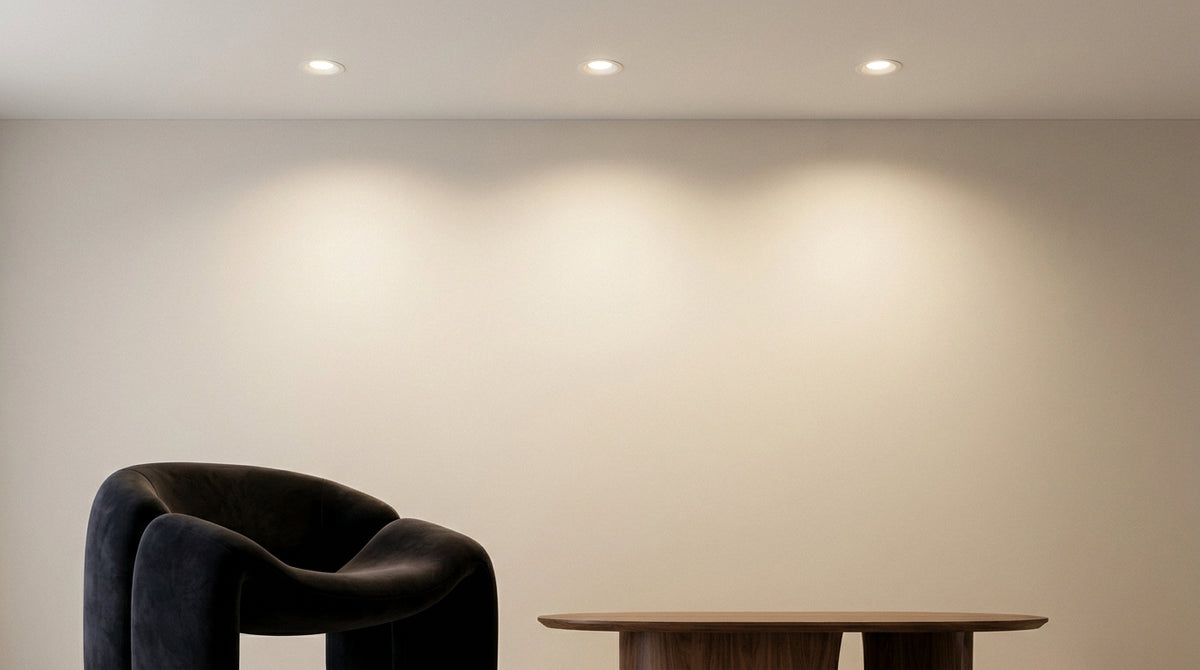
Check the clearance above the ceiling before buying anything: 2 to 3 cm for an ultra-slim module, up to 8 cm for a GU10 bulb spotlight. Also measure the space between the slab and the finished ceiling. That constraint decides what you can install, not the style.
Which ceiling light gives the best light?
The one whose output covers the surface without casting hard shadows. Allow 100 lumens per m² for a living room, 200 for a worktop, and spread the light across two or three points. A recessed ceiling light gives broad, even light; it lights a precise detail poorly.
Recessed, surface-mounted or pendant: which to choose?
The mounting changes the effect before it changes the budget. If you are revisiting a lighting plan for a living room and living space, start from the room plan and how it is used rather than from the product sheet.
- Recessed: the source disappears, only 3 to 5 mm of trim sits flush
- Surface-mounted: no cut-out, 3 to 10 cm of height lost
- Pendant: the light comes down, best kept for tables and islands
What our catalogue survey shows
The Grand plafonnier collection has 378 references as of 6 October 2026. On a survey of 222 of those listings on the same date, 97% declare a surface mounting and 1% a recessed mounting: recessed remains a niche choice, often dictated by ceiling height.
The declared durability points the same way: on those 222 listings, 78% advertise a 5-year warranty and 100% mention CE marking. As for looks, many of these models read as a minimalist ceiling light, white or black, blending into the plaster.
Our selection of large-format ceiling lights brings both families together, dimensions included, so you can compare like for like.
Can you install spotlights without a false ceiling?
Yes, provided there is clearance above the finished ceiling. A recessed spotlight sits in a void of 2 to 8 cm depending on the model; in a solid slab, a housing has to be sunk in. Without clearance, it is better to accept surface mounting than to force a recess.
The three scenarios
- Suspended plasterboard ceiling: 6 to 10 cm of void, recessing is straightforward
- Slab with a service void: 3 cm is enough for an ultra-slim module
- Solid slab: no chasing possible, either a sunk housing or switch to surface mounting
Beamed ceiling, ceiling that holds nothing: what alternatives?
Exposed beams break the alignment of spotlights and intercept the beam. Aim the light upwards, or choose a ceiling light for beamed ceilings, fixed between two joists.
When the ceiling can take nothing, light is built in layers: wall lights, floor lamps, reading lamps. Our guide to lighting a room without a ceiling light details this distribution.
Seeing the result at other people's homes helps you decide: our public Google listing gathers feedback from customers already equipped.
Do LED spotlights get hot?
Yes, but far less than a halogen of equivalent output. The heat leaves through the back of the module, hence the need to leave air. Trapped in an insulated box, an LED spotlight wears out faster and may trigger its thermal protection.
Air clearance matters more than wattage
An LED module dissipates its losses through the rear heatsink. Allow 2 to 3 cm of free air around the housing and do not pack insulation against it. A module kept cool lives up to its promised lifespan.
IP20 or IP44: what the room demands
- IP20: dry rooms, living room, bedroom, hallway, office
- IP44: bathroom outside the shower zone, kitchen near the sink
- To check: the same rating on the module and on its bulb
In a damp room, the module is often replaced without removing the housing: IP44 bulbs exist in common caps.
In which room should the light disappear into the ceiling?
What are the different types of recessed spotlights?
Three families: fixed, adjustable and ultra-slim. The fixed one lights straight down; the adjustable one can be aimed at a wall or a worktop; the ultra-slim one needs only 2 to 3 cm of clearance. Available height decides before style does.
Fixed, adjustable, ultra-slim
| Type | What it lights | Clearance needed |
|---|---|---|
| Fixed | a regular cone, no adjustment | 5 to 8 cm |
| Adjustable | a precise point, a wall, a worktop | 5 to 8 cm |
| Ultra-slim | broad and diffuse, no relief | 2 to 3 cm |
On an ultra-slim model, the trim sits flush with the plaster. That detail is what makes the light disappear, and it is also the hardest to fix if the cut-out is too wide.
GU10 cap or integrated LED module?
- GU10: interchangeable bulb, you change the colour without changing the spotlight
- LED module: slimmer, but the source is sealed in the housing
- E27 and G9: on large diameters, when you want to keep control
Several sources in the same ceiling complement each other well: recessed LED downlights light the circulation while a central fixture sets the mood.
Once the module is chosen, looks remain. Flat shapes and large curves dominate the season, to the point of inspiring the sleekest trending ceiling lights.
And if you prefer a single fixture to a line of spotlights, an LED ceiling light covers the same surface with far fewer cut-outs.
Ceiling lights to see before choosing


How do you install recessed spotlights in a ceiling?
Switch off the power, locate the existing supply, mark the axes in pencil, then cut with a hole saw at the exact diameter of the product. Space the modules evenly and keep 50 to 70 cm from the wall to avoid an over-lit wall. The rest comes down to layout.
Reusing the existing supply and drilling the right diameter
A central light point often feeds the whole line: spotlights tap off it, in parallel or in series depending on the wattage. The cut-out diameter is given to the millimetre on the product sheet, and that is the one to follow, not the trim diameter.
Our guide to the diameter of a recessed spotlight covers the usual matches between cut-out and ceiling result.
If you are replacing a central point with several sources, the tapping logic is the same as for changing a ceiling light.
In a living room, alignment matters as much as technique: installing recessed spotlights in a living room means starting from the sofa and the rug before marking anything.
How many spotlights, and at what distance from the wall?
The number is calculated in lumens, not in number of housings. Aim for the equivalent of 100 lumens per m² for general lighting, then spread that total. Our method for working out how many spotlights per m² gives the full calculation.
- One module every 1 to 1.50 m on a standard 2.50 m ceiling
- 50 to 70 cm from the wall to avoid an over-lit wall
- Two parallel lines in a wide room rather than a central alignment
Spacing tightens above a worktop and widens in a circulation area. The distance between ceiling spotlights is always read according to the mounting height.
Still torn between recessed and surface-mounted? Tell us about your ceiling and your room, and we will decide with you.
In stock · shipping costs shown at checkout · up to 30% off in your cart


Ready to turn inspiration into reality?
Tell us about your room, your style and your budget, and we will show you the pieces that truly suit your project.
Get guidance in 30 seconds →




