Can you cut LEDs? What can be cut, what goes wrong
This article is also available in French: Peut on couper des led
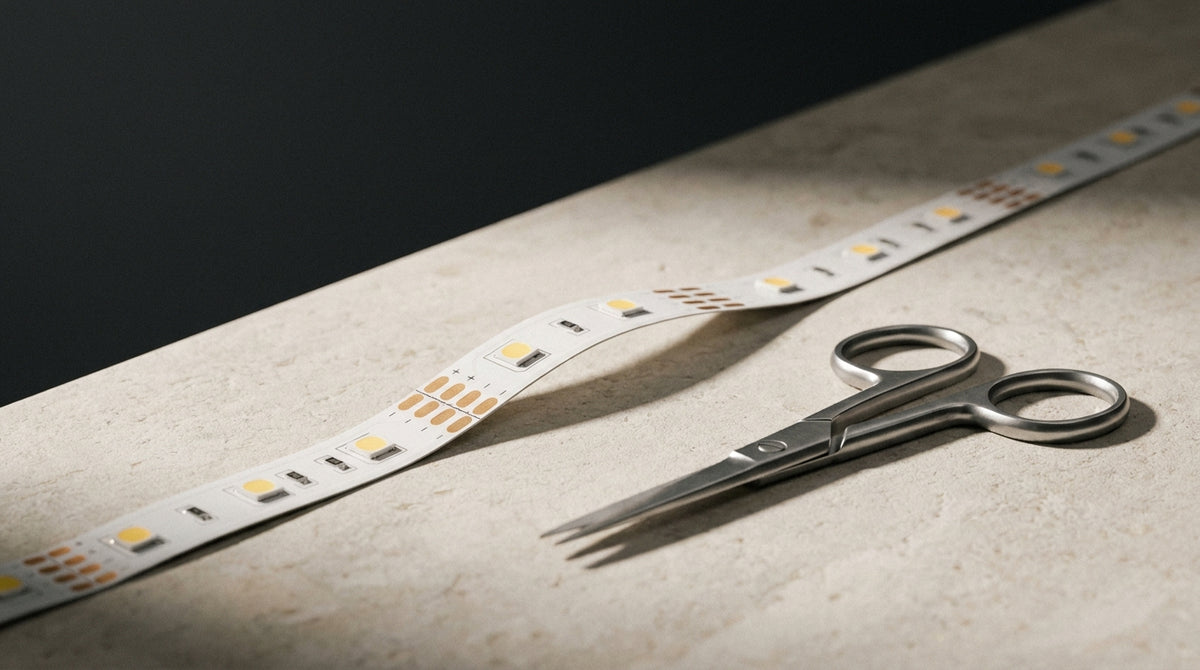
Cut only on the copper pads, where the scissors symbol is shown, never in the middle of a diode. The removed piece is lost and the transformer's power rating must be recalculated. A cut outside the marks switches off the rest of the strip, and no manufacturer covers it.
Is it possible to cut LEDs?
Yes, but only on a flexible strip sold by the metre. You cut a strip or a tape at the marked points; you never cut a bulb, nor a module built into a light fitting. It all comes down to how it is assembled: the strip is designed to be shortened, the rest is sealed at the factory.
This distinction is clear in the product listings, and our selection of LED lighting clearly separates the strip-based pieces, which you adjust, from the module-based pieces, which are fitted as they are.
| Item | Can it be cut? | What allows or prevents it |
|---|---|---|
| LED strip and tape | Yes | Sectionable circuit, regular cut marks |
| LED string lights | Sometimes | Depends on the wiring, series or parallel |
| LED bulb | No | Electronics and heat sink sealed at the factory |
| Built-in module | No | Power supply integrated into the light unit |
If you would rather not cut anything at all, the team quotes your lighting room by room: just write to us to get a quote for your lighting project.
Where do you cut an LED light?
Between two copper pads, at the spot marked with a scissors symbol. These marks recur at regular intervals along the whole length of the strip, and a cut at that point leaves the remaining part perfectly functional.
The copper pads and the scissors symbol
Two copper pads frame the area to be cut. The printed line between them shows the exact middle, sometimes accompanied by a pair of scissors.
- Cut in the centre of the line, never on one of the two pads.
- Lay the strip flat on a clean surface, for a clean cut.
- Test before sticking, a badly cut strip comes unstuck badly.
- Measure the remaining length before powering it back on.
What happens if you cut elsewhere
The cut falls in the middle of a group of diodes and everything after it stays off. The removed piece cannot be recovered. A strip that has become too short cannot be lengthened again with a solder joint on the edge of a diode. This happens often when a strip sticks out by a few centimetres in a corner, and the recovery options are detailed in our article on cutting an LED strip that is too long.
How do you cut an LED strip?
With the power off, in the centre of the mark, with fine, sharp scissors. The copper must stay clean, without burrs or crushing. Then you need to check that the length you keep fits within what the transformer can supply.
The movement and the tool
A craft knife crushes the circuit and tears the tracks: scissors remain the right option, provided they are sharp.
- Unplug the power supply before any handling.
- A single movement, without sawing, so as not to tear the copper.
- Check the cut closely, both pads must stay intact.
- Plan the connection before fixing the strip, not after.
A connector then takes up the part you keep. Without an original connector, the reliable methods are described in our guide to connecting a strip without a connector.
Recalculating the power after the cut
A shorter strip uses less: the unit remains compatible in most cases, unless it requires a minimum load to start. The opposite rule matters more: a strip extended beyond what the power supply accepts lights dimly, then heats up. The calculation of watts per metre and the choice of unit are detailed in our article on choosing and connecting an LED transformer.
Conversely, a fitting with a built-in module should be chosen at the right length from the start. A dining room chandelier with a fixed light source cannot be shortened: its diffusion is calculated for the table it hangs over.
Can you cut a COB LED strip, a string of LED lights or the LEDs in a lamp?
A COB strip is cut at the marks, like a standard strip. String lights can only be cut if they carry these marks, which depends entirely on how they are wired. The bulb and the module built into a light fitting, however, are never cut: the electronics are sealed at the factory.
The COB LED strip
Its continuous surface hides the diodes, so the cut marks are more discreet: a fine line, sometimes just a small notch in the backing. Look for them in raking light before getting out the scissors. On a worktop, the strip is fitted set back from the wall to avoid glare, as explained in our article on installing an LED strip under a kitchen unit.
Another point to check before buying: where it will be installed. In a survey of 250 references from our catalogue as of 29 September 2026, 94% declare an IP20 protection rating, reserved for dry rooms.
String lights: series or parallel
A string wired in series loses all its light as soon as one element is cut. In parallel, each branch stays independent and cutting becomes possible. Without a mark printed on the sheath, it is better to assume it cannot be cut. Our selection of LED string lights indicates the models designed to be adjusted.
The bulb and the module: never
An E27, E14 or GU10 base is replaced with a suitable bulb, it is not cut. Same logic for flat modules: a wall lamp or an LED ceiling light with an integrated light source is replaced entirely, the source cannot be replaced on its own.
Should LEDs be wired in series or in parallel?
In parallel, for everything that runs on 12 V or on domestic 230 V: each set receives the same voltage and one failing does not switch off the others. Series is reserved for small constant-current assemblies, where each diode must receive exactly the same current.
What happens if you wire an LED the wrong way round?
An LED is polarised: with anode and cathode reversed, it stays off. On a strip marked + and -, the mistake damages nothing, you just need to turn the connector around. On a single diode driven at 230 V, reversing it can destroy it; the subject is covered in our guide to wiring an LED to 220 V.
And when the whole room goes LED?
The reasoning changes scale: you no longer cut anything, you compose. A floor lamp for reading, a ceiling light for ambience, a wall light for the wall. Light is thought of in layers.
In a survey of 250 references from our catalogue as of 29 September 2026, 36% declare dimmability and 7% exclude it. So the dimmer is checked before buying, never after. Our Luminaire Led collection has 18269 references as of 29 September 2026, and buyer reviews are public on the establishment's Google listing.
Before ordering, two reference points are enough: colour temperature and power per square metre. Our guide to switching to all-LED room by room covers each situation, from the hallway to the kitchen.
Designer LED lighting: light without cutting


What did you want to cut an LED for?
In stock · shipping costs shown at checkout · up to 30% off in your cart


Ready to turn inspiration into reality?
Tell us about your room, your style and your budget, and we will show you the pieces that truly suit your project.
Get guidance in 30 seconds →