How to choose the right lighting for every room
This article is also available in French: Comment choisir l'éclairage le plus adapté ?

Allow 100 lumens per m² for a bedroom, 150 for a living room, 300 over a worktop. Then set the tone: 2,700 K to 3,000 K for rest, 4,000 K for working. The cap, the ingress protection rating and the warranty come afterwards, once the room has been measured.
What is the difference between 3000 K and 4000 K?
3,000 K gives a warm light in orangey yellows; 4,000 K gives a neutral light close to an overcast sky. One helps you relax, the other wakes you up. Neither is brighter: kelvins describe a hue, not an amount of light.
For a living space that is being fully redone, this choice is made before buying. A living room and living space renovation starts with this assessment: what time, what use, what tone.
Cool white or warm white: which gives the most light?
In lumens, not kelvins. A 4,000 K bulb and a 2,700 K bulb can show the same luminous flux. At equal flux, the first simply appears brighter, because the eye reacts more strongly to it.
- 2,700 K: very warm white, bedroom and reading corner
- 3,000 K: warm white, living room, dining room, hallway
- 4,000 K: neutral white, kitchen, office, bathroom
- 5,000 K and above: cool white, workshop and technical outdoor areas
The room-by-room detail is covered in our article on white or yellow light.
Type of natural light: which comes closest?
4,000 K during the day, 2,700 K in the evening. Daylight itself varies a great deal: warm at sunrise and sunset, noticeably cooler at midday. No bulb follows it on its own unless both hue and intensity can be varied.
In a bedroom, this setting matters more than elsewhere. A 3,000 K wall light placed at bedside height lights the page without dazzling, which a ceiling light cannot do. Rethinking a bedroom's lighting often starts there.
How do I choose the right bulbs for my lighting?
By the cap first, because the light fitting dictates it. Then by luminous flux in lumens, suited to the room's surface area. Wattage only comes last, and only to estimate actual power consumption.
What bulb wattage for the living room?
A 9 to 12 W LED replaces the old 60 W bulb. For a 20 m² living room, plan two or three light points rather than a single very powerful source.
- Flux: 1,500 to 2,000 lumens for a 20 m² living room
- Cap: E27 for a pendant, GU10 for an adjustable spotlight
- Tone: 3,000 K, neither white nor yellow
- Dimming: useful in a living room, unnecessary in a hallway
Cap or flux: where to start?
With the cap, without question. An E14 will not fit an E27 socket, whatever its wattage. Flux is chosen next, once the compatible format has been identified.
| Cap | Common use | To check |
|---|---|---|
| E27 | Pendant, floor lamp, ceiling light | Diffuser diameter |
| E14 | Wall light, small bedside lamp | Bulb length |
| GU10 | Recessed or track spotlight | Beam angle |
| Integrated LED | Flat ceiling light, strip light | Not replaceable |
Across a sample of 250 references from our catalogue as of 29 September 2026, the stated cap is E27 in 30% of cases, LED 19%, E14 15% and GU10 11%. The choice is therefore wide, but the sockets are not interchangeable.
So it is better to choose your bulb type and cap before ordering.
How many lumens per m² depending on the room?
Allow 100 lumens per m² for a bedroom, 150 for a living room, 200 for a kitchen and 300 over a worktop. These benchmarks apply to a ceiling of standard height, around 2.50 m. They are read room by room, never as a single value for the whole house.
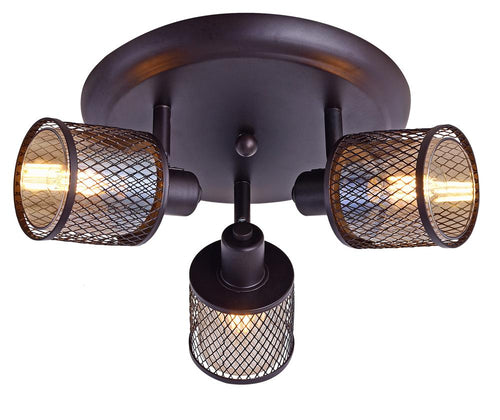
The light fittings to look at first, room by room
 Basic form Gold pendant light
 Basic form Gold pendant light
 Basic form Gold pendant light
 Velora Brown outdoor light
 Bobi 2-light black pendant
 Gentor 4-light white pendant
See the full selection: Lighting, Home Lighting, Online Lighting Store
- 100 lm/m²: bedroom, hallway
- 150 lm/m²: living room, dining room
- 200 lm/m²: kitchen, bathroom
- 300 lm/m²: office, worktop, workshop
How many lumens per m² in a dining room?
150 to 200 lm/m², with a pendant centred over the table rather than general lighting. A 15 m² room therefore needs around 2,500 lumens, split between the pendant and two additional light points.
Our catalogue lists 26,171 light fitting references as of 29 September 2026: enough to treat each room separately. A dining room pendant placed 75 cm above the tabletop lights the guests without dazzling them. In a kitchen, the same principle applies to an island, with a kitchen pendant hung lower, around 70 cm.
Is 2000 lumens a lot?
For a 12 m² bedroom, yes: the need is around 1,200 lumens. For a 20 m² living room, it is almost the minimum. The same value therefore changes sides depending on the surface area, which is why it pays to think in lumens per m².
To refine this, see how many lumens for a bedroom: the calculation is broken down by surface area and use.
How do I calculate lighting without getting the method wrong?
Multiply the surface area in m² by the room's lumen requirement. A 25 m² living room at 150 lm/m² needs 3,750 lumens, spread across several light points. A single 3,750-lumen ceiling light would give a flat room with dark corners.
Which room do you want to light first?
The step-by-step method is set out in our guide to calculating the amount of light a room needs.
Ingress protection, the criterion people forget
The IP rating indicates resistance to water and dust. Across a sample of 250 references from our catalogue as of 29 September 2026, 94% show IP20 and 4% show IP65: waterproof options exist, but you have to look for them.
- IP20: dry room, living room, bedroom, office
- IP44: bathroom, sheltered room
- IP65: exposed outdoors, poolside
How do I light a room without a ceiling light?
By layering three types of light: general, task and ambient. A floor lamp aimed at the wall provides general light without dazzling. Two wall lights on either side of the bed provide task lighting. A small table lamp completes the ambience.
The full method is detailed in our guide to lighting a living room with three layers of light.
If you are redoing an entire room and cannot work out how many light points you need, describe the room to our team via the contact page: you will come away with a lighting plan before you buy.
The reviews left by buyers on our Google listing give an idea of the support before and after ordering.
How do I light a damp room or an outdoor space?
With a suitable ingress protection rating: IP44 minimum in a bathroom and in sheltered areas, IP65 outdoors and near water. The rest does not change. Same lumens, same colour temperature, same layers of light. Only waterproofing is really added.
Outdoor wall light: what changes compared with indoors
Waterproofing, material and exposure. An outdoor wall light works in the rain, in temperature swings and sometimes in salt-laden air.
- Aluminium: withstands humidity and temperature variations
- Glass: does not yellow in the sun
- Treated metal: to be monitored near the coast
An IP65 outdoor wall light is fitted around 1.80 m, facing downwards, to light the way without sending light into a neighbour's home.
The choice of waterproof models is covered in our article on lighting a terrace or garden.
What warranty should I look for on an outdoor light fitting?
Two years is the most commonly stated duration. Across a sample of 250 references from our catalogue as of 29 September 2026, 94% state 2 years and 6% state 5 years. Outdoors, where the fitting is put under more strain, the second option makes sense.
On the same subject
In stock · shipping costs shown at checkout · up to 30% off in your cart
Ready to turn inspiration into reality?
Tell us about your room, your style and your budget, and we will show you the pieces that truly suit your project.
Get guidance in 30 seconds →