Task lighting: what it changes, room by room
This article is also available in French: Les Bénéfices d'Incorporer des Lampes et Eclairages de Tâche
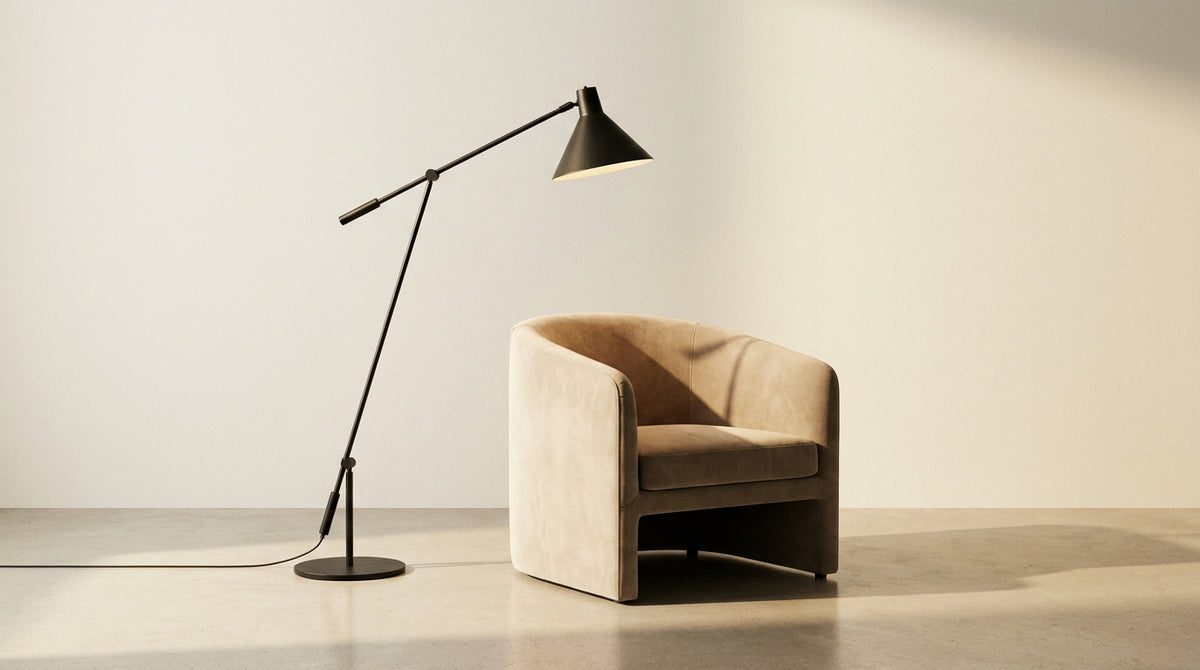
Count on one directed source per use, never a single ceiling fixture: a reading light at the bed, a floor lamp behind the armchair, an articulated lamp near the keyboard, a strip light under the upper cabinet in the kitchen. Aim the light at the activity zone, not at the whole room. Light follows the hand, it does not wait for it.
What are the advantages of LED lighting over task lighting?
A directed LED lights precisely while using a fraction of the power of a filament bulb, barely heats up and dims without turning orange. In a survey of 112 references from our catalogue as of 30 September 2026, 82% carry LED technology.
The rest comes down to the gesture. A floor lamp placed behind the shoulder lights the page without flooding the room, and moves a step when the use changes.
Why incandescent lamps are no longer suitable for task lighting
A filament bulb turns most of its energy into heat and yellows as soon as the intensity is lowered. Above a book or a chopping board, it heats the neck and distorts colours.
| Criterion | Incandescent | Halogen | LED |
|---|---|---|---|
| Heat near the head | High | Very high | Low |
| Lowered intensity | Yellows | Yellows | Stable |
| Long daily use | Poorly suited | Average | Suited |
In the same survey of 112 references, 42% declare an E27 base: the bulb remains replaceable, which allows switching to LED without changing the fixture.
Warm or cool, what temperature for task lighting?
Count on 2700 K for reading or dining, 4000 K for sewing, drawing or working on a screen. Whiter than that, the light leans blue and tires the eyes in the evening. This setting is detailed in our guide white or yellow light.
A task lamp is therefore chosen on two criteria only: the direction of the beam, and the colour temperature.
The surface and shade of the walls shift these markers further, and our lighting and decor advice covers them room by room.
How important is the lamp in an already lit room?
A ceiling fixture lights the room, not your hand. The task lamp concentrates the light on the activity zone: aim for three to five times more light on the page than on the wall behind. It is this contrast that makes reading comfortable, not the number of sources.
Why a well-lit room remains uncomfortable for reading
A powerful ceiling fixture lights everything at once, therefore nothing in particular. The eye constantly readjusts the gap between the page and the background, and this accommodation tires it. Ambient lighting keeps this background low and stable, the lamp does the rest.
One source per use, not one source for everything
Four solutions cover most needs: the reading wall light above the bed, the floor lamp with adjustable arm behind an armchair, the articulated lamp near the keyboard, the strip under the upper cabinet. The choice hinges on the distance to the zone, not on the stated power. In the same survey of 112 references, 60% of the fittings are pendant and 13% wall-mounted: the directed source remains to be added.
Adjustable fixtures for lighting a task


At what height should a reading light be placed to read without looking up?
Align the lower edge of the shade with the shoulder, 40 to 50 cm from the page and 30 cm to the side, never in the line of sight. Sitting on the edge of the bed, the shoulder serves as a marker: the source is placed at that height, not at mattress level.
Headboard: where exactly to drill
Measure from the mattress surface, not from the floor: the thickness of the mattress and base changes everything. Our guide on the height of a headboard reading light covers high beds and upholstered headboards.
A wall light placed elsewhere in the room follows the same logic, with a different dimension depending on what it lights. The guide for the height of a wall light distinguishes the picture, the hallway and the bedside.
Why ceiling light is not enough when reading lying down
Lying down, the ceiling fixture falls behind the head and leaves the book in the shadow of the skull. A short side source lights the page without hitting the neighbour's eyes. This is the role of a reading wall light, fixed at shoulder height and adjustable.
A floor or clip-on lamp covers the same need without drilling, and moves from one room to another: the reading lamp is then chosen on the length of its arm.
To locate the workshop and check the contact details, the Designix Google listing remains available online.
If you prefer to have the layout and height validated before drilling, you can ask the team your question, who answer from Vaulx-en-Velin.
How do you light a worktop without casting a shadow with your hand?
Place the source in front of you, on the opposite side to the hand holding the knife. A strip fixed under the upper cabinet, offset 10 cm forward from the back of the cabinet, casts the shadow behind the fingers instead of onto the board.
The cast shadow test
Turn everything off, switch on the task lamp alone, place your hand flat. If the shadow covers the useful zone, the source is behind you. It must be in front or to the side, at face height.
How much light above the sink or the hob?
A worktop requires higher illuminance than the rest of the kitchen: the hand and the blade work there in detail. Our guides on lumens for a kitchen give the value per zone, sink, hob and chopping area.
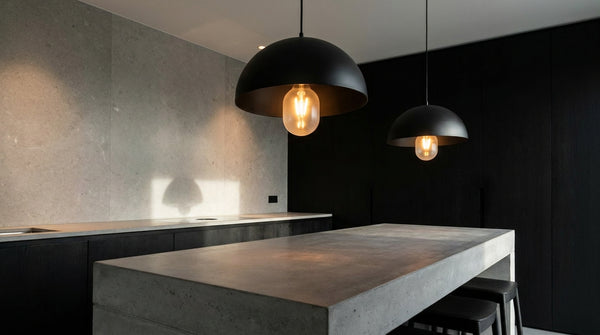
Above an island, a kitchen pendant lowered to face height completes the strip, provided it aims at the worktop and not at the room.
Where do you most need directed light?
The desk: directed light or ceiling fixture?
Directed light, backed by a ceiling fixture set low. A ceiling fixture alone forces the general intensity up and leaves a reflection on the screen. An articulated lamp at eye height, placed at an angle, lights the keyboard without glare.
Removing the reflection on the screen
A matte screen reflects less than a glossy one, but the angle matters more than the surface. Move the lamp away from the screen's centre line and keep the source below eye level: the reflection disappears even before lowering the intensity.
Switch and cable: what to check before drilling
A switch on the cord forces you to lean over; a control on the base or on the shade can be found blind. Also locate the cable route before the first hole, especially against a lined partition.
A desk lamp is therefore chosen on three details: the control reachable without leaving the chair, an arm long enough to light the sheet beyond the keyboard, and the cable located before drilling.
In a survey of 112 references as of 30 September 2026, 97% are advertised with a 2-year guarantee, and 98% with an IP20 protection rating: enough for a workstation, not enough in a damp room.
The rest of the house follows the same rule, one source per use. Our guide to lighting each room well covers the heights and temperatures, room by room.
In stock · shipping costs shown at checkout · up to 30% off in your cart


Ready to turn inspiration into reality?
Tell us about your room, your style and your budget, and we will show you the pieces that truly suit your project.
Get guidance in 30 seconds →