LED strip width: the right measurement, room by room
This article is also available in French: Largeur bande led
Choose the strip width first, then the profile that houses it: 10 mm covers most uses, from the worktop to indirect ceiling lighting. Below 8 mm, check the profile opening above all. Above 12 mm, power dictates the choice, not looks.
Which LED strip width do you really choose?
Start with 10 mm: this width fits most aluminium profiles on the market and works as well on a worktop as on an indirect ceiling. Go down to 8 mm for a discreet line of light, up to 12 mm when power or mixed colours require it. Width is chosen before length, and it dictates the rest.
The same logic governs our selection of design lighting: it is not the source that creates the effect, it is the way it is housed. A bare strip shows every light point, the same strip in a diffuser profile becomes a continuous line.
In a living room renovation, this line of light often comes before choosing pendants. It runs along a unit, highlights a bookcase, replaces a skirting board. Width only decides how much space it takes.
What width changes in the final result
A wide strip exposes more surface, heats less and lasts better over time.
- 8 mm: fine line, for niches and short runs;
- 10 mm: crisp line, compatible with common profiles and 220 V strips;
- 12 mm: power, RGB, or a line placed far from the surface to be lit;
- Opal diffuser: it does as much for evenness as the strip width.
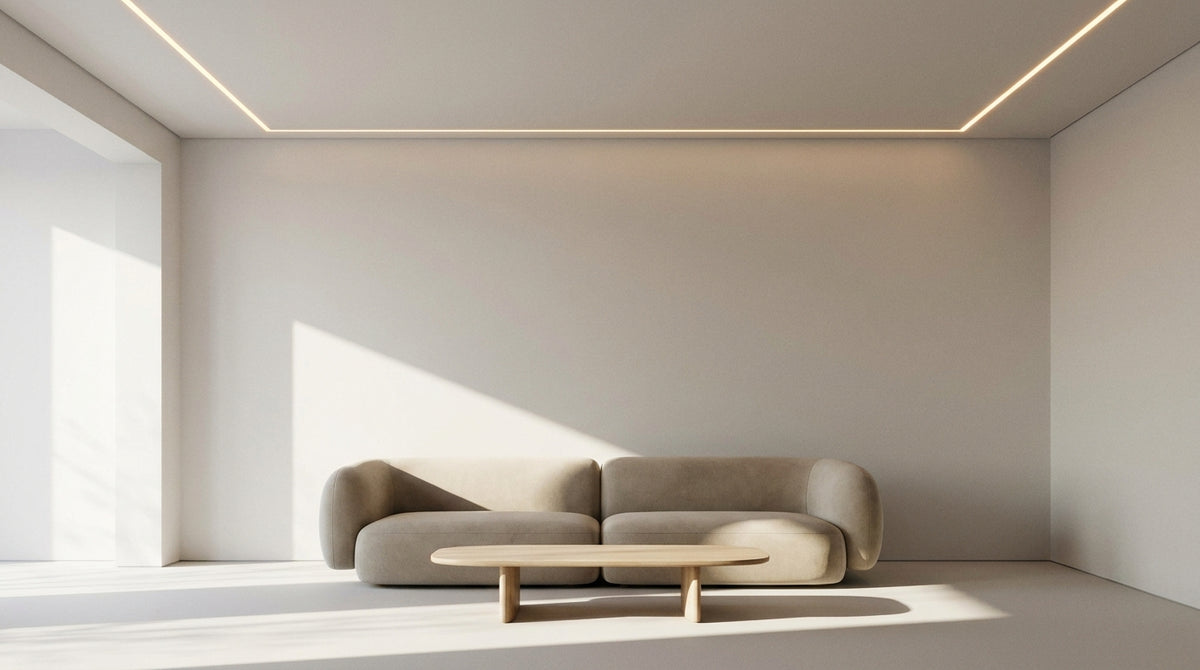
On the ceiling, everything depends on the distance between the strip and the wall it lights. An LED strip on the ceiling set a few centimetres from the wall gives a wash, pressed against it gives only a line.
LED strip dimensions: the market references
Formats range from 4 mm to 12 mm, with a tipping point around 10 mm. Two details change the installation, and they are rarely written down.
First, 4 and 5 mm almost only exist in side lighting or COB LED, where a continuous track replaces visible diodes. Second, the stated dimension is that of the strip: the housing itself must be wider.
Our Luminaire Led collection has 18,850 references as of 29 September 2026, and LED technology is declared on 249 of the 250 listings in our survey. Design LED light fittings show what a well-housed line becomes.
What is the width of an LED profile?
It is measured on the inside: the strip must slide in with 1 to 2 mm of play, and the diffuser must clip on without pressing on it. A profile intended for 10 mm therefore offers a slightly larger opening. It is this dimension, never that of the strip, that decides the installation.
The profile decides the width, not the other way round
An aluminium profile does three things: it dissipates heat, it smooths the light, it keeps the strip from touching the surface. This is the real installation constraint of the project, and it is settled before buying the strip.
- Inner width: 1 to 2 mm more than the strip, otherwise the diffuser presses on the LEDs;
- Depth: the wider and more powerful the strip, the taller the body must be;
- Diffuser: opal for an even line, clear for a point-by-point effect;
- Mounting: recessed, surface-mounted or glued, depending on what the surface accepts.
Under a kitchen cabinet, which width fits?
8 mm is enough in most cases, preferably COB: the light falls without visible dots on the worktop. A 10 mm is justified if the worktop is deep or if the line must reach beyond the edge.
The move that matters: set the strip back a few centimetres from the edge rather than increasing power. That is the rule when installing a strip under a kitchen cabinet.
The kitchen light fitting then takes over in the areas the strip does not reach, such as the table or the island.
Which LED strip width for outdoors?
No width makes a strip waterproof: the protection rating decides. In a survey of 250 references from our catalogue as of 29 September 2026, IP20 accounts for 94%, IP65 for 4% and IP44 for 2%. For an exposed terrace or balcony, aim for IP65.
A properly protected outdoor light fitting ages better than a strip merely sheltered under a roof overhang. Width only becomes a criterion after this check.
IP20, IP44, IP65: what a survey of our catalogue shows
| Rating | What it withstands | Where to plan for it |
|---|---|---|
| IP20 | Dry air, light dust | Living room, bedroom, under-cabinet |
| IP44 | Water splashes | Bathroom, covered shelter |
| IP65 | Direct rain, water jets | Terrace, facade, pergola |
In the same survey, a 2-year warranty is declared on 100% of references. An outdoor strip is judged on its casing as much as on its width.
220 V LED strip without a transformer: what it changes for installation
A 220 V strip connects without a driver to house, which simplifies high-level installations. It remains wider for the same format and requires particular care when wiring an LED.
- 220 V: no transformer, but cut marks further apart;
- 12 or 24 V: finer cuts, driver to be planned nearby;
- Outdoors: IP65 minimum, whatever the voltage;
- Switch: it is fitted on the supply, in both cases.
If you prefer to start from a light fitting already designed rather than a strip to install yourself, you can describe your room to us: we will tell you what works.
Cuttable LED strip: where to cut depending on width
Only on the printed marks, shown by a line or a dot. They recur at regular intervals, closer together on a narrow strip than on a 12 mm one. A cut between two marks leaves the next section unlit.
Cut marks are not the same from one width to another
The wider the strip, the longer each group of LEDs, so the further apart the marks. Measure the useful length before cutting, and check that you can cut an LED strip that is too long without switching off the rest of the line.
Sections are then joined without added parts, as when connecting an LED strip cleanly.
LED strip 1 m, 5 m, 10 m: width does not follow length
Length changes the available intensity and the number of marks, not the thickness of the backing. A 1 m line and a 10 m line can share the same width. What changes is the power supply and the voltage drop at the end.
- 1 m: short adjustment, under a cabinet or in a niche;
- 5 m: common length, to be re-fed if the line runs over several walls;
- 10 m and more: feed in the middle of the line and a suitable cable cross-section.
When the distance to cover becomes significant, an LED ceiling light settles the question more simply than a strip, and without cut marks.
How to choose by room?
The room sets the colour temperature and the use, the width sets the available space. Under a cabinet, a narrow strip and a moderate output. In indirect ceiling lighting, a well-dissipated 10 mm. Outdoors, IP65 above all. The quiz below decides in three questions.
Where will your LED strip live?
A strip is replaced, a light fitting is kept. If doubt remains, the Designix Google listing gathers the reviews left by customers.
Dimmable LED strip: what can be adjusted, and what cannot
Intensity is adjusted, not colour, except on an RGB strip. In our survey of 250 references as of 29 September 2026, dimming is declared yes on 35% and no on 7%, the information being given on only 106 listings.
A controllable strip behaves like a dimmable LED: the dimmer and the power supply must keep up, not just the strip.
- Warm white: living room, bedroom, ambient lighting;
- Neutral white: kitchen and worktop, where you see what you are doing;
- Output: think in lumens per metre rather than in watts;
- Dimming: to be checked on the strip listing and on the dimmer listing.
LED bandeau or LED strip: the word changes, the measurement does not
Both terms refer to the same flexible strip. The dimension that counts remains the width of the backing, then that of the profile. When the line must become an object, you move to a pendant light: then it is the diameter and the installation height that decide.
LED lights to extend the strip without distorting the mood


In stock · shipping costs shown at checkout · up to 30% off in your cart


Ready to turn inspiration into reality?
Tell us about your room, your style and your budget, and we will show you the pieces that truly suit your project.
Get guidance in 30 seconds →