Accent lighting: getting the light that highlights right
This article is also available in French: Comment créer un éclairage d'accentuation dans votre maison

Place a single source between 30 and 50 cm from the wall you want to highlight, aim it up or down, and narrow its beam to between 15° and 25°. Then switch off everything else: if the effect holds without general lighting, your accent works.
What are the 3 types of lighting?
Three roles, three separate settings. General lighting lights the whole room, task lighting lights a specific activity such as reading or cooking, accent lighting lights what you look at: a wall, a material, a painting. Accent lighting is set last, once the other two are in place.
A living room renovation is planned in that order: conduits for the general lighting first, sockets for the task lighting next, accent points last. Drilling afterwards always costs more than a cable planned in advance.
General, task, accent: who does what
- General: ceiling fixture, pendant or distributed sources, so you can move around without harsh shadows
- Task: reading lamp, reading wall light, under-cabinet strip, the source is barely seen and the worktop is clear
- Accent: narrow beam on a chosen surface, painting, wall, armchair
- Overlap: the same wall light becomes task lighting in the evening and accent lighting when aimed at the wall
A wall light is therefore judged on one simple question: aimed at you, or at the surface to reveal?
Why accent lighting is set last
An accent is a contrast: it only exists if the rest is dimmer. Setting it first forces you to raise the general lighting afterwards, which wipes it out. Accent lighting is therefore designed the opposite way to the other circuits.
The adjustable spotlight often fails for one reason only: it is aimed at the walkway instead of the wall. Aim at the surface, never at the eyes.
How can I create ambient lighting?
Light the surfaces, not the room. A strip hidden behind a shelf or a cornice throws light back onto the wall and draws a halo. Two low sources at 2700 K are enough: ambience comes from the contrast between a lit wall and an area left dark.
Light/dark contrast: where to place the sources
- 2700 K: the warm tone of a living room, without turning orange
- 30 cm from the wall: the distance at which the halo stays soft instead of forming a sharp circle
- Two low points: one around 40 cm from the floor, one around 1.10 m, rather than a single high source
- One area left dark: that is what makes the rest exist
What to switch off before switching on
The ceiling light is the first enemy of ambience: switched on, it flattens relief. Dim it to a third of its power, or switch it off, and the accent appears without adding anything.
An LED strip takes a few minutes to fit under a moulding and stays out of sight. It is the least visible and most effective gesture in a living room.
Three layers are better than one, and the balance depends on how you light your living room, source by source.
Accent lighting: the selection that adjusts
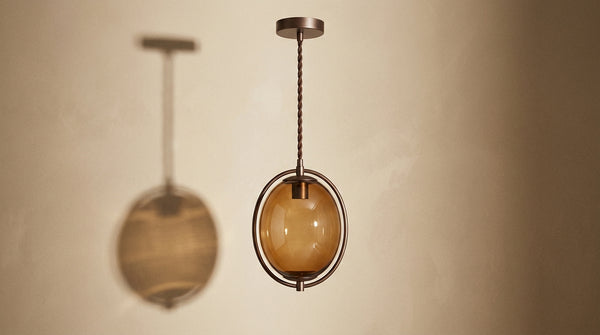
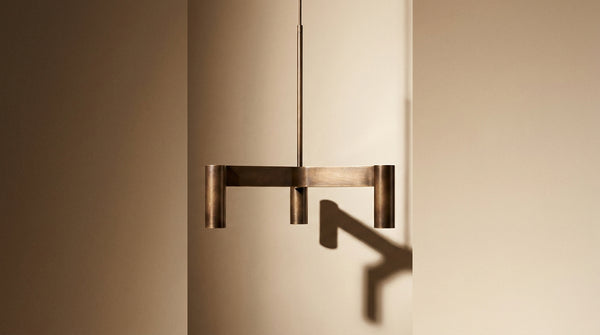
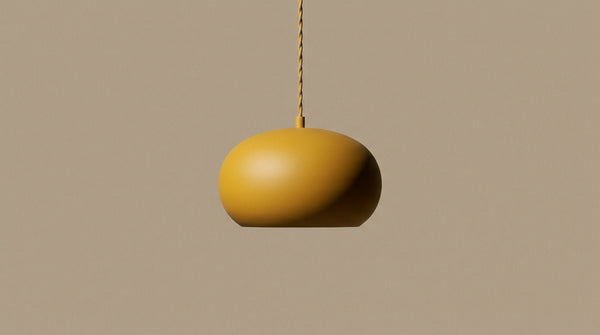
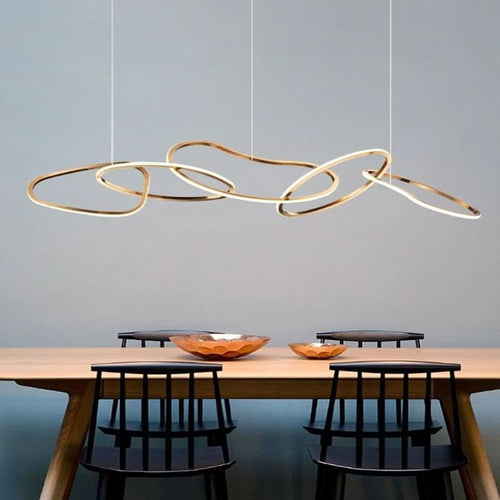
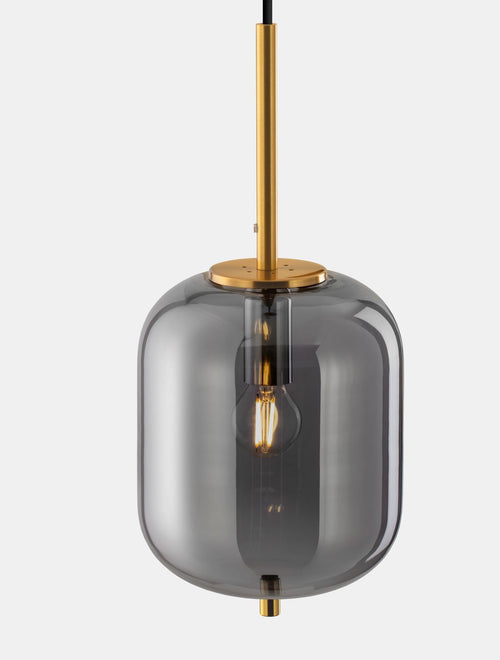
 Basic form gold pendant light
 Basic form gold pendant light
 Basic form gold pendant light
 Velora brown outdoor light
 Bobi 2-light black pendant
 Gentor 4-light white pendant
See the whole selection: Lighting, Home Lighting, Online Lighting Store
How do you bring light into a dark room?
Multiply the low points instead of increasing power at the ceiling. Two or three sources placed between 40 cm and 1.20 m, aimed at pale walls, raise perceived brightness without glare. A dark room lacks reflected light, not watts.
Surfaces before sources
A white wall reflects far more than a dark one. Before buying one more source, look at what the light has to bounce off: a pale ceiling and a matt floor change the result more than a stronger bulb.
The question of location remains: on a survey of 250 references in our catalogue as of 29 September 2026, 94% carry the IP20 rating, in other words dry interiors. A terrace or a facade wall is handled with other ratings. Indoors, everything therefore depends on how you light a dark room, not on power.
Multiply the low points
- 1.20 m: the height of a low point that lights a wall without glare
- At least two sources, never just one, to avoid a single harsh shadow
- Orientation: towards the pale wall, never towards the centre of the room
- E27 cap: the easiest to replace, with the LED remaining the most compact
A floor lamp solves the problem without drilling: you move it until the angle is right, which no wall light allows.
Before drilling anything, choose the source: the lighting collection brings together the models that adjust, and that is the only choice you cannot make up for afterwards.
How do you set an accent properly?
Allow 30 to 50 cm between the source and the wall, a beam of 15° to 25°, and an axis offset 20 to 30 cm from the wall so the fixture does not cast its own shadow. Set the height before fixing: a spot of glue is quicker to correct than a filled hole.
At what distance from the wall should the source be placed
The further the source is from the wall, the wider the cone opens and the more the halo spreads. At 30 cm, a narrow beam draws a sharp circle; at 80 cm, the same beam becomes a blurred patch.
On a large surface, a spotlight track avoids multiplying holes: you add or remove a spotlight depending on what you want to light.
What height for an accent wall light
A wall light aimed upwards has its centre between 1.70 m and 1.90 m to wash the wall without lighting the ceiling. Aimed downwards, allow 1.20 m to 1.50 m, otherwise the beam falls on the floor.
If your wall is stone, solid brick or behind a service partition, the measurement changes: it is better to talk about your project before drilling.
Narrow or wide angle
| Beam angle | What it reveals | Source / wall distance |
|---|---|---|
| 15° to 25° | an object, a painting, a texture | 30 to 50 cm |
| 36° | a bookcase, a section of wall | 50 to 80 cm |
| 60° | a whole wall, washed | 80 cm to 1 m |
The result also depends on the tone: white or yellow light does not tell the same story on a stone wall and on a painted wall.
To see the result in other people's homes, the reviews left on our Designix Google listing are public and verifiable.
Which feature of your room do you want to highlight?
How do you trigger the light remotely or on movement?
A smart plug is enough to switch on an existing lamp remotely, with no work and no extra switch. For movement, fit a presence detector indoors and a motion detector outdoors, with a short delay and low sensitivity.
Phone or smart plug
- Smart plug: the lamp keeps its switch, you add remote control
- Smart bulb: useful if the fixture is hard to reach, unnecessary if the switch stays within reach
- Evening scenario: one lamp at 20% is better than a ceiling light at 100% when you get home
Presence detector inside, motion detector outside
Indoors, presence detection picks up small movements: the light does not switch off while you read. Outdoors, the passive infrared detector reacts to moving heat, which limits triggers from a cat or a branch.
The setting matters more than the model: high sensitivity and a long delay cancel out the energy savings. For layout in a living room, our advice on installing recessed spotlights in the living room gives the spacing.
Why does the light flicker when you dim it?
It is flicker: a non-dimmable LED bulb driven by a dimmer receives a voltage it cannot interpret, and blinks at low intensity. Flicker tires the eyes even when it is barely visible.
On a survey of 250 references in our catalogue as of 29 September 2026, dimming appears on 24% of the survey and 16% explicitly exclude it. For the rest, a dimmable bulb fitted to a standard fixture is enough to remove the phenomenon.
On the same subject
In stock · shipping costs shown at checkout · up to 30% off in your cart
Ready to turn inspiration into reality?
Tell us about your room, your style and your budget, and we will show you the pieces that truly suit your project.
Get guidance in 30 seconds →