Brown pendant light: shade, material, right height
This article is also available in French: Suspension marron
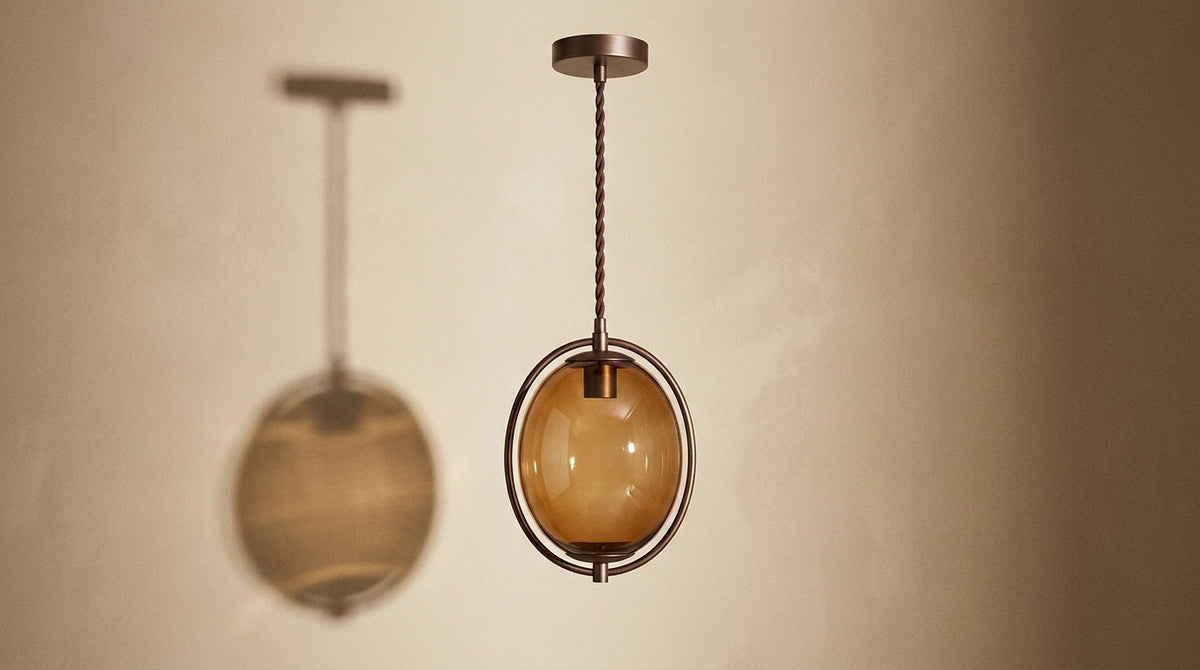
Choose the material before the shade: amber glass and brown metal do not give the same brown under the same bulb. Across 246 large pendant lights in the catalogue as of 21 November 2026, black is listed on 63% of the product pages, brown on none. The shade is therefore judged by eye, not by the label.
Light, dark or chocolate brown pendant light: which shade lights what?
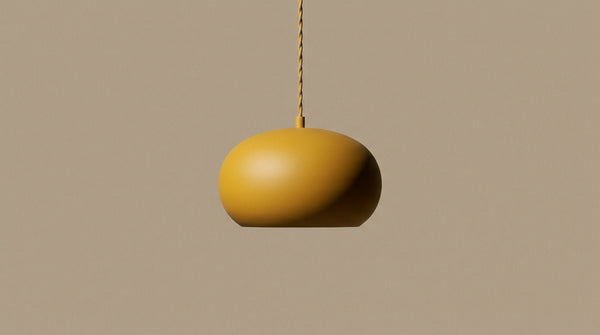
Light brown reflects light, chocolate absorbs it. In a room of less than 15 m², a beige or hazelnut shade brightens the space without turning it gold. A deep brown needs a light wall behind it and a bulb that does not exceed 3000 K. The shade is chosen according to the light already there.
A living room lighting project often starts with this question: how much light should come from the floor, the walls, the ceiling. The pendant light is only one of the three points.
Which colour to pair with brown?
Off-white, sage green, terracotta and brass. Brown accepts three natural neighbours: light neutrals that open it up, greens that refresh it, warm metals that extend it. Matt black, on the other hand, dulls it.
- Off-white and cream: opens up a dark brown, enlarges the space
- Sage or olive green: cools an overly brown interior without harsh contrast
- Terracotta and rust: extends the warmth, to be used sparingly on a single object
- Brass and brushed gold: reflects light upwards, useful on a closed shade
A brown light fixture is easier to pair when the room already has light wood: the floor or the table is enough, no need to add a piece of furniture.
Beige brown pendant light: the shade that brightens without gilding
Beige reflects almost as much as matt white, without the coldness. Placed above a light oak table, it extends the wood instead of contrasting with it. It is the safest shade when the floor is already brown.
The survey of 21 November 2026 puts it another way: white is listed on 42% of the 246 product pages, gold on 32%. Beige sits between the two, without falling into yellow. Brown-coloured shades cover this zone, from sand to cocoa.
Brown pendant light in wood, rattan, amber glass or metal: the material decides the effect
Wood diffuses a warm, matt light, amber glass filters it, brown metal reflects it in sharp patches. At the same shade, the material changes the colour of the lit wall. Of the 917 references in the large pendant collection, 246 were surveyed: metal listed on 49% of the product pages, glass on 31%.
Brown glass pendant light: what the bulb becomes
Behind amber glass, a filament bulb shifts from warm white to soft orange. Tinted glass filters cold wavelengths: the light arrives at a lower temperature than it is emitted. Smoked glass, on the other hand, dims it frankly.
- Amber glass: warms the wall, keeps the filament visible
- Smoked glass: lowers the level, best kept for rooms that are already bright
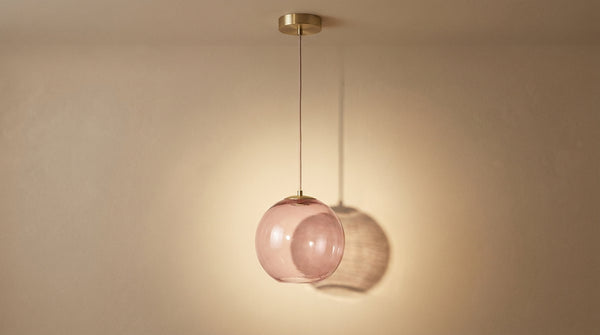
- Ribbed or frosted glass: spreads the source, projects a pattern on the ceiling
An amber glass pendant light therefore tolerates a slightly cooler bulb than you would install under an opaque shade.
Brown wood pendant light: warmth without the bulk
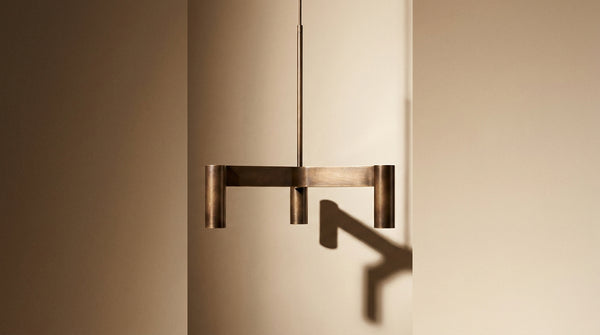
A light wood, oak or ash, warms without weighing down. Walnut or mahogany is visually heavy and needs distance. The rule depends on diameter: beyond 50 cm, a wooden shade should be hung high so it does not overwhelm the room.
Rattan works differently: it filters, casts shadows, and is as much to look at as it is to light with. A large rattan pendant light holds a space without closing it, which solid wood cannot do. Light wood, for its part, is more forgiving than you might think: hung as a living room wood pendant light, it handles a 20 m² room without darkening it.
Warm-toned pendant lights to discover


At what height should a brown pendant light be hung?
75 cm above a dining table, 2.10 m from the floor in a passageway, 2.20 m above a coffee table. These three measurements cover most cases. The rest depends on the diameter of the shade and the ceiling height.
Brown pendant light in the living room: coffee table or dining table?
Above a coffee table, allow 2.10 to 2.20 m from the floor so it does not get in the way. Above a dining table, the pendant light comes down to 75 cm from the surface. An open-plan living area therefore needs two separate points, not one.
A designer pendant light for the living room is first judged at this distance: too low, it blocks the view; too high, it no longer draws anything on the table.
Brown pendant light in the bedroom: the drop seen from the bed
Sitting in bed, you should not see the bulb. Allow at least 2.10 m from the floor, and offset the pendant light if the bed is offset. A height-adjustable pendant light is adjusted once the furniture is in place, not before.
In a bedroom pendant light, the light should be low: a model that shines downwards is less tiring than one that throws everything up to the ceiling.
| Hanging point | Drop reference | What to avoid |
|---|---|---|
| Dining table | 75 cm above the surface | dazzling seated guests |
| Kitchen island | 75 to 85 cm above the worktop | blocking the view into the room |
| Coffee table | 2.10 m from the floor minimum | getting in the way when standing |
| Hallway, entrance | 2.20 m from the floor | bumping into the shade |
Over an island, two or three aligned sources are better than one: a kitchen and dining room lighting project is designed around the worktop, not the centre of the room. A kitchen chandelier slim enough not to block the view does the rest.
For a table, the choice of a dining room pendant light follows the same measurement, but diameter matters just as much: a wide dining room chandelier above a narrow table overwhelms the surface.
Which room will the brown pendant light hang in?
Still torn between two shades? Ask the workshop with the colour of your floor and the ceiling height: the answer comes with the drop and the socket to choose.
Which bulb and which socket for a brown pendant light?
An E27 socket for a large pendant light, a G9 for a model with several small sources. Aim for 2700 K in a living room, 3000 K if the brown is dark. Of the 246 references surveyed, LED is listed on 35% of the product pages and E27 on 27%.
2700 K or 3000 K: the temperature that saves a dark brown
2700 K pulls brown towards honey, 3000 K keeps it neutral, beyond 4000 K it turns grey. A chocolate brown in a room without daylight handles 3000 K. A light brown near a window is fine with 2700 K.
2700K bulbs remain the default choice under a brown shade. Check the socket first: in the same survey, G9 is listed on 21% of the product pages and GU10 on 9%, and an E27 bulb does not fit a G9 socket. Another telling figure: 98% of the survey is IP20, so a pendant light is not installed in the volume of a shower, even in glass.
How to wire the blue and brown wires of a chandelier?
Blue goes to neutral, brown (sometimes red) to live, green-yellow to earth. Switch off the circuit breaker, strip 8 mm, tighten each wire in its terminal block. Without an earth wire on the light fixture, installation stops there.
- Blue: neutral, terminal marked N
- Brown or red: live, terminal L
- Green-yellow: earth, mandatory on a metal body
- Wire with no readable marking: do not guess, test with a multimeter
An installer quoting for several hanging points will find the technical data sheets in the professional catalogue, including socket, IP rating and diameter.
Then there is longevity. In the survey of 21 November 2026, a 5-year warranty is listed on 55% of the 246 product pages: it is the criterion that separates a piece you keep from a piece you replace. The Vaulx-en-Velin workshop answers on shade as well as on drop, and buyer reviews can be found on Designix's Google listing, kept up to date.
In stock · shipping costs shown at checkout · up to 30% off in your cart
Ready to turn inspiration into reality?
Tell us about your room, your style and your budget, and we will show you the pieces that truly suit your project.
Get guidance in 30 seconds →