Cleaning a cardboard lampshade: the dry method
This article is also available in French: Comment nettoyer un abat jour en carton
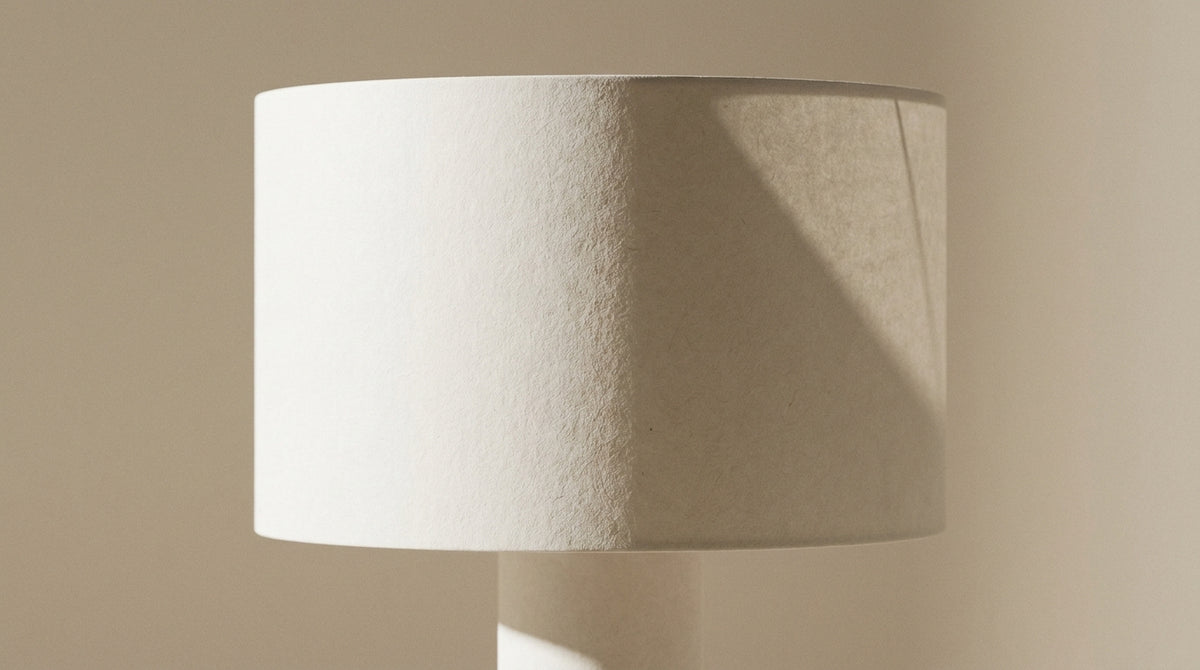
Clean a cardboard lampshade dry: a feather duster or soft-bristled brush for dust, a clean white eraser for marks, never water, which warps and breaks down the cardboard. Lamp switched off, bulb cooled, two passes a year are enough.
How do you clean a cardboard lampshade?
Three steps, no liquid. Switch off the lamp, let the bulb cool, then dust from top to bottom with a feather duster or a soft-bristled brush. Greasy marks come off with a white eraser, in small dabs. Our lampshade collection brings together 789 references as of 26 September 2026, and cardboard remains the most fragile material when it comes to moisture.
Water does more than stain: it softens the fibre, makes the surface buckle and loosens the bond between the cardboard and its frame. Once delamination has started, nothing can undo it. Hence the rule: remove, do not wash.
- Feather duster or soft-bristled brush, twice a year, for surface dust
- White eraser for fingerprints and greasy marks
- Soft-bristled paintbrush in the ridges and corners of the frame
- Water, alcohol, solvent: never, the fibre warps and the glue gives way
| Soiling | Method that works | To avoid |
|---|---|---|
| Dust | Feather duster, top to bottom | Blowing, which pushes the dust in |
| Fingerprint | White eraser, light rubbing | Rubbing hard, which digs into the cardboard |
| Greasy stain | Absorbent paper pressed on, without rubbing | Damp cloth, alcohol, solvent |
| Old watermark | Absorbent powder, then brushing | Any liquid, even lukewarm |
How do you clean a white cardboard lampshade?
Dry, and nothing else. White cardboard is even less forgiving than tinted cardboard: a single drop leaves a ring that will never come out. A white eraser removes the mark without wetting the fibre, provided you work in light dabs rather than long rubbing strokes.
How do you clean a rice paper lampshade?
With a brush, very gently. Rice paper tears at the slightest pressure and fears water as much as cardboard does. A clean make-up brush is enough for the dust; other materials need another method, which you will find in our guide to cleaning a lampshade according to its material.
In a survey of 27 references from our collection as of 26 September 2026, linen appears on 52% of the listings, metal on 30%, and 96% carry the E27 base along with the IP20 rating.
How do you clean a lampshade that has yellowed?
You do not whiten it again, you tone it down. Yellowing comes from three sources: the heat of the bulb, UV and nicotine. On cardboard the effect is usually permanent; on plastic or PVC, a gentle method recovers part of the original shade.
- Heat: the bulb bakes close to the fibre
- UV: a lampshade exposed to full sun yellows faster
- Nicotine: the yellow-brown film settles in an even layer
On linen or velvet, soapy water is still possible, with the detailed method for cleaning a fabric lampshade. When the yellowing is even and the fibre healthy, repainting a lampshade is the only real way to make it new again.
How do you clean yellowed plastic?
Lukewarm water, mild soap, a wrung-out microfibre cloth, then dry immediately. Yellowing of plastic is a surface phenomenon: the top layer oxidises under UV and heat. Switching to an LED bulb, which heats up far less than a filament bulb, slows the process without stopping it.
How do you clean white PVC?
A drop of Marseille soap in a litre of lukewarm water, a well wrung-out microfibre cloth, never soaking wet. Test first on a hidden area, inside the lampshade. No abrasive sponge, no alcohol, no ammonia: PVC first whitens, then dulls permanently.
How can I remove fly droppings from my lampshade?
Let them dry, then lift them off with a dry brush. A fresh dropping spreads into the fibre and leaves a ring; once dry, it comes off almost by itself. Work over a bin, with a soft-bristled brush, without ever pressing on the area.
- Dry brush: dry deposits come off by brushing
- Toothpick: for encrusted spots, without scratching the surface
- White eraser: on the mark left after removal
- Never a damp sponge: it fixes the soiling into the paper
Which product dissolves soot?
None on cardboard. Soot settles as a fine powder: a dry brush and a static microfibre cloth are enough. On a metal or glass lampshade, lukewarm soapy water is suitable. On a covered frame, changing the fabric of a lampshade often costs less than a risky restoration.
How do you remove watermarks from a lampshade?
With absorbent powder, never with a damp cloth. Spread fuller's earth or talcum powder over the ring, leave it overnight, then brush off. On an old watermark, the result stays partial: the liquid has migrated into the fibre, and what has gone will not come back.
Replace the lampshade rather than rescue it?
Three signs condemn the lampshade: a warped frame, cardboard that is splitting at the edges, a watermark that dates back several years. In these cases, replacement costs less than an uncertain restoration, and the result is immediate.
- Warped frame: it will not straighten properly
- Edges that are splitting: delamination has set in
- Deeply marked fibre: no cleaning will rescue it
- Shape that now looks dated: replacement changes the whole piece
If your lampshade belongs to a piece you love and you would rather not entrust it to chance, you can write to us: we will tell you honestly whether it can be rescued or needs replacing.
How do you fit a lampshade?
Lamp unplugged, bulb removed, you screw or clip it on. Most models attach with a ring screwed onto the socket, to be tightened by hand only. A lampshade that tilts signals a badly seated ring, not a fault with the lamp.
Which lampshade for a floor lamp?
A large format, taller than it is wide, for a floor lamp: a diameter of less than a third of the total height of the base unbalances the silhouette. Choosing a large lampshade then depends on the base and the light diffusion you want. And if the base is weakening, it is better to repair a lamp before dressing a tired fixture.
Replacement is also the moment to review the whole picture: a wall light above a low sideboard, a bedside lamp for a reading corner, or a living room chandelier when the room lacks presence. In a kitchen, an LED ceiling light handles general lighting without cluttering the worktop, and a pendant light above an island recentres the light where you work.
Cardboard, linen and metal lampshades: the selection
 pleated white fabric pendant light, oval lampshade Ø 60 cm | Velina
 Separate lampshade K2011NS – Small handmade teardrop lampshade in black linen Ø25 cm for E27 sockets
 Pendant lampshade, black bar 3 grey velvet adjustable 97-167 cm | Velsa
 K1066QS white linen lampshade
 K7396QS white linen lampshade
 Black arc wall reading light, fabric lampshade Ø60 | Noctis
See the whole selection: Lampshades: Pendant, Table Lamp and Floor Lamp
Which lampshade are you replacing?
In stock · shipping costs shown at checkout · up to 30% off in your cart


Ready to turn inspiration into reality?
Tell us about your room, your style and your budget, and we will show you the pieces that truly suit your project.
Get guidance in 30 seconds →