Hanging a chandelier from the ceiling with a hook: the right method
This article is also available in French: Comment fixer un lustre au plafond avec crochet
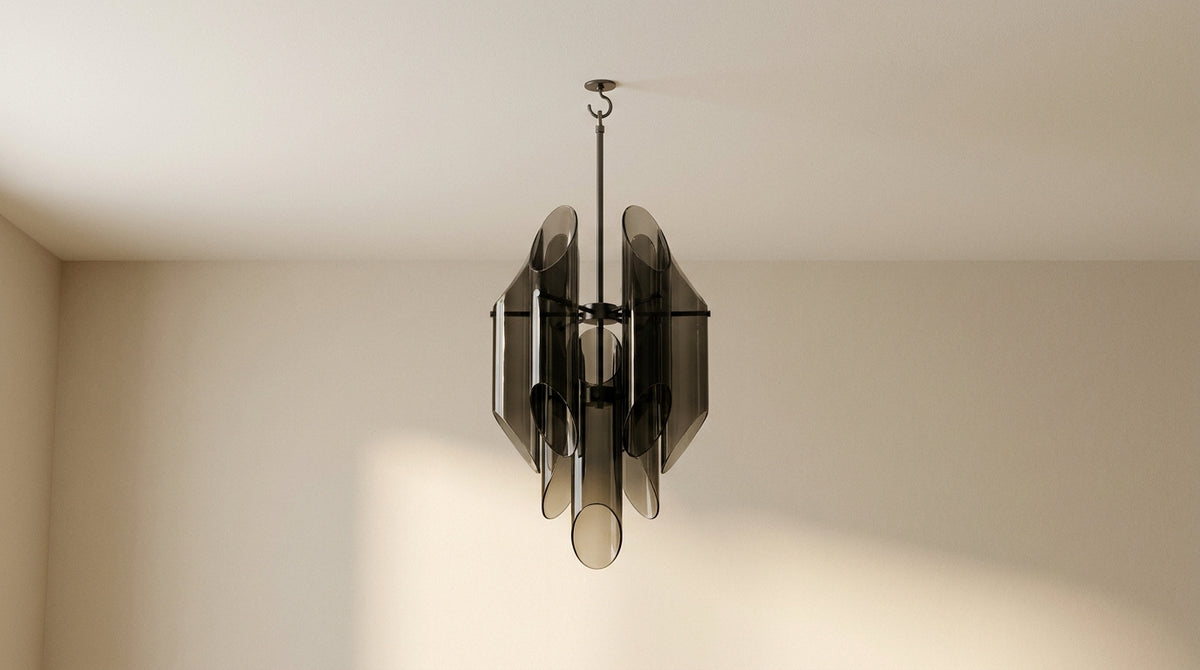
First choose your hook based on the nature of the surface, not just the weight of the chandelier: screw-in for concrete or a beam, toggle anchor for plasterboard. What matters is the material that takes the load. Then check the load rating on the hook's packaging and compare it with the light fixture.
How do you hang a heavy chandelier from the ceiling without risk?
The load never rests on the hook alone: it passes through the material it is fixed into. In concrete or a beam, a screw-in hook takes the strain. In plaster, you have to go through the board and anchor behind it. The weight of the fixture helps you choose, never decides on its own.
A large glass and metal living room chandelier often weighs more than it looks, and that is what surprises you at installation time. A suspended assembly adds a lever arm that the hook has to absorb.
What actually carries the load
- The beam or concrete takes the strain directly, with no intermediate accessory
- Plasterboard carries nothing on its own, it is the anchor behind it that does the work
- Wood panelling is treated like plaster, with a toggle wide enough
- Render and paint do not count: they give way at the first tightening
A ceiling that sounds hollow under your finger means a thin board or an air gap. In that case, guessing where to drill wastes time: better to follow the steps to install a chandelier before drilling.
How to hang a pendant light depending on the surface
The surface decides everything, and it reads in three seconds: a tap with a nail, or simply looking at the ceiling. A well-anchored glass pendant hangs straight, with no vibration and no false plumb.
Which hook for a light fixture, and where to find it?
The right hook is the one that matches the surface, not the catalogue. A screw-in hook for concrete, solid brick or a beam. A toggle anchor hook for plasterboard. A bracket mount when a box already exists. The three are not interchangeable.
| Hook | Surface | What to plan for |
|---|---|---|
| Screw-in hook | Concrete, solid brick, beam | A pilot hole the diameter of the thread, no wider |
| Toggle anchor hook | Plasterboard, panelling | Go through the board and let the toggle open behind it |
| Bracket hook | Existing DCL box | Reuse the box screws, never the central screw |
Screw-in hook in concrete, solid brick or a beam
It screws into a pilot hole, then tightens until the shank no longer moves. On a beam, aim for the heart of the wood, never the edge. The load stated on the packaging gives the limit, and it should be read before buying.
Hook and toggle anchor in plasterboard
The toggle opens behind the board and spreads the load. It requires a larger hole than the hook, so careful marking is essential. If the board crumbles on contact, the anchor needs rethinking.
For a lightweight pendant light, a clean installation is enough. In an older room with an ornate ceiling, it is better to check how a chandelier works with a ceiling rose before choosing the anchor.
Chandeliers and pendants ready to hang

How do you fit a ceiling hook, step by step?
Mark the plumb line of the light point, drill to the diameter of the hook, screw in until it locks. Three actions, no improvisation. A hook that still turns in its hole after tightening will not hold the load, even if the anchor seems solid.
Marking, drilling, fitting
- Mark the exact plumb line of the cable, not of the furniture
- Drill to the working depth, without forcing the bit
- Screw the hook in by hand, then lock it without crushing the material
- Test by pulling downwards before hanging anything
Flush ceiling light or pendant: what changes at installation
A flush ceiling light sits against the surface, a suspended fixture hangs on a cable. The first forgives a slight plumb error, the second does not. That is also what distinguishes the two installations when installing a chandelier on the ceiling, then wiring a ceiling light.
If your ceiling sounds hollow or the plumb line of the light point is not obvious, describe the room to us: our team will reply before the first drill hole, via the contact page.
How do you hang a chandelier from the ceiling without a hook?
A mounting bracket or a DCL box takes the load instead of the hook. The bracket is screwed to the surface and the fixture clips onto it. The DCL box is already designed to carry a fixture. Both solutions avoid drilling a new hole.
What surface do you have above the light point?
Mounting bracket and DCL box
The DCL box is the simplest starting point when one already exists. It comes off with two screws, and you find a sound fixing. The precise steps are described in our guide to installing a chandelier on a DCL box.
Many recent LED ceiling lights come with a compatible bracket, which makes installation easier. In a room with low headroom, it is often the best option.
What holds and what fails when you avoid drilling
- A well-screwed bracket in the material carries a standard fixture without difficulty
- A tired or cracked DCL box must be replaced, not worked around
- An adhesive fixing is not suitable for a suspended fixture, only for a light object
- A hook left in place in a damaged ceiling keeps pulling on the fragile area
When a hook already exists but the surface has suffered, the question shifts: see hanging a chandelier from the ceiling and installing a pendant light without a hook, two complementary cases.
At what height should the fixture be set once hung?
Above a table, allow around 70 to 80 cm between the bottom of the fixture and the tabletop. In a stairwell or under a high ceiling, no measurement holds: the fixture is adjusted by hand, once the room is furnished. The best reference remains the eye.
Above a table
Measure from the lowest point of the shade to the tabletop, not from the hook. A fixture that is too high lights the table without showing it off. A fixture that is too low gets in the way of guests in the middle.
In a dining room, a dining room chandelier is set once the table is in place, never before. The size is also chosen according to the table: a dining room fixture that is too large overwhelms the space.
In a stairwell or under a high ceiling
Under a high ceiling, the fixture sometimes hangs several metres down and the load increases with the length of the cable. The anchor point must be fixed into a solid material. Our Cathedral Ceiling Chandelier collection has 9 references as of 30 September 2026, designed for these volumes. The details of the cases are in our article on a chandelier and a high ceiling.
In stock · shipping costs shown at checkout · up to 30% off in your cart


Ready to turn inspiration into reality?
Tell us about your room, your style and your budget, and we will show you the pieces that truly suit your project.
Get guidance in 30 seconds →