How many lumens for a kitchen? The zone-by-zone method
This article is also available in French: Combien de lumens pour une cuisine
Multiply the floor area by 300 to 500 lumens, then add 500 to 700 lumens per square metre in the working zones. The total is then spread across several sources: in a kitchen, a ceiling light on its own always leaves the worktop in shadow.
How many lumens for a kitchen, in practice?
Allow 300 to 500 lumens per square metre for moving around and storing, plus 500 to 700 lumens per square metre in each work zone. A 12 m² kitchen therefore needs a combined total of 3,600 to 6,000 lumens, spread between the ceiling, the worktop and the dining area.
This is a sum of zones, never a total to be delivered by a single lamp. A kitchen light is therefore chosen zone by zone: the ceiling for moving around, low sources for cooking, softer light for sitting down to eat.
An L-shaped kitchen shows this quickly: the ceiling light placed in the centre lights the floor, but the worktop stays in the shadow of the wall unit, right where the hand does the chopping.
How many lumens per m² for a kitchen?
The benchmarks are read by use, not by room.
| Zone | Benchmark | What it changes |
|---|---|---|
| Moving around, storing, washing | 300 to 500 lumens per m² | floor and units easy to read, no cast shadow |
| Working | 500 to 700 lumens per m² | clear blade and food |
| Sitting down to eat | dedicated source, lower intensity | lit faces, relaxed mood |
How many lumens for a 15 m² kitchen?
Between 4,500 and 7,500 lumens in total, that is 15 m² multiplied by 300 to 500 lumens. For 20 m², allow 6,000 to 10,000 lumens. This total is then split into three layers.
- The general share covers the whole floor area, spread across the ceiling in one or two points.
- The worktop adds 500 to 700 lumens per m² worked, under the wall units.
- The dining area gets its own source, dimmable in the evening, without lighting the whole room at full power.
In an irregularly shaped room, it is better to work out the figures zone by zone: our guide to calculating the amount of lighting needed sets out the method in detail.
The reasoning applies to every layout, including in our advice on kitchen lighting.
How many lumens for the worktop?
Allow 500 to 700 lumens per square metre of worktop, on top of the general calculation. These lumens come from low sources, placed under the wall units and directed towards the surface: this is what removes the shadow of your body from the chopping board.
Should general lighting and worktop lighting be added together?
Yes, the two add up, but they do not serve the same purpose.
- General lighting lights the room and avoids dark zones when moving around.
- Worktop lighting adds a directed layer, at hand height.
- The total is counted in lumens, never in number of lamps.
- A ceiling light alone does not replace the low source, it complements it.
LED strip, batten light or spots under the wall units?
All three light the worktop, but not in the same way.
| Solution | Result | When to choose it |
|---|---|---|
| LED strip | continuous light, no breaks | straight wall units, long worktop |
| Batten light | flux concentrated on one line | short zone, above the sink |
| Spots under wall units | adjustable pools of light | angled worktop, specific needs |
Fitting a strip calls for some care on corners and cuts: everything is in our guide to installing an LED strip under a kitchen unit.
On the side walls, a kitchen wall light provides discreet extra light and avoids adding another point on the ceiling.
Are 1000 lumens enough to light well?
1,000 lumens light a zone well, not a room: that is the equivalent of 2 to 3 m² in general lighting, or about 1.5 to 2 m² of worktop. In a 12 m² kitchen, you need four to six times more, spread over several points.
What 1,000 lumens really covers
- 2 to 3 m² of floor in general lighting, no more.
- 1.5 to 2 m² of worktop when the source is directed towards the surface.
- A single point of 1,000 lumens on the ceiling does not reach the worktop, blocked by the wall units.
- Four points of 250 lumens look better than a single one of 1,000, for the same total.
Spreading 3,600 lumens over six 600-lumen spots or four 900-lumen spots does not give the same result. The number of points is calculated separately, as our guide on how many LED spots per m² explains.
Are 800 lumens enough for a given room?
For a whole room, no: 800 lumens cover 1.5 to 2.5 m² in general lighting. To supplement a worktop, yes: two well-directed 400-lumen sources are enough over a short zone, where a single 800-lumen point on the ceiling never reaches the board.
What does 3000 lumens mean?
3,000 lumens represent the general lighting of a 6 to 10 m² kitchen, or about a third of a large open-plan kitchen. Three words are often mixed up: the lumen measures what the source emits, the lux what arrives on the surface, the kelvin the colour of the light.
If you would rather start from a real kitchen than from a calculation, you can describe your kitchen to the team: that is exactly what the contact page is for.
How many lumens for a kitchen ceiling light?
Allow 2,400 to 4,000 lumens for the general share of an 8 m² kitchen, carried by a ceiling light or a pendant. A ceiling light is sized on the floor area: its light falls vertically and is blocked by the wall units as soon as you get close to the worktop.
A single point on the ceiling or several sources?
Several, almost always. A single point creates shadow zones as soon as a unit or a body comes between.
- Two points on the ceiling instead of one remove half the cast shadows.
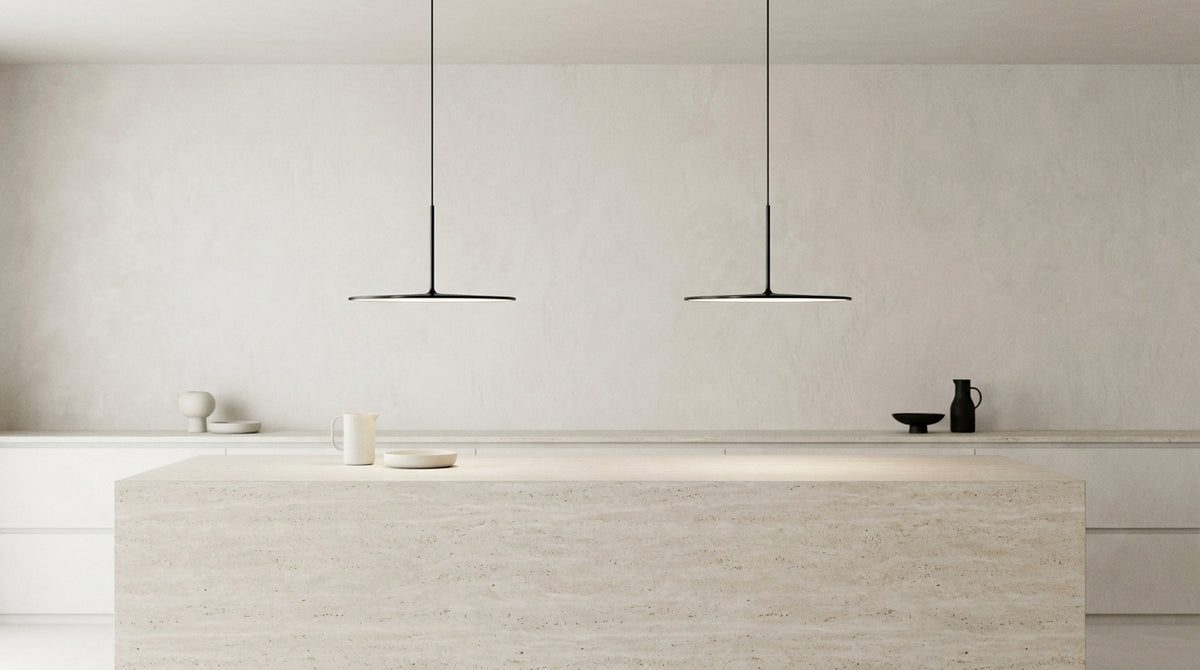
- A pendant above the island brings the light close to the worktop, without glare.
- A ceiling light alone suits a small kitchen, provided the low layer is added.
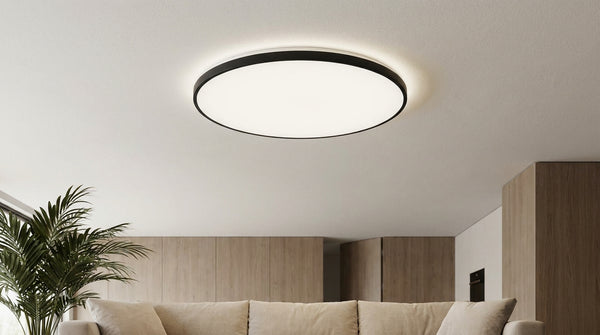
When the room is compact, a well-sized LED ceiling light carries the general share without cluttering the space.
Is IP20 enough in a kitchen?
Yes, in the vast majority of cases. On a survey of 250 references from our Kitchen Lighting collection, taken as of 28 September 2026, the IP20 rating appears on 98% of the survey and IP44 on 2%. The rating only goes up near a water point or direct splashing.
The cap, meanwhile, decides replacement. Again on these 250 listings, E27 is declared on 24% of the survey and GU10 on 23%. Adjustable spots are then replaced bulb by bulb, usually with GU10 LED bulbs.
What our catalogue says: suspended mounting dominates
On the same survey of 250 references, suspended mounting accounts for 62%, surface-mounted 17%, wall-mounted 13% and freestanding 6%. The catalogue therefore leans towards low points, and the collection counts 9,466 references as of 28 September 2026.
Those hesitating between a short and a long model will find the height adjustment in our article on the kitchen pendant.
The rest comes down to materials and shapes: our selection of kitchen pendants can be browsed by style.
The establishment's Google listing gathers buyer feedback, useful before deciding on a model.
What light is missing in your kitchen today?
What if the kitchen is open to the living room?
Count the kitchen for itself, then add a lower ambience on the living room side. An open-plan room does not need a single total but two levels: the kitchen keeps its 300 to 500 lumens per m², the living room is set to its own uses.
Separating the ambiences without splitting the room in two
- Height: a low pendant marks the kitchen zone without a partition.
- Dimming: on our survey of 250 references as of 28 September 2026, it is declared "yes" on 18% of the survey and "no" on 7%, with the rest of the listings declaring nothing.
- Colour temperature distinguishes the worktop from the dining area without changing the furniture.
The work is on a single volume with two uses, which we cover in our support for kitchen and dining room renovation.
Between a living room and an open-plan kitchen, the transitions of materials and colours extend right through to the kitchen light.
What colour temperature for the dining area?
Stay between 3000 and 4000 K above the worktop, to see the true colour of food, and move rather to 2700 K above the table, where you want a restful light. The choice also depends on the shade material, as summed up in our article on white or yellow light.
A kitchen chandelier hung low above the table brings the light back onto the plates, without adding another point on the ceiling.
Lights for lighting a kitchen


Related reading
In stock · shipping costs shown at checkout · up to 30% off in your cart


Ready to turn inspiration into reality?
Tell us about your room, your style and your budget, and we will show you the pieces that truly suit your project.
Get guidance in 30 seconds →