GU10 or GU5.3 spotlight: which to choose, room by room
This article is also available in French: Spot GU10 ou GU5 3
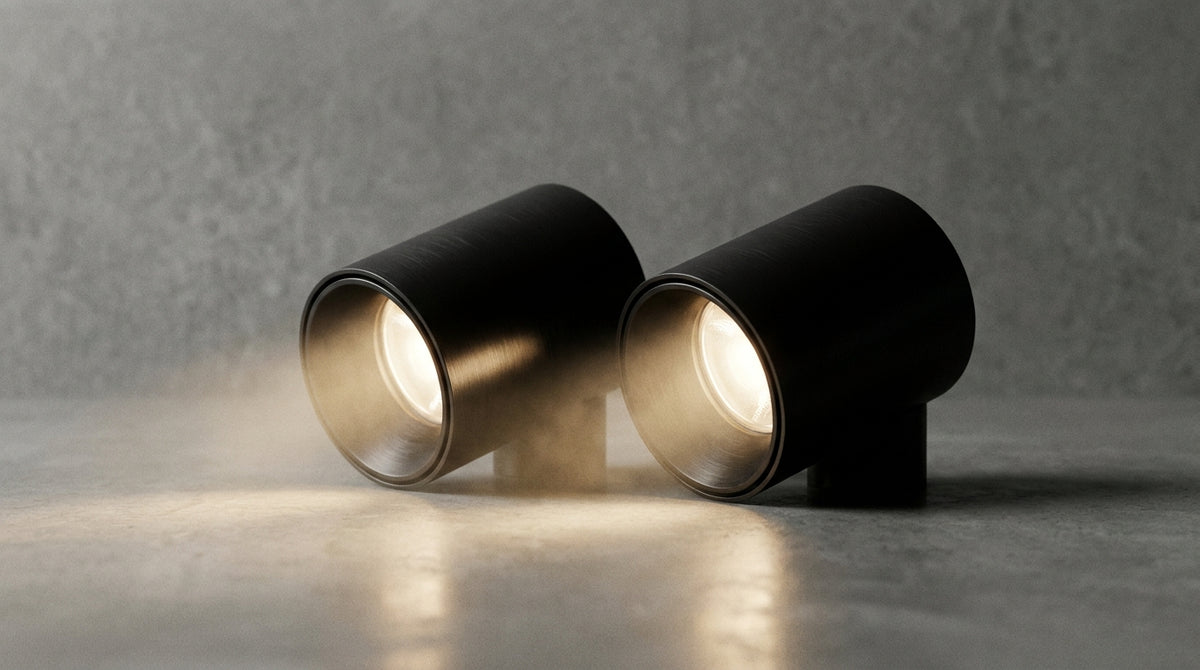
Look for the transformer behind the spotlight, in the false ceiling or in the junction box. If there is one, the installation is 12 V and you need a GU5.3 base. If the spotlight is powered directly at 230 V, it is a GU10. This step settles the question before any order.
What is the difference between GU10 and GU5.3?
These are two spotlight bases that do not run on the same voltage. The GU10 connects directly to the 230 V of the home, the GU5.3 to 12 V supplied by a transformer. The number indicates the distance between the pins in millimetres. Before choosing anything, check what already exists in the ceiling: it is the starting point of any living room lighting project.
What does GU actually mean?
GU means "pin base" and the number that follows gives the space between the two pins, in millimetres. Ten for a GU10, 5.3 for a GU5.3. The two look alike enough to be confused, although they are not interchangeable. Measuring the size of a bulb base takes ten seconds and saves a trip back to the shop.
It is often said that the GU10 is a bayonet base. That is incorrect: it locks with a quarter turn. A true bayonet base is pushed in and then twists onto two side lugs, which is quite different.
230 V on one side, 12 V on the other
The 230 V comes from the consumer unit and powers the GU10 with no intermediary. The 12 V passes through a transformer, housed in the false ceiling or in a surface-mounted box. A transformer at the end of its life causes flickering and sometimes switches off when turned back on.
| Criterion | GU10 | GU5.3 |
|---|---|---|
| Voltage | 230 V | 12 V |
| Distance between pins | 10 mm | 5.3 mm |
| Transformer | No | Yes |
| Common recess diameter | About 80 mm | About 50 mm |
| Typical use | Hallway, kitchen, bathroom | Display case, alcove, slim furniture |
Where the transformer hides
Look for a small box between the spotlight and the incoming line. Three locations come up most often.
- In the false ceiling, a few tens of centimetres from the spotlight
- In the junction box, on the incoming side of the circuit
- In the fixture, on compact models with a built-in box
Which spotlight for which room?
Bathroom and kitchen: a GU10 in IP44 minimum outside the water zones. Display case, alcove and accent lighting: an adjustable GU5.3, slimmer and more discreet. Low ceiling and hallway: a shallow recessed GU10, evenly spaced to avoid shadow areas.
Bathroom and kitchen
In a bathroom, the spotlight must withstand humidity: IP44 minimum, IP65 above the shower. In a kitchen, an adjustable GU10 lights the worktop without casting the shadow of your hands. Both rooms are planned together in a kitchen and dining room renovation, with a ceiling lighting plan for moving around and a second one for working.
On the bulb side, reinforced protection is needed at points close to water: the selection of LED bulbs for bathrooms groups the models suited to this use.
Bulbs and spotlights with GU10 and GU5.3 bases
 Bulb | Ambra II
 Bulb | Cirion
 GX53 LED bulb 7W
 Art 3D LED bulb | Rave
 Bulb | Cirene
 Bulb | Rosranica
See the whole selection: LED bulbs: E27, E14, G9, GU10 | Designix
Display case, alcove and accent lighting
A GU5.3 fits into the slimmest fixtures, where a GU10 will not go. For a display case or an alcove, aim for a narrow beam and an adjustable spotlight: the light must fall on the object, not into the room.
Low ceiling and hallway
Under a 2.20 m ceiling, a shallow recessed spotlight avoids the "staircase" effect of spotlights that are too long. First work out the right number, with our guide on how many spotlights per m² depending on the height.
Then set the spacing, detailed in our article on the distance between ceiling spotlights. An even wash is better than one very bright point in the centre.
Once the room and the voltage are settled, only the bulb remains: our selection of GU10 bulbs covers 230 V, from the hallway to the bathroom.
GU10 spotlight: what power and what light?
A 4 to 7 W LED GU10 is enough under a 2.50 m ceiling. Allow 5 W in a hallway, 7 W in a living room. Since the switch to LED, power in watts no longer says anything about the light produced: it is lumens that light.
What is the power of a GU10 spotlight?
From 4 to 7 W in LED to replace a 35 to 50 W halogen. Replacing a halogen spotlight with an LED divides consumption by five or six, for the same light output.
The right reflex is still to read the specification in lumens, not in watts: our guide on bulb power for a living room gives the correspondences room by room.
Our bulb collection has 266 references as of 5 October 2026. On a sample of 32 of these references, recorded on the same date, 100% are LED and 100% are IP20; 72% are guaranteed 2 years and 28% 5 years. These shares apply to the sample, not to the whole collection.
Do 1000 lumens light well?
Yes, for a room of 8 to 10 m² or for two or three spotlights on the same ceiling. 1000 lumens correspond to an LED bulb of about 10 to 12 W. For 20 m², aim instead for 3000 to 4000 lumens spread over several points: 2000 lumens on a single spotlight becomes a lot for domestic use.
2700 K or 3000 K depending on the room?
2700 K for a bedroom or a living room: warm white light rests the eye in the evening. 3000 K for a kitchen, a hallway or a bathroom, whiter and easier to read on a worktop. Our comparison on warm or cool light details what each temperature changes in use.
If you go for neutral white, the 3000 K bulb collection groups the corresponding models, across all powers.
Can you replace a GU5.3 with a GU10?
Yes, on two conditions: that the cut-out accepts the new spotlight and that the 12 V transformer is removed. A GU10 connected behind a transformer will not light, or flickers. The cut-out, however, often changes: about 50 mm for a GU5.3 against 80 mm for a GU10.
What to do with the transformer
It is disconnected and removed. The GU10 is then connected directly to the 230 V supply, with a terminal block or a suitable connector. If you stay on 12 V, it is better to choose GU5 bulbs compatible with the transformer in place, some older models tolerate LEDs poorly.
Three things are not done: leaving the transformer upstream, mixing 12 V and 230 V on the same circuit, forcing a GU10 into a 50 mm cut-out.
The replacement, step by step
- Switch off the circuit breaker and check that there is no voltage.
- Unclip the spotlight, locate the transformer and disconnect it.
- Connect the new GU10 spotlight to the 230 V, then put it back in place.
- Switch back on and check that no point flickers.
The full procedure, with details of the fixing clips, is in our article on replacing a recessed GU10 spotlight.
You now know which base your ceiling requires: if you prefer us to check the survey with you before buying, our workshop answers in a few words, and you can talk to the workshop about your project.
Which spotlight to install in your home?
Fixed, adjustable or dimmable spotlight?
Fixed for a hallway or an entrance, where the light must fall straight. Adjustable for a worktop, a bookcase or a painting, to aim at the useful surface. Dimmable for a living room: the intensity is set according to the time and the use.
Fixed or adjustable spotlight?
A fixed one gives an even wash and costs less. An adjustable one is set after installation, which makes up for a badly placed wall or a moved piece of furniture. On a low ceiling, the adjustable one remains the most comfortable.
Do you need a dimmer?
It is not the spotlight that carries the function, it is the bulb. A dimmable spotlight requires a compatible bulb and a suitable dimmer, otherwise the light flickers or buzzes.
To check before buying, buyer reviews are available and permanently up to date on our Google listing.
In stock · shipping costs shown at checkout · up to 30% off in your cart


Ready to turn inspiration into reality?
Tell us about your room, your style and your budget, and we will show you the pieces that truly suit your project.
Get guidance in 30 seconds →