Entrance lighting ideas: composing light from the threshold
This article is also available in French: Idée éclairage entrée

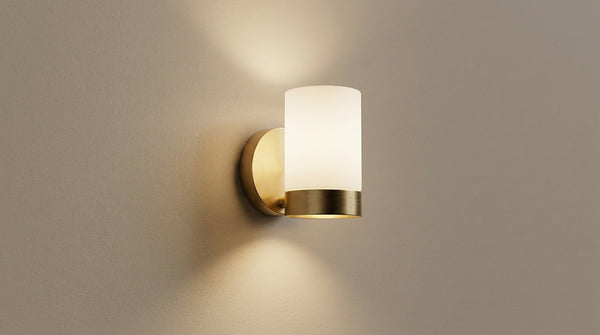
Count three sources and two heights. One wall light at 1.70 m on the side wall, a second at the end of the hallway, and a light point above the threshold. The first lights the face of whoever enters, the second gives depth, the third secures the step. All at 2700 K so the entrance does not look like a parking garage.
A successful entrance is judged on what you see when you push the door open: a lit face, a wall that breathes, a floor without harsh shadows. If you are redoing the whole thing, our support on an entrance, hallway and staircase lighting project starts from exactly these three points.
Which light for an entrance: pendant, wall light or ceiling light?
The wall light wins in nine entrances out of ten. Across a survey of 247 wall lights in our catalogue as of 8 November 2026, 96% are wall-mounted and 90% are IP20, so reserved for indoor use. A pendant is only justified when there is volume above head height, and a ceiling light when the passage is wide.
The choice depends less on style than on geometry. A 1.20 m wide hallway struggles with a central fixture: it creates two dark zones on the sides, exactly where you put your feet.
Entrance hall lighting: what each mounting changes
The mounting decides the quality of light before the shape of the fixture. A wall light projects up and down, a ceiling light illuminates flat, a pendant concentrates. Everything that lights an entrance is detailed on our page about entrance lighting.
- Wall light: side light, zero shadow on the floor, ideal under a 2.50 m ceiling
- Ceiling light: broad coverage, but flattens volumes and tires the eye in a narrow space
- Pendant: deliberate focal point, reserved for entrances over 2.70 m
- Surface-mounted: fallback solution when no recess is possible
Pendant or ceiling light when the ceiling is high
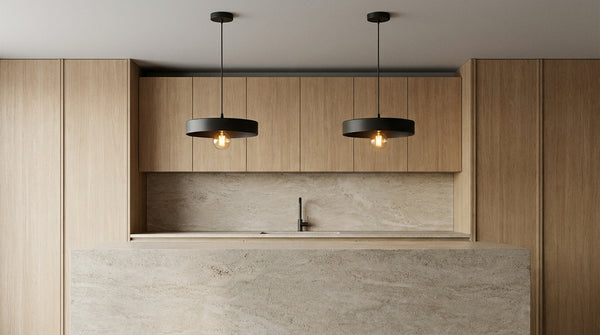
Beyond 2.70 m, the pendant regains the advantage. It brings the light down to working height instead of letting it die at the ceiling. A modern entrance chandelier in opal glass or black metal works from 2.80 m, provided at least 2.10 m of clear passage is left under the fixture.
The calculation is simple: ceiling height minus 2.10 m gives the available pendant length. Under 2.50 m, forget it. Between 2.50 and 2.70 m, a short, flat model remains possible.
Once the mounting is settled, the rest comes down to finish. Our selection of entrance wall lights covers indoor and outdoor, in black, white and gold.
How to light a long, narrow entrance hallway?
Light the walls, not the axis. Two or three wall lights staggered at 1.70 m from the floor give a grazing light that enlarges the perceived width. A single central point on the ceiling creates a tunnel. On the same survey of 247 listings, 98% declare the room as "hallway", making it the second most documented use after the living room.
Hallway entrance lighting: side light rather than the centre
The spacing rule fits in one sentence: one wall light every 1.50 m to 2 m, never two facing each other at the same height. The offset creates a rhythm and avoids the administrative corridor effect.
A 4 m hallway takes two wall lights, one on each side, offset. Beyond 6 m, move to three. Our collection of hallway wall lights gathers adjustable models and compact formats suited to these widths.
- 1.70 m: standard mounting height, at eye level
- 1.50 to 2 m: spacing between two sources
- 2700 K: the temperature to hold, neither cold white nor orange
- Dimmable: useful if the entrance also serves as a night passage
Entrance without a window: where to place the second source
Without natural light, the entrance needs a relay at the end of the path. Place it at the back, on the wall you see when entering: it gives a depth the hallway does not have. A very flat small entrance ceiling light works if the ceiling is low.
When there is no ceiling power supply, the solution goes through the wall or a rechargeable wall light. The principle is developed in our guide to lighting a room without a ceiling outlet.
If you are hesitating between two mountings for your entrance, the team will answer on height and IP rating: simply contact us.
Which outdoor lighting for a house entrance?
Aim for IP44 minimum above the door, IP65 if the fixture is exposed to driving rain. An entrance under a canopy looks dry and stays damp: the IP44 minimum applies in all cases. Across our survey of 247 wall lights as of 8 November 2026, only 2% are IP44 and 7% are IP65, the rest being indoor.
Outdoor wall light: the IP rating to demand above the door
The IP rating is read on the specification sheet, not on the photo. The first digit protects against solids, the second against liquids: IP44 withstands splashes, IP65 withstands jets. The details of how to read it are in our article on the IP rating of an outdoor light.
Our outdoor wall light is also chosen on material: aluminium or treated glass age better than painted metal under a damp porch.
Detector or night light: lighting without dazzling the first step
The detector handles safety, not comfort. A flow that is too powerful triggered 2 m from the face dazzles and makes the staircase unusable. Aim for an adjustable model, directed towards the floor, with moderate power.
- IP44: minimum under a canopy, even in dry weather
- IP65: exposed wall, with no protection above
- Low orientation: the light sweeps the floor, never the eyes
- Detector: adjustable timer, avoid permanent standby
The outdoor catalogue can be browsed by IP65 outdoor wall lights when exposure is real.
How to compose a modern entrance hall without getting it wrong?
Hold a single white temperature across all sources, 2700 K, and vary the shapes. A modern hall is not built by multiplying fixtures, but by aligning their light colour. Two different shades in 6 m² are immediately visible and break the impression of care.
Mounting height of a wall light in an entrance
Mount at 1.70 m from the floor, centre of the fixture. This height places the source at eye level without dazzling and allows you to see its reflection in a mirror. In a very high hallway, go up to 1.80 m to prevent the light from hitting the legs.
Our collection of LED wall lights simplifies this adjustment: no bulb to choose, the temperature is set by the fixture. Conversely, an E27 model, which accounts for 31% of the survey, leaves you free to change the bulb later.
Light temperature: 2700 K rather than 4000 K
4000 K is an office neutral white, not an entrance white. In a passage space where you arrive from outside, it hardens the features and gives a clinical impression. 2700 K warms the complexion and prepares for the atmosphere of the rest of the home.
| Temperature | Rendering in an entrance | Recommended use |
|---|---|---|
| 2700 K | Warm white, welcoming | Entrance, hallway, staircase |
| 3000 K | Soft white, neutral | Very bright hall, glass roof |
| 4000 K | Cold white, sharp | Garage, utility room |
The colour of the fixture matters as much as that of the bulb. Black accounts for 53% of the survey, white and gold for 40% each: three families that coexist without contradicting each other. To broaden the search beyond the entrance, lighting is chosen by room and by style.
Entrance lighting: the Designix selection
 Wall light | Heor
 Wall light | Zenena
 Wall light | Flovena
 Wall light | Sveva
 Wall light | Bastia
 Wall light | Tubara
See the whole selection: wall light, wall lamp and designer wall lighting
Which entrance looks most like yours?
In stock · shipping costs shown at checkout · up to 30% off in your cart


Ready to turn inspiration into reality?
Tell us about your room, your style and your budget, and we will show you the pieces that truly suit your project.
Get guidance in 30 seconds →