Outdoor wall light: how to choose according to the wall
This article is also available in French: Applique murale extérieure
Before looking at a model, check what your wall is exposed to: an overhang that protects it, driving rain that whips it, sea spray, or just the passing of a walkway. This exposure determines the IP rating, the material and the mounting height. A sheltered wall is fine with IP44, an exposed wall requires IP65.
Which IP rating to choose for an outdoor wall light?
Aim for IP44 under an overhang, IP65 on a wall that rain hits head-on. IP44 stops splashes, IP65 withstands jets. IP54 sits between the two without promising against running water. The first digit refers to dust: 4 for solid objects, 6 for complete sealing.
Our collection of outdoor wall lights has 1,623 references as of 4 November 2026, enough to cover each facade zone rather than a single model. In a survey of 80 of these listings on the same date, IP44 accounts for 35%, IP65 for 33% and IP54 for 29%.
IP44, IP54, IP65: what rain really gets through
Rain does not go through a seal; it creeps up by capillary action and stops in the groove of the cap. An IP44 mounted horizontally under an overhang stays dry. The same IP44 on a wind-driven wall takes water from below and keeps it.
| Rating | What it stops | Where to install it |
|---|---|---|
| IP44 | Water splashes | Wall under overhang, covered terrace |
| IP54 | Splashes, limited dust | Porch, conservatory, sheltered wall |
| IP65 | Water jets, dust-tight | Exposed wall, seaside, driveway |
Under an overhang, is IP44 enough?
Yes, as long as water does not run back up and the wall stays more than a few tens of centimetres from the ground. At the seaside, salty air attacks the screws before the electronics: go straight for a watertight model, even under cover. The details of the two digits are explained in our article on the IP rating of an outdoor light. For a wall battered by wind, the selection of IP65 outdoor wall lights avoids compromise.
Which outdoor wall light for a terrace?
Choose a model that sends light down to the ground and onto the wall, never into your eyes. Two wall lights framing the area are enough on a 15 m² terrace. A sensor has no place there: the light must stay on when you are sitting outside.
At what height should an outdoor wall light be installed on a terrace?
Allow 1.80 m to 2 m from the ground. The light passes above the eye line of a seated person and bounces off the paving. Lower, you light up knees and dazzle the table. The benchmarks for each room are detailed in our guide on wall light height.
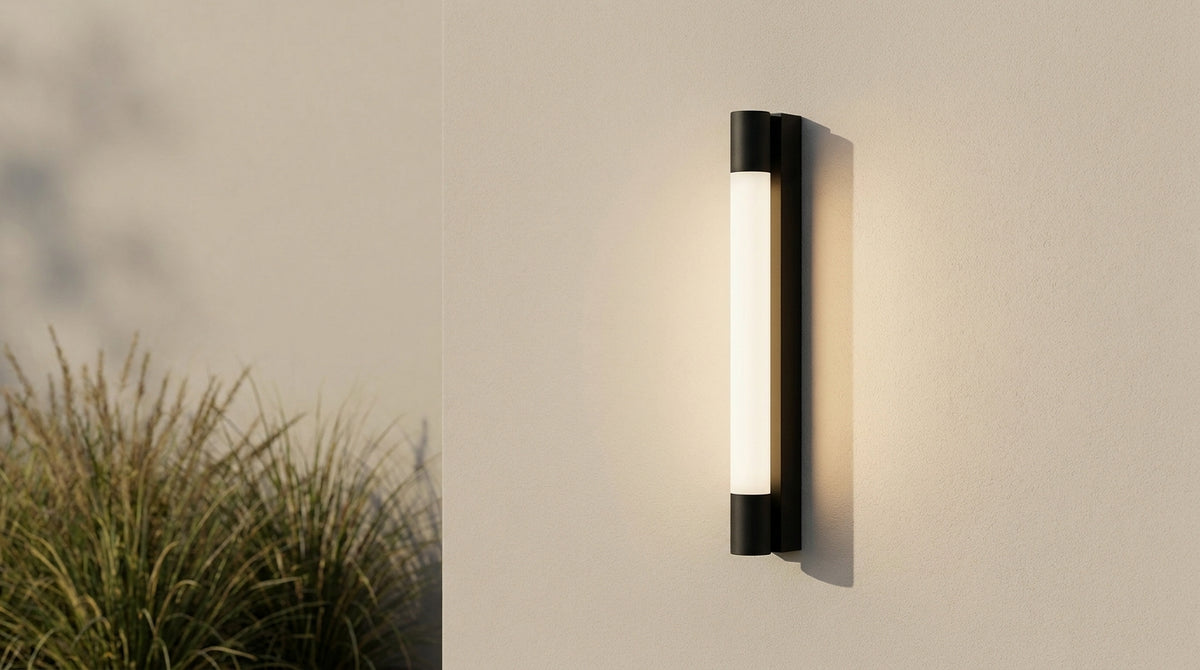
On a terrace, shape matters as much as light output. A vertical black aluminium tube stays discreet by day and draws a clean line in the evening. That is the principle of designer outdoor wall lights for terraces: a simple volume, grazing light on the render.
What power and light colour for a terrace wall light?
A powerful outdoor wall light is not the one that consumes the most, but the one that puts its lumens in the right place. Stay between 2700 K and 3000 K on a house wall: cool white makes the facade look cold and attracts insects. Allow 8 W to 12 W in LED for a 3 m wall.
The calculation depends mainly on the area to cover, not the wattage on the label. Our guide on LED power for outdoor lighting gives typical values by use, from simple passage to lighting a table.
Outdoor wall lights: our selection
 Outdoor light | Alanevano
 Outdoor light | Pelham
 Outdoor light | Lumenza
 Outdoor light | Oryn
 Outdoor light | Cirena
 Outdoor light | Piola
View the whole selection: Outdoor wall light, outdoor wall lamps
An outdoor wall light with sensor or solar: useful or gadget?
A sensor makes sense on a passage, an entrance, a garage: the light comes on when someone arrives. On a terrace where you settle in, it turns off at the wrong moment and leaves you in the dark mid-conversation. Solar, on the other hand, depends entirely on the panel's orientation.
On which wall does a motion sensor really make a difference?
On a driveway, gate or garage wall, yes: the light arrives with the visitor and goes off after they pass, with no timer to set each evening. Check that the head points at the approach, not the wall opposite. Our article on outdoor lighting with sensor details the range and delay settings. The corresponding models are in the wall lights with motion sensor.
Is a solar outdoor wall light enough?
It is enough to mark out a driveway or garden wall, not to light a terrace where you dine. Solar technology accounts for 1% of the survey of 80 listings in our catalogue as of 4 November 2026: a niche, not the core of the offer. On a south-facing wall, the panel recharges the battery during the day and the light lasts part of the night. In the shade of a tree or under an awning, it goes out early. The comparison of solar outdoor wall lights helps you decide according to orientation.
Aluminium, metal or glass: which material for an exposed wall?
Powder-coated aluminium holds up best on an exposed wall: it does not rust and keeps its colour. Painted metal needs watching for chips, glass looks lovely in the evening but fears impacts. In 80 listings surveyed on 4 November 2026, aluminium appears on 65% of references, metal on 51%, glass on 38%.
What really lasts outdoors, material by material
- Aluminium: light, stable, it does not swell with moisture and accepts matt finishes
- Painted metal: a rawer look, to be touched up as soon as a chip exposes the steel
- Glass: the most beautiful effect in the evening, the most exposed to wind and balls
- Acrylic: diffusing and economical, it yellows with years of sun
The full list of aluminium outdoor wall lights shows one thing above all: the slimness of the profiles, impossible to achieve with thick folded metal.
Black or white: which colour for a facade?
Black blends into old render or dark stone; white disappears on a light wall but shows every rain mark. The survey of 80 listings on 4 November 2026 gives black at 55% and white at 35%. On a stone facade, an anthracite tone is more discreet than a true black.
If your wall gets sea spray or stays in shade all day, the doubt clears in a few minutes: just write to us to confirm your choice before ordering. The reviews on our Google listing can be checked in one click.
Integrated LED or replaceable bulb: what to choose?
Integrated LED is forgotten for years, but makes failure permanent. A replaceable bulb lets you change the colour temperature and power as use evolves. You still need a socket that holds up outdoors: E27 for generous volumes, GU10 for narrow beams.
E27, GU10, G9: which socket for an outdoor wall light?
Of the 76 listings in our survey that declare a socket as of 4 November 2026, integrated LED accounts for 45%, E27 for 26%, GU10 for 10% and G9 for 6%. E27 accepts filament bulbs and high power, GU10 remains compact and directional. G9 is reserved for small decorative volumes. An integrated LED wall light is perfectly suited to an outdoor corridor that is never left on for long.
Does changing the bulb really change the mood?
Yes, and it is the only free adjustment. The same wall light goes from workshop light to entrance glow depending on the bulb chosen. If you want to keep that freedom, E27 outdoor wall lights are the most flexible.
Then there is installation. A stone wall requires slow drilling and suitable anchors; fresh render does not take over-tightened screws well. Our guide to installing a wall light covers solid walls, dry lining and cable routing on a facade.
In stock · shipping costs shown at checkout · up to 30% off in your cart


Ready to turn inspiration into reality?
Tell us about your room, your style and your budget, and we will show you the pieces that truly suit your project.
Get guidance in 30 seconds →