E27 bulb size: the guide to dimensions and the right base
This article is also available in French: Taille ampoule e27
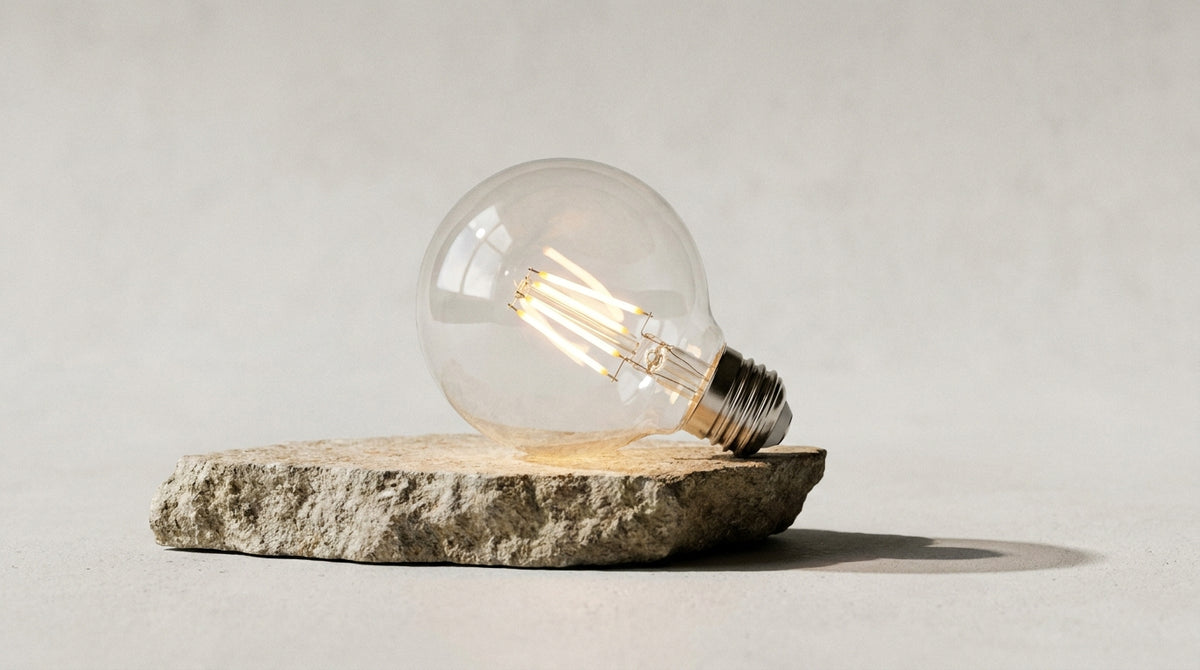
The E27 base measures 27 mm in diameter: it is the large screw thread, the one used on standard household sockets. Measure the inside of your socket between two opposite threads. 27 mm means E27. 14 mm means E14. That diameter then decides everything: bulb shape, available height, and the wattage the fixture accepts.
What are the different bulb sizes?
Three formats cover almost every indoor fixture: the small E14 screw base, the large E27 screw base and pin bases such as GU10. The measurement that matters is never the length of the glass, it is the diameter of the base and the shape of its fitting.
The E27 base bulb collection brings together 96 references as of 29 September 2026, from the bulb to the smoked glass and the chandelier flame. Enough to find the exact shape rather than buying a batch at random.
What is the diameter of an E27 base?
27 mm, measured at the widest thread. An E14 measures 14, a bayonet B22 measures 22. A base is always measured by diameter, never by thread length: two sockets can have the same depth and opposite diameters. The full equivalences are gathered in our article on bulb base size.
What is the length of an E27 bulb?
There is no standardised length: it depends on the shape of the glass. An E27 bulb rarely exceeds 110 mm, a sphere goes higher, a flame stays low. What decides compatibility is the space left between the socket and the bottom of the shade.
- Bare socket: every shape fits, this is the simplest case
- Conical shade: a bulb or a flame, which let the light flow downwards
- Closed globe: measure the inside diameter before choosing a sphere
- Long pendant: a tall shape balances the silhouette better
What is the size of an E27 bulb?
An E27 bulb has no single size: only its base is standardised, at 27 mm. The diameter of the glass and the total height vary from one shape to another. Two E27 bulbs can be 45 mm or 125 mm wide, and both will screw in without a problem.
The table below summarises the four bases most often found in a home.
| Base | Diameter | Fitting | Fixtures concerned |
|---|---|---|---|
| E14 | 14 mm | Small screw thread | Bedside lamps, small chandeliers |
| E27 | 27 mm | Large screw thread | Pendants, ceiling lights, floor lamps, wall lights |
| GU10 | 10 mm between pins | Two pins | Recessed spotlights, tracks, adjustable ceiling lights |
| B22 | 22 mm | Bayonet | Older fixtures |
E27 base bulbs: the shop selection


E14, E27, GU10: the right bulb for every socket
A base does not adapt, it is respected: an E27 socket physically rejects an E14, which is too thin, and a pin base does not screw in. Recessed spotlights and adjustable ceiling lights often use GU10 bulbs, while bedside lamps call for a small E14 LED bulb.
Measure your socket before ordering
Remove the bulb in place and measure the inside of the socket, between two opposite threads. No ruler to hand? A 1 euro coin is a little over 23 mm: if it does not fit into the socket, it is E14; if the socket is clearly wider than the coin, it is E27. The method is detailed in our guide to identifying the size of a bulb.
How do you know the size of a bulb?
Read the socket, not the bulb. The base is the only standardised dimension, so it is the only one that does not mislead. If the old bulb is still there, compare its thread with that of the socket: they must fit together without play and without force.
The screw thread, the most reliable clue
An E27 screws in in about three turns, an E14 needs more for the same depth. The thread is wider on large bases, and that is what makes fitting impossible between the two. A base that resists is never the right one.
The space available under the shade
Once the base is identified, the height remains. Count the distance between the socket and the nearest obstacle, then allow 10 mm of margin. Three configurations come up again and again:
- Open pendant: no constraint, the shape becomes an aesthetic choice
- Ceiling light with glass: aim for a short bulb, bulb or flame type
- Floor lamp with shade: prefer a tall shape, which also lights the ceiling
- Closed enclosure: check the ventilation around the glass
A fixture where the bulb touches the glass heats up and yellows. It is the most frequent defect seen when changing a ceiling bulb.
Unsure about the compatibility of a specific reference? Our buying help and after-sales service answers before purchase, based on the model of the fixture.
What are the different shapes of E27 bulbs?
Five shapes cover most of the market: the bulb, the globe, the sphere, the flame and the tube. They produce the same light at equal wattage, but do not distribute it in the same way. The shape sets the mood as much as the colour temperature.
Bulb, globe, sphere, flame: the effect in the room
- Bulb: the all-purpose shape, discreet above a table
- Globe: generous glass, made for a led ceiling light or a fixture with visible glass
- Sphere: 360 degree diffusion, ideal in a wall light or a floor lamp
- Flame: slender silhouette for chandeliers and electrified candlesticks
- Tube: long and narrow, designed for elongated fixtures
Compact shapes for closed fixtures
In a glass globe or an enclosure, the margin is counted in millimetres. A compact shape, a little wider than it is tall, fits where a classic sphere gets stuck. It is also the territory of the LED filament bulb, whose visible filament is as much to look at as it is to light with.
Which fixture do you want to equip in your home?
What wattage and colour temperature for an E27 bulb?
The base says nothing about wattage: an E27 exists in 4 W as well as 15 W. What changes the effect is the flux in lumens and the colour temperature. Two bulbs of the same wattage can light from single to double.
The right colour temperature per room
- 2700 K: warm white, bedroom, living room, reading corner
- 3000 K: softened warm white, dining room and kitchen
- 4000 K: neutral white, hallway, office, bathroom
- 6000 K: cool white, outdoors and technical areas
In the same room, mixing two temperatures shows at first glance. The subject is detailed in our article on warm light or cool light.
E27 base and dimmer: what to check
Not all bulbs dim. A non-dimmable LED connected to a dimmer flickers, buzzes or refuses to light. Check the word "dimmable" on the packaging, then the compatibility with the type of dimmer already installed. Our dimmable bulb range gathers the models designed for dimming.
To calibrate the flux according to the surface, our guide on bulb wattage for the living room gives the reference points room by room. And when the doubt concerns the fixture itself, the Designix Google listing gathers buyer feedback: verifiable reviews on Google.
If your fixture is on a dimmer and you hesitate between two models, our customer service settles the question in one answer: ask us for advice before ordering.
In stock · shipping costs shown at checkout · up to 30% off in your cart


Ready to turn inspiration into reality?
Tell us about your room, your style and your budget, and we will show you the pieces that truly suit your project.
Get guidance in 30 seconds →