Salt lamp: 5 checks that expose a fake
This article is also available in French: Comment reconnaître une vraie lampe de sel
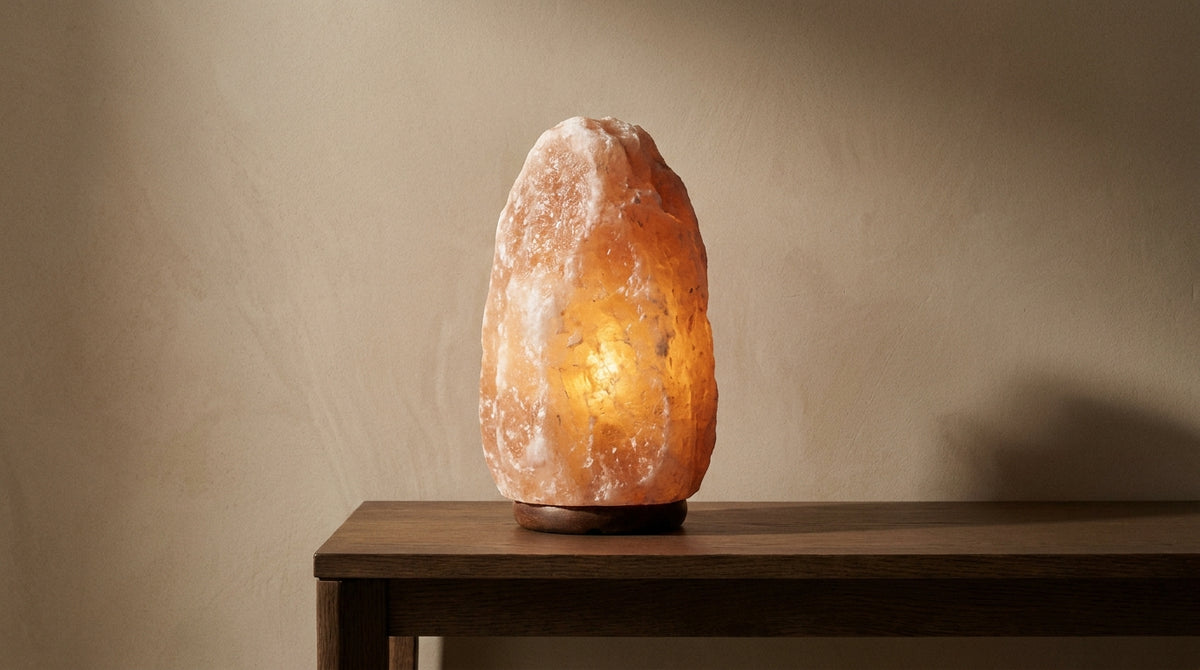
Weighed in the hand, a real block of rock salt is noticeably heavier than an equivalent volume of resin. Next, run a finger over the surface: it catches, the grain is uneven, and no edge is sharply geometric. A moulded piece, by contrast, stays smooth, light and perfectly regular.
How can you tell if it is a real salt lamp?
Three gestures are enough: lift the block, scratch the surface, then look at it against the light. The weight should surprise you, the material should resist slightly under a fingernail, and the light should pass through in uneven veins. A smooth, light and uniformly pink lamp is almost always a moulded piece.
Weight and grain
Pick up the lamp with both hands. A block of rock salt is dense, therefore heavy, and its mass is distributed unevenly: one side pulls more than the other.
- Weight: a real block surprises by its density, a moulded piece stays surprisingly light
- Grain: the surface catches under the finger, it is never glassy
- Edges: irregular, never aligned to the millimetre
This reflex applies to any designer light: when a material does not behave as it should, doubt is legitimate.
Colour, transparency and inclusions
Himalayan salt is never a single shade: it ranges from pale pink to deep orange within the same block.
- The shade varies: gradients, pale veins, almost white areas
- Against the light: light passes through in patches, with opaque spots
- Grey or brown inclusions are normal, they are trapped minerals
- A bright, uniform colour (green, blue, purple) signals a treatment or a resin
The same reasoning applies to designer pieces: recognising a Pipistrello lamp also relies on material clues.
Is a salt lamp that weeps a bad sign?
No, it is rather a good sign. Salt is hygroscopic: it takes up water from the air, holds it, then releases it as salty droplets. A resin lamp never weeps, whatever the season.
- A tray or saucer under the block protects the furniture
- A ventilated room limits drips, which intensify above 60% humidity
- Regular use: the heat of the bulb dries the surface
What are the downsides of a Himalayan salt lamp?
It gives little light, heats up to the touch, dislikes humidity and remains fragile in a child's hands. It does not purify the air in a room and does not replace ceiling lighting. It is an ambient light, not a functional fixture.
What a salt lamp does not do
- It does not purify the air: the ions praised on some listings cannot be measured at the scale of a living room
- It does not light the room: its useful range is measured in tens of centimetres
- It does not replace a ceiling light for moving around or reading in the room
- It does not heal anything: it is a decorative object, to be treated as such
Heat, children, cats and humidity
The block conducts heat poorly, but the bulb heats up. After an hour, the surface becomes unpleasant to the touch on an E14 or E27 model.
- Children: place it out of reach, a block of several kilos remains heavy and breakable
- Cats and dogs: an animal that licks the salt absorbs sodium, keep it out of their path
- Kitchen and bathroom: humidity speeds up drips there
- Halogen bulb: replace it with a low-consumption LED
How long does a salt lamp last?
A well-treated block lasts for years. What wears it out is not use but water: stored in a damp place, it hollows out, turns white, then crumbles.
- It hollows out: the surface erodes and the shape rounds off
- It turns white: a dry film appears, it comes off with a cloth
- It crumbles: when the structure cracks, the block is ready to be replaced
A table lamp in glass or metal fears neither water nor drips, which makes it easier to install in a living room.
Socket and bulb: what really uses power
A salt lamp uses little power, because its socket only accepts a low-wattage bulb. The thing to watch is heat, not kilowatts.
- E14 socket: small blocks, low-wattage bulbs
- E27 socket: large blocks, to be fitted with a 4 to 6 W LED
- Heat: too powerful a bulb cracks the salt
- Colour temperature: a 2700 K LED keeps the warm shade that gives it its charm
In a survey of 219 references in our catalogue as of 29 September 2026, 24% declare an E27 socket, 21% an integrated LED, 11% an E14 and 11% a GU10. In the same survey, 89% state a 2-year warranty. The counter for the Top of Best Sellers collection shows 37,350 references on the same date.
Unsure about the socket, the wattage or the mounting height? The quickest way is to write to the Designix team: the answer arrives before the purchase, not after.
Where should you not put a salt lamp in the home?
Keep it out of the bathroom, the kitchen, the utility room and any damp room: the salt weeps continuously there and ends up hollowing out. Also avoid windowsills in full sun, which dry out and crack the surface, as well as walkways where people go barefoot.
Rooms to avoid
- Bathroom: water-saturated air turns the block into a sponge
- Kitchen: cooking steam produces the same effect
- Utility room and cellar: permanent humidity, guaranteed damage
- Baby's room: a heavy, hot block within reach, move it
Where to place it for the best effect
- On a hallway console, at eye level
- On a bedside table, away from the bed, as an evening night light
- On a shelf or a low unit, never against a damp wall
- In a living room, alongside a LED ceiling light that takes over when you need to see clearly
In a bedroom, it serves as a night light: a few pointers on which light to sleep with help avoid mistakes. For real bedroom lighting, a bedroom fixture placed on the dresser is a better replacement for the block.
Where will this accent light live?
Salt lamp or designer table lamp?
The salt lamp gives a warm, very localised glow, with ongoing maintenance. A designer table lamp lights a wider area, does not weep and is chosen for its material. In a living room, the designer object is more versatile; the salt lamp remains a decorative object.
| Criterion | Salt lamp | Designer table lamp |
|---|---|---|
| Brightness | Accent glow, short range | Wide lighting, reading possible |
| Humidity | Fears water, drips | No constraints |
| Bulb | E14 or E27 low wattage | E14, E27, GU10 or integrated LED |
| Maintenance | Regular dry cloth | Simple dusting |
| Durability | Hollows out with humidity | Stable, warranty stated |
Table lamps and accent lights in the selection
 Glass ball pendant light, modern gold and black design | Sphère Céleste
 Danish pendant light | Cocoon
 Tree pendant light | Lueur Sylvestre
 Modern living room wall light, black and gold design | Gravity
 Pendant light | Lotus
 Wine Glass Pendant Light | Esprit Vinicole
See the whole selection: Top of Best Sellers and Best Seller Decoration Designix
For a warm atmosphere without the constraints of salt, ambient lighting relies on discreet sources and a dimmer. Above a table, a chandelier fills this role while structuring the room. In a corner, a floor lamp frees up the floor and lights your reading.
If your hesitation concerns the seller's reliability, the Google listing for the business can be checked in one click, with its address in Vaulx-en-Velin.
In stock · shipping costs shown at checkout · up to 30% off in your cart


Ready to turn inspiration into reality?
Tell us about your room, your style and your budget, and we will show you the pieces that truly suit your project.
Get guidance in 30 seconds →