Installing a boho wall light: getting the mounting right
This article is also available in French: Installer une applique bohème : le guide pas à pas
Position the bracket between 1.10 m and 1.50 m from the floor depending on use, switch off the breaker, check that there is no current with a tester, then drill at the diameter of the wall plug. Before buying the bulb, check the socket: in a survey of 88 wall lights from our catalogue on 4 October 2026, 47% are E27.
How do you install a wall light, step by step?
The installation comes down to five steps: switch off, mark, drill, plug, connect. The paper template supplied with the wall light sets the position of the holes and avoids the one-centimetre offset that forces you to drill again. The rest depends on the wall and on what comes out of it.
On a bare partition wall, the real difficulty is not the drilling but the power supply. If you are redoing the whole room, it is better to plan everything before getting out the drill: a complete lighting plan for the living room distributes wall lights, pendants and reading lights so that each area has its own source, instead of concentrating the light in the centre.
At what height should the bracket be fitted?
Allow 1.10 m to 1.20 m from the floor for a bedside wall light, and 1.50 m in a hallway or stairwell. In a bathroom, align it with the top of the mirror, never inside the shower zones.
- Bedside: 1.10 m to 1.20 m, at shoulder height once sitting up in bed
- Hallway and stairs: 1.50 m, high enough not to dazzle, low enough to light the steps
- Bathroom: top of the mirror, outside zones 0 and 1
- Reading: 1.20 m to 1.30 m, aimed at the book and not at the face
A simple trick: tape a piece of cardboard to the wall, step back two paces and adjust before drilling. Our guide to the ideal height of a wall light covers the cases of the bedroom and the living room in detail.
Find the height that suits your room: ideal height for a wall light.
Which room are you fitting your boho wall light in?
Which drill bit and which wall plug for which wall?
The drill bit is chosen for the surface, not for the wall light. A masonry bit for solid masonry, a bit at the exact diameter of the plug for plasterboard, and no hammer action on plaster blocks.
| Wall | Drill bit | Wall plug |
|---|---|---|
| Concrete, solid brick | masonry, Ø 6 mm | expanding nylon |
| Hollow brick | masonry, Ø 6 mm | expanding, long |
| Plasterboard on studs | at the diameter of the plug | toggle or self-drilling |
| Plaster blocks | no hammer action | chemical or toggle |
A rattan wall light often needs only a toggle plug in hollow plasterboard. And if you do not want to drill at all, note that it is possible to install a wall light without drilling, with a clip or on a cable.
If your wall is hollow plasterboard, if you are unsure between a hardwired model and one that plugs into a socket, or if the room is damp, describe your wall to an adviser and we will put you in touch with someone who will decide with you before you buy.
Hardwired, plugged in or DCL: which setup should you choose?
There are three setups, and the choice depends on what already comes out of your wall. A waiting cable calls for a hardwired connection; a free socket calls for a cord; neither calls for a rechargeable or solar wall light.
How do you plug a wall light into a power socket?
The cord runs down to the nearest socket, in a trunking or a fabric cable, with no intermediate joint. Two wires or three depending on the model: the earth is only used if the wall light provides for it. A cable that is too short is replaced, not extended with a connector block.
The wire-by-wire diagram is set out in our article on plugging a wall light into a socket.
If you are adding several sources on the same circuit, an integrated-LED wall light gives off less heat and uses less power than a high-wattage filament bulb.
Powering from a socket remains the simplest solution when the room has no dedicated wall supply.
How do you fix a wall light to a DCL box?
The DCL box provides three terminals. You connect the wires, screw the base plate onto the two mounting points of the box, then clip on the cover: no additional drilling is needed.
- Live: red, brown or black wire, to terminal L
- Neutral: blue wire, to terminal N
- Earth: green-yellow wire, only if the wall light provides for it
- Cable slack: a few centimetres folded back into the box, without pinching them
A bare supply, on the other hand, means adding a flush-mounting box or a cover to keep things tidy. This is the most common case behind an old wall light that has been removed.
Do you need an integrated switch or a two-way switch?
An integrated switch saves running a cable to the opposite wall: you switch on from the body of the wall light, which suits a bedroom or a reading corner. A two-way switch remains the right answer when the wall light is switched on from the door, in a hallway or on a staircase.
Models of wall light with integrated switch are fitted in exactly the same way as a standard wall light, with no remote control.
Which boho wall light should you choose?
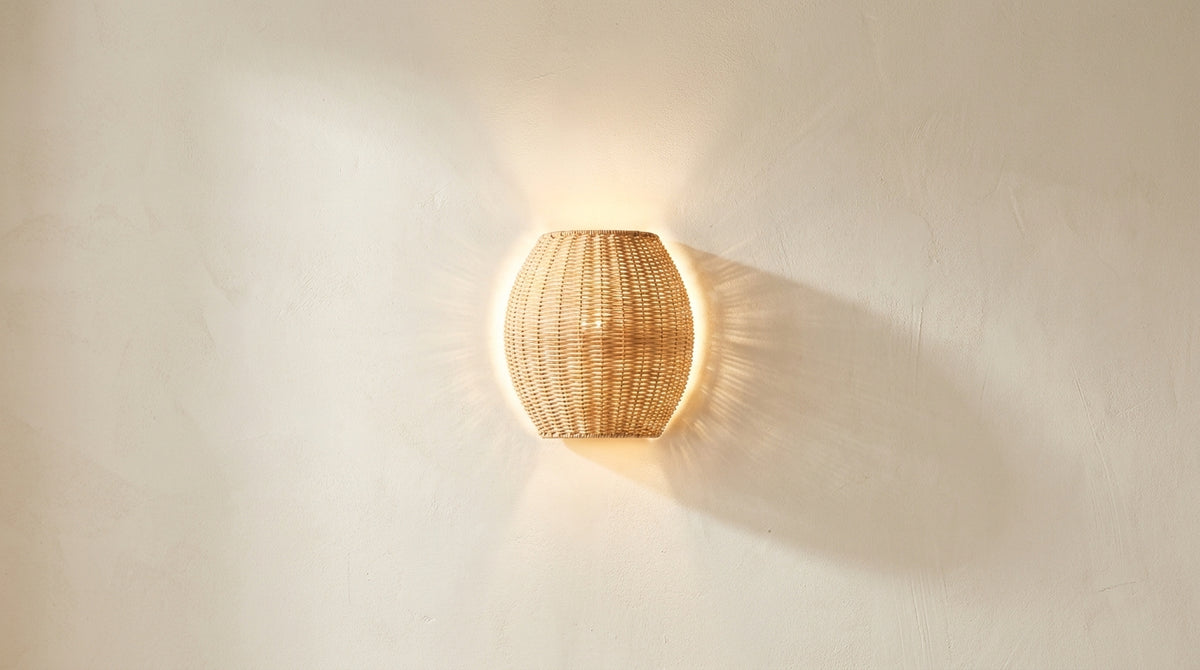
Look for the material before the shape. A boho wall light works when the light passes through it: rattan, wicker, caning or linen diffuse a warm glow and cast a shadow on the wall. An opaque wall light gives light without telling a story.
Rattan, wicker or wood: which material?
- Rattan: tight weave, filtered light, dust with a soft brush
- Wicker: wider mesh, pronounced shadows, keep away from damp rooms
- Wood: clean structure, heavier, a dry cloth is enough
- Linen and cotton: shade washable according to the label, never machine-wash by default
Natural fibres tolerate neither water nor household products: regular dusting with a brush keeps them looking good. Our selection of rattan wall lights brings together the tight weaves, which are easier to live with day to day.
To move away from the purely natural look, wall lights play with sculptural shapes: half-moon, sphere, cloud.
And if you are starting from scratch, the wall light also comes in black metal, useful for a more graphic entrance. Our guide to choosing a boho chic wall light for your living room sets out the material combinations.
How many models and at what budget?
The choice comes down to size more than style. Our range of 1,772 wall light references, surveyed on 4 October 2026, runs from the small bedside model to the large piece for a living room wall. The declared warranty is 5 years on 55% of the survey and 2 years on 45%.
Before you confirm, a look at our Google listing shows buyer reviews, updated continuously.
Boho wall lights: the selection


Which bulb for a boho wall light?
Aim for a filament bulb, usually an E27 socket, around 2700 K. Warm light feeds rattan and wood, whereas a cold white hardens the material and erases the shadow that gives a boho wall light all its charm.
Which socket should you choose?
In our survey of 88 wall lights on 4 October 2026, the sockets break down as follows.
| Socket | Share of the survey | Worth knowing |
|---|---|---|
| E27 | 47% | the widest choice of bulbs |
| GU10 | 19% | narrow beam, adjustable |
| G9 | 14% | small module for a slim wall light |
| E14 | 11% | candle format, compact wall light |
Also check the ingress protection rating: 94% of that same survey is declared IP20, so never above a water point without IP44.
Which colour temperature?
2700 K for a bedroom or a boho living room, 3000 K if the room also serves as an office. Beyond that, the light turns whiter and the weave loses its warmth.
To decide according to the room, our article on choosing between warm and cold light gives the useful benchmarks.
In stock · shipping costs shown at checkout · up to 30% off in your cart
Ready to turn inspiration into reality?
Tell us about your room, your style and your budget, and we will show you the pieces that truly suit your project.
Get guidance in 30 seconds →