Brass ceiling lights: choosing the right light for every room
This article is also available in French: Plafonnier laiton
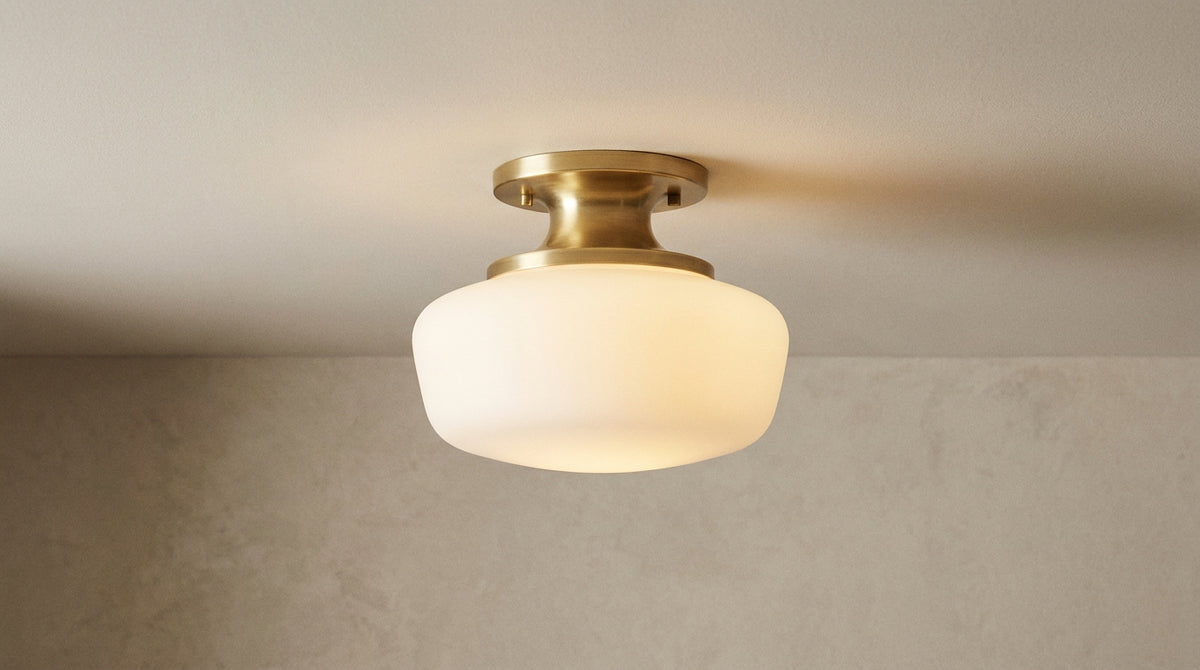
Measure the room before you choose: allow around 100 lumens per square metre in a living room, then check the clearance under the fitting. The rest comes down to the bulb base and the diameter. A brass ceiling light in E27 spreads light widely, a G9 model lights in points.
Which brass ceiling light lights best?
The bulb base matters more than the shape. An E27 spreads light widely and evenly, a G9 lights in points, a GU10 directs its beam. Of 59 brass references recorded in our catalogue on 5 October 2026, 25% have an E27 base, 19% a G9, 17% an LED and 10% a GU10.
Before the base comes the quantity. A living room needs around 100 lumens per square metre, a bedroom 50 to 80, with light at 2700 K to stay warm. Our living room lighting project explains how to spread those lumens between ceiling, walls and reading corners instead of betting everything on a single point.
E27, G9 or GU10: which base to choose?
| Base | Rendering | Where it excels |
|---|---|---|
| E27 | Wide, even output | Living room, bedroom, hallway |
| G9 | Crisp points of light | Corridor, small ceiling light |
| GU10 | Directed beam | An area to highlight |
| Integrated LED | Constant output, nothing to replace | Heavily used room |
Integrated LED accounts for 71% of the survey, which is explained by everyday use: nothing to buy again, nothing to track down. A socket model stays more flexible if you like changing the temperature. In a corridor, a flat LED ceiling light works better than a model with a visible bulb.
Brass ceiling light and opal glass: what effect?
- Opal glass: soft light, bulb hidden, no glare
- Clear glass: visible filament, a deliberate decorative look
- Smoked glass: softened output, a more graphic silhouette
Opal glass produces a steady halo, made for a bedroom or a corridor. Clear glass lets the bulb show and becomes an object in its own right. In the survey of 5 October 2026, 36% of brass references pair brass with glass.
What is the difference between a ceiling light and a chandelier?
A chandelier hangs in the room, a ceiling light stays against the ceiling. The chandelier comes down and becomes a decorative object; the ceiling light spreads light more widely and preserves headroom. In a hallway or corridor, the ceiling light wins. Above a table, the chandelier takes over.
- Ceiling light: fixed to the ceiling, headroom preserved, wide lighting
- Pendant: hangs on an adjustable cable, sits above a table
- Chandelier: several branches, decorative volume, preferably a high room
- Wall light: fixed to the wall, lights without using the ceiling
What are ceiling fittings called?
The generic term is ceiling fitting. Ceiling light refers to the flat or dome model, pendant to the model that hangs, chandelier to the branched model. The confusion comes more from sales vocabulary than from technique. Our article on chandelier or pendant covers each case with the matching height.
Which format for which ceiling height?
Below 2.40 m, a flat or semi-recessed model keeps you from ducking. Above that, you can hang lower. Allow 30 to 40 cm in diameter up to 20 m²: a model that is too small leaves shadow areas that nothing makes up for. For a large room, look instead at chandeliers and large ceiling lights.
Are brass light fittings in fashion?
Yes, and for a simple reason: brass ages well. Where a chrome metal marks every trace, brass develops a patina and keeps its warmth. It suits an old interior as well as a contemporary decor, and its golden light warms a room without darkening it.
The trend covers shapes as much as material. Our article on the 2026 ceiling light trend shows that simple volumes and matt finishes are overtaking elaborate models.
What colour is brass, and which finish to choose?
Raw brass is golden yellow. Watch the words used: gold and brass do not describe the same thing. Of 59 brass references recorded in our catalogue on 5 October 2026, 78% show a gold colour, 47% black and 46% white.
- Brushed brass: fine grain, matt, few fingerprints
- Gilded brass: shiny, reflects light, brings sparkle to a hallway
- Aged brass: deliberate dark patina, suits old wood
- Brass and glass: the material recedes behind the diffuser
Colour temperature matters just as much. 2700 K leans amber and warms the brass, 3000 K stays neutral. The comparison warm or cool light helps you decide depending on the room.
How to spot fake brass?
Weight and edges give the diagnosis. Solid brass is heavy in the hand; painted gold metal is light and leaves a pale line on the edges. Our guide to recognising fake brass details the points to check.
Which brass ceiling light for each room?
The room decides the format. A living room needs 30 to 40 cm in diameter in E27, a hallway a compact model, a bathroom an IP44 rating minimum. Of 59 brass references recorded in our catalogue on 5 October 2026, 93% are IP20 and 7% IP44.
Living room and bedroom: what size and what height?
A ceiling light alone creates a central point and leaves the corners dark. Add a floor lamp or a wall light. Our living room ceiling light selection brings together the formats that cover a room up to 20 m². In a bedroom, aim smaller and warmer.
Brass ceiling light in the bathroom: the IP rating not to miss
In a bathroom, the protection rating governs everything. IP20 is suitable away from wet areas, IP44 resists splashes and becomes necessary near the basin or the shower. Unprotected brass oxidises over time. Our brass wall lights complete a discreet ceiling light.
And if the ceiling light is not enough?
A ceiling light illuminates, it does not create atmosphere. Three sources switched on separately transform a room more reliably than a more powerful fitting.
- Floor lamp in the reading corner, for low light
- Wall light at hand height
- Table lamp on a low piece of furniture
A floor lamp in the corner and a wall light often suffice to rebalance a living room that is too dark at the ends.
If you are unsure about the finish or the base, let us settle it: describe your room and the light you want, and we will reply with the matching references.
Brass ceiling lights: the selection to compare


How to fix and wire a brass ceiling light?
Switch off the breaker, locate the DCL box on the ceiling, screw the bracket onto the two anchor points provided. A brass ceiling light is often heavier than a plastic model: keep the plugs supplied and never hang the fitting from its cable.
DCL box or direct fixing?
The DCL box, that round base on the ceiling, is fitted in most recent homes: three wires, a cover to screw on. On an older building without a box, fixing is done directly into the fitting's bracket. The connection stays the same: live, neutral, earth. Our guide to wiring a ceiling light sets out the diagram step by step.
Semi-recessed or surface-mounted?
A semi-recessed model sits up in the box and gains a few centimetres of headroom. Surface-mounted, it stays visible but comes off without tools, which makes a future replacement easier. In a low corridor, the semi-recessed model makes the difference.
For commercial premises rather than a home, the scale changes: several points, separate circuits, overall costing. The professional area groups these projects.
Buyers comment on what they receive, and their public feedback appears on the Designix Google listing.
On the same subject
In stock · shipping costs shown at checkout · up to 30% off in your cart


Ready to turn inspiration into reality?
Tell us about your room, your style and your budget, and we will show you the pieces that truly suit your project.
Get guidance in 30 seconds →