Baby night light: which light for peaceful nights
This article is also available in French: Meilleur veilleuse pour bebe
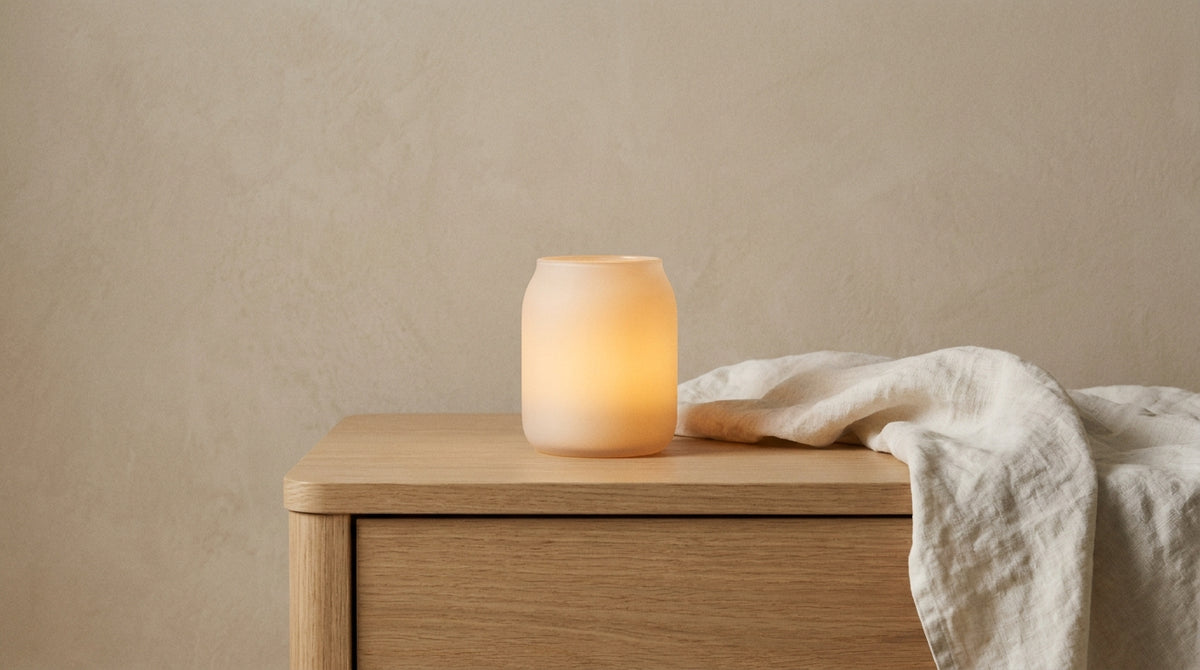
Set the night light to an amber light between 2200 and 2700 K, turn the intensity down to the lowest level that still lets you make out your baby's face, and place it below the level of the mattress, out of reach of little hands. You want to see without waking, and never shine light directly into the eyes.
How to choose a baby night light: the 3-measurement method
Three measurements decide the rest: colour temperature, minimum intensity, and mounting height. Aim for 2200 to 2700 K, an intensity that goes low enough not to wake your baby, and a light source placed below your baby's eye level. Shape, material and bulb fitting come afterwards.
A useful reference point: our collection of night lights for the baby's room brings together 562 references as of 30 September 2026, which you can browse product by product. Enough to compare a wall light, a table lamp and a projector without changing shop.
What light intensity for a night light?
Intensity matters more than the stated wattage. A good night light goes down to the equivalent of a candle at one metre, then comes back up for the 3 a.m. feed. The test is simple: if you can make out the colours in the room, it is already too bright.
- Dimming: look for a true dimmer, not a two-position switch
- Lowest level: the lowest setting must stay steady, without flickering
- Button: you can find it by touch, without lighting up the room
- Memory: the night light should return to its last setting after a power cut
To go further room by room, our lighting advice room by room details the right level for each use.
At what height should you place the night light so it does not dazzle your baby?
Below the line of sight, never in line with the cot. A low piece of furniture between 40 and 60 cm from the floor, facing the wall or downwards, is enough. From the mattress, your baby sees a glow, not the source.
| Measurement | Reference | What it changes |
|---|---|---|
| Temperature | 2200 to 2700 K | Little blue light, falling asleep preserved |
| Intensity | Dimming down to the minimum | See without waking |
| Height | Below the level of the cot | No direct glare |
If you are still hesitating between two models, the Designix team answers your questions on height and bulbs before you buy: simply ask an adviser your question.
Should a baby sleep with a night light?
No, not all night at full power. A night light left on continuously keeps a light level that delays falling asleep and creates a habit that is hard to break. Switching it on for nappy changes and feeds, then turning it down to the minimum or switching it off, is enough in most rooms.
From what age is it recommended to use a baby night light?
In the first months, it is mainly for the adult. A newborn wakes up to feed, not to see: light makes no difference to their rhythm, but it helps the parent get up without switching on the room light. Around six months, when nights start to stretch out, it becomes a cue at bedtime.
The criterion is not age, it is how the household sleeps. A room that helps you sleep relies on three things: darkness, quiet, and a light that never goes higher than necessary. These guidelines for choosing a bedroom light that helps you sleep apply as much to the parents' room as to the baby's.
Why no baby night light?
Because a badly set night light does more harm than a dark room. Four situations justify doing without one or unplugging it:
- Glare: source in line with the cot, baby squints on waking
- Cool white: above 4000 K, the brain receives a daytime signal
- Habit: the child can no longer fall asleep without it
- Stimulation: an animated projection catches the eye instead of letting it relax
Which colour of night light helps baby sleep?
Amber or red, between 2200 and 2700 K. These shades contain very little blue, the wavelength that holds back melatonin. Cool white, even at low power, sends the brain a morning signal. Below 2000 K, you go into a deep red, which is less easy to see by when changing a nappy.
Which light for a baby night light: amber, red or white?
| Shade | Temperature | Use | Limitation |
|---|---|---|---|
| Amber | 2200 to 2700 K | Feeds, nappy changes, checking on baby | Little contrast |
| Red | 1800 to 2200 K | Night waking, settling back to sleep | Tiring to read by |
| Warm white | 2700 to 3000 K | Morning waking, play | Too stimulating at night |
The choice between white or yellow light comes up mainly for the room's general lighting, not for the night light itself.
Best red-light baby night light: what it really changes
It changes one specific thing: settling back to sleep. Under red light, you get up, reassure, settle your baby back down, without the brain receiving the morning signal. It does not make your baby calmer, and it has no effect on colic or teething.
Its limitation is practical: colours are hard to tell apart. To change a nappy or check for redness, an amber light at 2200 K is more comfortable. How blue light works explains why these shades behave so differently at night.
Which type of night light should you choose?
The type is chosen based on what you do at night, not on the product page. Feeding: a table lamp near the armchair. Nappy change: a fixed source that lights the changing area. Settling back to sleep: a soft projection on the ceiling. Power: the plug-in version avoids a flat battery at 3 a.m.
On the bulb side, the range is mostly standard: from a sample of 98 references in our collection as of 30 September 2026, 55% state an E27 fitting against 9% with E14. A large fitting gives you more choice for switching to a very low-intensity bulb.
Best breastfeeding night light: place it where you get up
Breastfeeding happens standing up, in the dark, with one hand occupied. The night light should therefore be within arm's reach from the armchair, set before you sit down, and facing the floor. A plug-in night light stays on at a very low level all night, with no button to look for.
Best ceiling-projection baby night light: what it brings
It moves the source out of the field of vision: instead of a lamp in line with the cot, the light arrives diffuse from the ceiling. Your baby sees shapes, not a bulb. It is the most effective solution for settling back to sleep without switching on a light, provided you choose a slow projection in a single colour.
The same principle of ceiling projection is available for adult bedrooms, with more graphic patterns.
Best musical baby night light: useful or too much?
Useful if the music replaces a lullaby, unnecessary if it is added to an already long routine. Two things to watch: the starting volume must be very low, and the timer must cut the sound without cutting the light. A night light that switches off completely wakes the child who was falling asleep.
On this point, plug-in night lights keep the light on when the sound stops.
Which night light for your baby, depending on your situation?
Best night light for a 2-year-old and a 3-year-old: what changes
Between 2 and 3 years old, it is not the light that changes, it is the hand holding it. At 2, everything becomes an object to handle: the night light must be able to fall. At 3, the child wants to choose their colour and switch it on themselves. The need for light decreases, the need for reassurance remains.
Best night light for a 2-year-old
- Unbreakable: no glass within reach of the bed
- Hidden cable: cord out of reach or battery operation
- Cool surface: a low-power LED does not heat up
- Single button: no sequence to remember
Best night light for a 3-year-old
It becomes a bedroom object, not just a tool. Ball shape, metal or glass material, white or black colour: from the sample of 98 references in our collection as of 30 September 2026, 59% state a 2-year warranty and 41% a 5-year warranty. A criterion that matters when the object is handled every evening.
A light that follows the child's tastes is better than a model bought twice. Evolving lights for a child's bedroom follow this logic: the light changes with age, the fixing stays.
Where to place the night light in the baby's room?
Below eye level, never facing the cot. A wall light between 60 and 80 cm from the floor, a table lamp on a bedside unit at mattress height, or a free socket near the armchair. The beam lights the floor or a wall, and your baby's face stays in the shade.
- Wall-mounted: the wall light frees up the top of the furniture and stays out of reach
- Table: on the bedside unit, facing the wall
- Floor: a low model that never crosses the cot
- Portable: to take into the hallway for night wakings
The position is decided at the same time as the rest of the room: you place the light points, and each bedroom light, before the furniture.
One last reference point before you settle on a model: customer reviews are visible on Designix's Google listing.
Soft lights for the baby's room


In stock · shipping costs shown at checkout · up to 30% off in your cart


Ready to turn inspiration into reality?
Tell us about your room, your style and your budget, and we will show you the pieces that truly suit your project.
Get guidance in 30 seconds →