Plug-in night light: choosing the right one for each room
This article is also available in French: Veilleuse a brancher
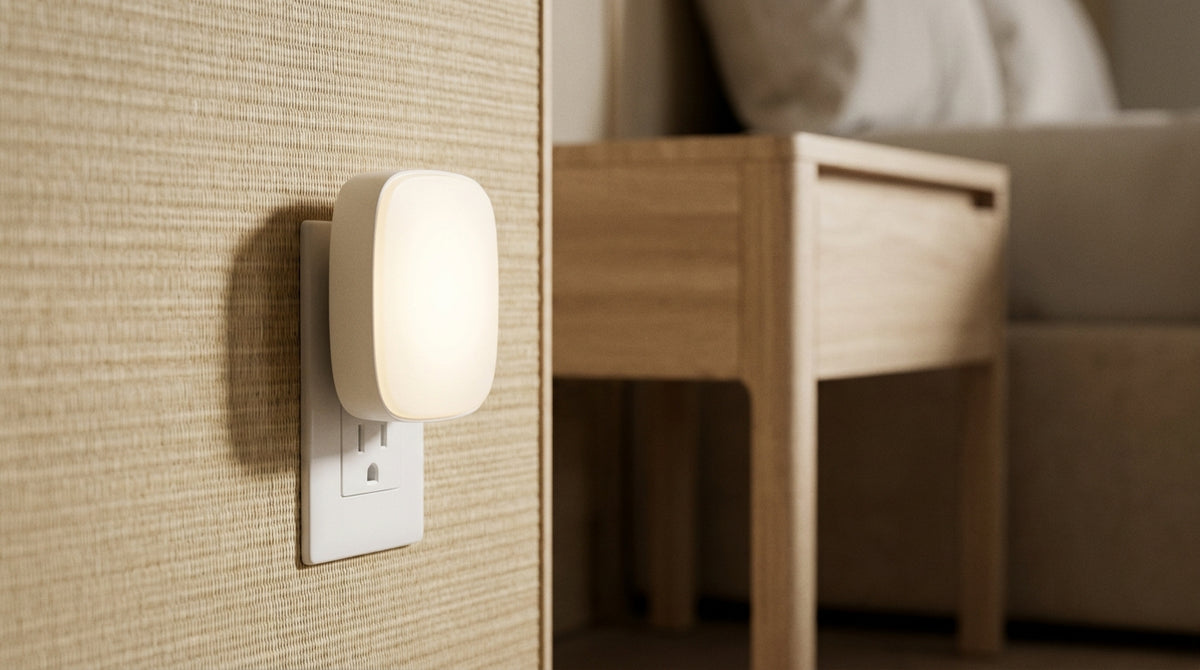
Plug the night light into a wall socket: the bedside table stays clear and no cable trails on the floor. Aim for 2,700 K, adjustable brightness and a dusk sensor if the room is used at night. A night light is chosen with the same criteria as a wall light.
What is the night light that plugs into an electrical socket?
A plug-in night light is a low-power fixture powered directly by the mains, with no battery or rechargeable cell. It sits on a table, on the floor or on the wall, and switches on via a switch, a dimmer or a sensor. Nothing to recharge, nothing to hunt for in the dark.
Mains plug-in night light: what sets it apart from an accent lamp
The difference shows at waking: a night light is bright enough to find your bearings, never enough to break sleep. An accent lamp, on the other hand, is designed to be seen switched on.
| Criterion | Plug-in night light | Rechargeable night light | Accent lamp |
|---|---|---|---|
| Power supply | Mains, continuous | Battery to recharge | Mains, occasional use |
| Power | A few watts | A few watts | Higher |
| Brightness | Adjustable, down to a faint glow | Adjustable | Generally fixed |
| Typical use | All night | Moving around, naps | Reading, ambience |
- 2,700 K for the tint, the most restful at the end of the day.
- Dimmer to go down to a simple guiding glow.
- Dusk sensor to switch on in the evening and off in the morning.
- Low power to mark out a hallway without waking anyone.
A well-chosen night light goes unnoticed when switched off. Treated as a designer light fixture, it echoes the material and tint of the rest of the room instead of adding one more object.
Plug-in night light: no-work plugging in
A wall socket is enough: no drilling, no cable to run, no work on the electrical panel. That is what makes it so easy to install, whether renting or in a guest bedroom.
- Accessible socket: check it stays clear once the bed is in place.
- Switch on the cord: handy when the socket is behind a piece of furniture.
- Switched socket: a wall switch to cut power without bending down.
- No extension lead: one night light alone on its socket, nothing running under the bed.
In a hallway, it pays to group two light points on a single control: the method is explained in our guide to wiring several lamps to one switch.
Then there is the tint. If you are torn between two temperatures, our comparison of white or yellow light shows what changes at bedtime.
Which night light for a baby?
A plug-in night light is suitable from birth, provided it lights low and warm: a guiding glow, never room lighting. Place it out of the bed's line of sight, in a corner, aimed at the wall. The child does not stare at the source and falls back asleep faster.
At what age should a night light go in the bedroom?
From the very first nights, a fixed glow saves switching on the ceiling light for a bottle or a nappy change. Around two or three, when the child gets up alone, the role changes: the night light marks the path to the door instead of lighting the room.
- Before walking: very low light, aimed at the wall.
- Around two years old: automatic switch-on at dusk, nothing to handle.
- Shared bedroom: a single source for two beds, otherwise the glows answer each other.
- Night waking: floor-level sensor, switch-on halfway.
Shape matters as much as brightness, and our guide to choosing a baby night light reviews the models suited to each age.
Which night light colour for sleeping?
Warm white, around 2,700 K, remains the safe bet: it contains very little blue, the component that delays falling asleep. An amber or slightly rosy glow also works. A blue or cool white night light works against sleep.
- Warm white: clear guiding light, without harshness.
- Amber: the least stimulating, suited to night waking.
- Dimmer: a genuinely low brightness matters more than the tint.
- Blue and cool white: to be avoided in a bedroom.
On the wall, a baby bedroom wall light replaces the freestanding night light and completely frees the shelf.
Where will the night light be used first?
Which night light to choose room by room?
A bedroom night light lights the floor, a hallway night light lights the passage, an adult's night light lights a hand or a page. Mounting height matters more than power: the lower and more grazing the source, the less it wakes.
Plug-in night light for children: bedroom, hallway, landing
- Bedroom: source at floor level, aimed at the wall.
- Hallway: hip height, to light the floor without dazzling face-on.
- Landing: motion sensor, the light only follows movement.
- Staircase: two points rather than one, to avoid shadow at the top of the steps.
In a hallway without a well-placed switch, a hallway wall light with a sensor settles the matter without adding a control.
In the bedroom, the source stays below the child's eye line, aimed at the wall and never at the bed.
That is the whole principle of a bedroom light fixture conducive to rest: light the floor, not the room.
Plug-in night light for adults: read, get up, fall back asleep
An adult is not looking for a monitoring light but a passage light: enough to find their glasses or glass of water, not enough to restart wakefulness.
- Reading: beam aimed at the page, never at the sleeper.
- Night waking: sensor at the foot of the bed, switch-on halfway.
- Falling back asleep: minimum brightness, amber tint.
- Hallway: a low source avoids the ceiling light at three in the morning.
On the bedside table, a dimmable bedside lamp does the job of a night light and also serves evening reading.
Set at shoulder height, the same light frees the whole shelf and the hand finds it without searching.
That is the role of an adult bedroom wall light, fixed on the side opposite the sleeper.
In a reading corner, a higher point lights the armchair without touching the bed.
A dimmable floor lamp completes the room and switches off with one gesture.
Does a night light use a lot of electricity?
No. An LED night light draws a few watts, a fraction of what a ceiling light consumes. Three parameters decide the real cost: the power of the source, the number of hours switched on and the presence of a sensor that turns the light off in the morning.
What makes a night light's consumption vary
- Power: in the region of 0.5 to 3 W for a night light LED.
- Duration: eight hours a night, without thinking about it.
- Sensor: automatic switch-off at daybreak, the biggest factor.
- Bulb: an LED replaces a filament bulb with the same base.
The question of the base comes up often: our article on which bulb for a bedroom details the useful temperatures and wattages.
Should the night light be left on all night?
Yes, that is its purpose, provided it stays very low. A night light kept at minimum brightness does not disturb sleep; a source that is too strong delays falling asleep. A dusk sensor or a timer handles the whole night without touching it.
If you are still torn between a plug-in night light and a wall light, the team helps you decide based on the room and the height of your installation: talking to the team takes a few minutes.
In stock · shipping costs shown at checkout · up to 30% off in your cart


Ready to turn inspiration into reality?
Tell us about your room, your style and your budget, and we will show you the pieces that truly suit your project.
Get guidance in 30 seconds →