Plug-in night lights: how to choose, room by room
This article is also available in French: Veilleuse à brancher sur prise électrique
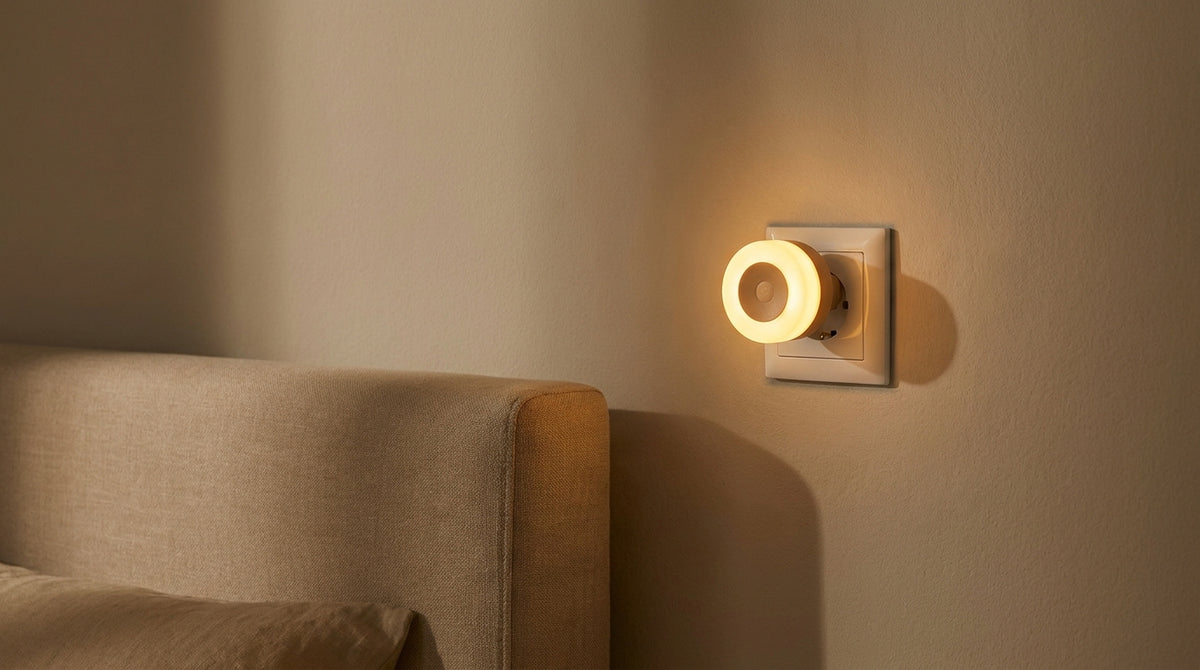
Choose the room before the model. A hallway night light is not chosen like a bedroom one: brightness, colour temperature and ingress protection change with each use. Allow one free wall socket per night light, with no extension lead slipped under the bed.
Plug-in night lights: what are they really for?
They light just enough to find your way without waking anyone. A plug-in night light takes up a free wall socket and gives off a soft, often adjustable light. It makes a hallway usable at night, reassures a child and saves you from switching on the ceiling light to find the switch.
The method comes down to three measurements: the area to cover, the height at which the light falls, and the moment it should come on. Our decor and lighting advice sets out this reading room by room if you prefer to start from the plan rather than the product.
Night light definition: what sets it apart from a supplementary lamp
A night light is a low-power fixture, switched on for long periods, often all night. A supplementary lamp lights a specific activity for a short time. The line is drawn by brightness, not by shape.
Across a sample of 219 references from our catalogue on 28 September 2026, 84% of the sample states an IP20 ingress protection rating: indoors yes, damp rooms no. The same sample carries a 2-year warranty on 89% of the sample and mentions LED on 79% of the sample.
- IP20 for a bedroom, hallway or living room
- IP44 and above for a bathroom
- E14 cap on small formats, E27 on larger ones
- Dimmability stated on only part of the sample: 27% yes, 11% no, across 84 declared product sheets
Dusk sensor, timer: what turns it on without you
Three automatic functions replace the manual gesture. The night light comes on when the room drops below a brightness threshold and switches off when daylight returns.
- Dusk sensor: switches on at nightfall, off at dawn
- Motion detector: for a hallway, entrance or staircase
- Timer: switches off after a set time, useful when falling asleep
- Built-in switch: the simplest for a child to understand
Which night light should you choose, room by room?
Set three criteria according to the room: brightness, colour temperature and ingress protection. A baby's room needs few lumens and a very warm light. A hallway can take a motion detector. A bathroom requires a high ingress protection rating.
Which night light for a baby in the bedroom?
Aim for the minimum useful light, directed at the wall and never at the bed. The goal is not to light the room but to allow a nappy change or a bottle without fully waking.
The choice narrows once you start from the use: our baby night light selection details the formats that fit on a low socket without dazzling.
For the wall rather than the socket, wall lights for a baby's room are fitted at mattress height and free up floor space.
Night light for hallway, staircase and toilet
Here, the light should guide your feet without lighting the room. A model with a motion detector does the job on its own and switches off behind you.
In a narrow hallway, hallway wall lights shine downwards and avoid a bright patch on the ceiling.
For a staircase, two low points are better than one high point: staircase wall lights let you find your way without lighting the step. In the toilet, a lighting idea for the toilet often comes down to a single source placed low.
Night light for an adult bedroom and bathroom
In adulthood, the night light becomes a low dimmable point: enough light to read a page, little enough not to wake the other person.
LED bedside lamps often replace the night light, provided you can dim them very low.
The detail that changes everything in a bedroom comes down to height: a source placed below mattress level never lights the face.
In the bathroom, the rule changes. Humidity decides: a well-protected bathroom light is chosen on its IP rating, never on its looks.
| Room | Decisive criterion | To avoid |
|---|---|---|
| Baby's room | Low brightness, warm light, directed at the wall | A source pointed at the bed |
| Hallway and staircase | Motion detector, IP20 is enough | Cold white in the middle of the night |
| Toilet | Compact format, instant switch-on | A bright point in your line of sight |
| Adult bedroom | Dimmable, E14 cap | Fixed power that is too high |
| Bathroom | IP44 minimum | A socket within reach of splashes |
Unsure between two formats for the same room? Describe your room and we will point you to the right model, rather than the best seller.
Night lights, supplementary lamps and plug-in wall lights


Is it good to sleep with a night light on?
For an adult, even a weak source late at night can delay falling asleep and fragment sleep. For a child who wakes up, a well-adjusted night light reassures more than it disturbs. The right question is not yes or no: it is how bright, what colour, and for how long.
A home that helps you sleep is built on clear contrasts: a dark room at bedtime, a low point for night-time waking, bright light in the morning.
What colour of night light is best for sleeping?
A warm light, between 2200 K and 2700 K, amber or orange. Cold white and blue hold back melatonin and delay falling asleep. The more the colour leans towards red, the more neutral it stays for sleep. Our white or yellow light comparison explains what colour temperature changes in how a room feels.
Until what age should you use a night light?
There is no set age to stop. You remove the night light when the child crosses the hallway alone and reaches the switch without hesitating. Many families keep it until the child starts school, then move it to the hallway or the toilet.
Where does the night light need to watch over your home?
Can you plug a night light into any socket?
Yes, as long as the socket is free, powered and the circuit is not already loaded. An LED night light uses a few watts, far below the limit of a socket circuit. The real risk is not the night light alone, it is piling devices onto the same circuit.
The cap matters as much as the socket, and it is the most common buying mistake. Our guide to bulb types and caps saves you that detour via a returned parcel.
How do you wire a switch from a socket?
You tap the supply from the socket: the live wire goes through the switch, the neutral goes straight to the light, the earth follows the same path. The tap is made with the power off and the consumer unit identified. If the circuit is already loaded or the consumer unit is unclear, call an electrician.
Another route, with no tapping: fitting a wall light without an electrician remains the most direct solution, since you use the existing socket.
Free socket, switched socket, extension lead: what changes
- Free socket: the night light comes on with its own button
- Switched socket: a wall switch controls the socket, handy for a child
- Extension lead: acceptable if the total stays low, never under a bed or behind a curtain
For small formats, E14 cap bulbs cover most needs without changing the fixture.
And if the room has no ceiling point, a plug-in night light is often the only way to light a room without a ceiling light without touching the consumer unit.
In stock · shipping costs shown at checkout · up to 30% off in your cart


Ready to turn inspiration into reality?
Tell us about your room, your style and your budget, and we will show you the pieces that truly suit your project.
Get guidance in 30 seconds →