Authentic Muller chandelier: 5 signs that reveal a copy
This article is also available in French: Lustre Muller authentique : 5 signes qui trahissent une copie
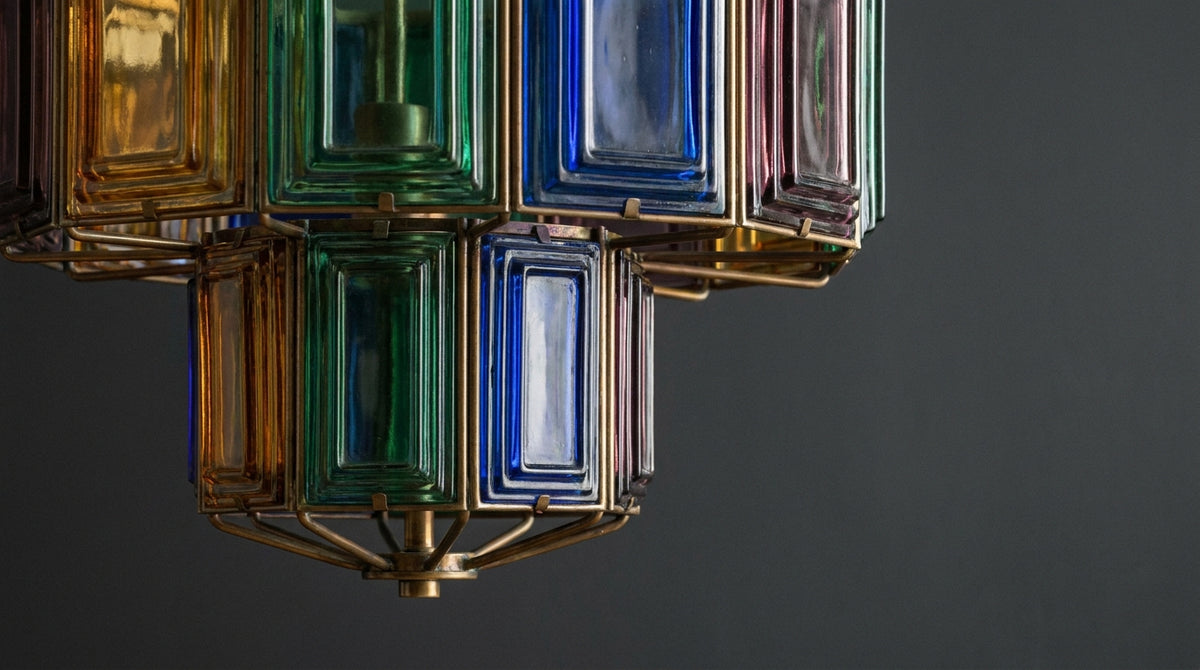
Turn the piece over, light the base at a grazing angle, then look at the edge of the glass against the light. Three checks are enough to rule out a copy: a signature engraved or moulded into the mass, a fine and nuanced pâte de verre, and a mount whose drill holes line up. If any one of the three is missing, the object is not period.
What are the 5 signs that betray a copy?
Five markers are read in order: the signature, the pâte de verre, the consistency of the mount, the weight when held and what you find under the base. An authentic Muller chandelier passes at least four. A counterfeit always fails two.
The signature: engraved or moulded, never painted
A signature in brush or marker on Muller glass should stop you short. On Lunéville pieces, the mark is taken into the material or traced with a wheel, with an irregular line that follows the worker's hand. It is the quickest sign to settle.
A chandelier is also judged in its future space: a living room lighting project is thought through before purchase, ceiling height included.
The pâte de verre: fine, nuanced in depth
Against the light, true pâte de verre shows gradients that sink into the mass, a thin edge and no opaque bubbles. Industrial pressed glass stays flat, of a uniform shade, with thick edges.
The reasoning holds for other old materials, and the 5 tests that settle a salt lamp start from the same logic: the material speaks before the brand.
The mount: drill holes, patina, weight
A period mount has its holes aligned, its even patina and its original screws. A copy shows misaligned drill holes, metal that is too shiny or visible solder joints under the arms. Hold the object: an old one feels heavy for its size.
The same examination applies to a new chandelier: balance of the arms, thickness of the glass, regularity of the finish.
How to spot a fake Muller Frères signature?
Look under the base, on the rim of the bulb holder or on a glass tail. The authentic signature is taken into the mass or engraved with a wheel. A painted inscription, too sharp, or placed on thick glass betrays a copy, even an old one.
Where is the signature on a chandelier?
Never on top, almost always underneath. It is found under the base of a bowl, on the edge of a wall element or on the small bulb holder that receives the socket. A torch and a magnifying glass often bring it out of an old patina.
Erased signature, rematched mount: the borderline cases
Too harsh a cleaning has wiped out more than one wheel engraving. The material and the mount then take over, because pâte de verre cannot be remade. Same reasoning for identifying a genuine Pipistrello lamp: it is the manufacturing details that decide.
What the Lunéville mention changes
It is what moves an object from regional glassware to signed piece. A legible Muller Frères Lunéville signature taken into the mass already ticks two of the five boxes. Without the mention, the piece remains plausible, but it calls for one more examination.
How do you know if a chandelier is valuable?
Three elements decide: the authenticity of the signature, the condition of the glass and the completeness of the mount. A signed, whole piece with no chips is worth far more than a rare piece reassembled with heterogeneous elements.
What raises or lowers it
- The signature complete, legible, taken into the mass
- The glass with no chip, no missing part, no visible repair
- The mount original, with its arms, its screws and its patina
- The completeness rate compared with the original piece
Gilding weighs just as much: unmasking a fake bronze or brass chandelier often comes down to how the patina formed under the arms.
The case of old aftercasting
A period aftercast is not a counterfeit: it is a piece cast from an original, sometimes in the same workshop. It keeps the pâte de verre and the proportions, but the signature is absent or shallow. Its value remains real, below that of a signed piece.
To place an object on this scale, knowing the value of a chandelier means cross-referencing condition, signature and the local market.
One detail is sometimes enough to tip the estimate: what gives an antique its value often comes down to an original screw or a missing starter cover.
If you like the piece but the signature remains doubtful, better to get an opinion before paying: asking for advice before buying costs less than regret.
And to judge for yourself, our visitors' public reviews remain available on our Google listing.
Do you need a Muller chandelier to create this look at home?
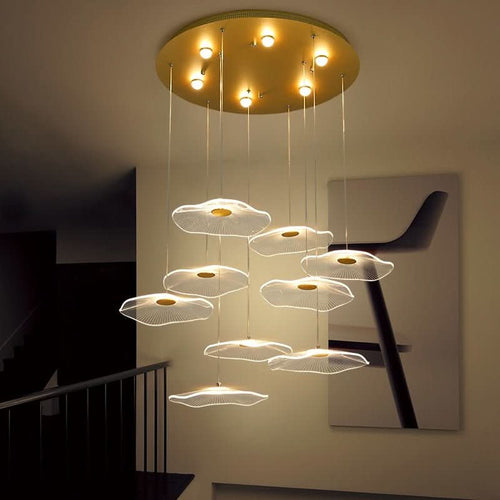
No. The effect comes from the composition: several sources at different heights, warm light, a central point that hangs low. A well-chosen contemporary piece gives the same presence as an old one, without the uncertainty of authenticity.
What height between the bottom of the chandelier and the table?
Allow 75 to 85 cm between the bottom of the piece and the tabletop. Above a kitchen island, stay around 75 cm, never at eye level. A dining room chandelier is chosen on this height, not on the diameter shown in the photo.
And under a high ceiling?
Beyond three metres, a medium-sized piece floats and loses its presence. A wider span makes up the difference, and the large chandelier collection counts 126 references as of 4 October 2026. The choice of fixing matters just as much: which chandelier with a ceiling rose is decided before drilling.
A chandelier is recognised by its structure: several arms, an axis, a cluster of elements. Telling a chandelier apart from a pendant avoids ordering the wrong silhouette.
The Muller look in a room today: chandeliers and large pendants


Where should your light shine?
How to choose a pendant light without risking a copy?
Look at the material before the style, then the light, then the proportions. A well-finished glass and metal pendant ages better than a piece with light metal, and its rendering is set by the colour temperature of the bulb.
Material and colour temperature
2700 K remains the safe choice in a living room: a warm light that does not turn the glass blue. 3000 K suits a kitchen better. Across a sample of 72 chandelier references in our catalogue as of 4 October 2026, 46% state an E27 socket and 61% metal as the main material.
What changes a room is the number of sources: a large glass light that diffuses at several levels lights better than one powerful central point.
Proportions, and what they say about manufacturing
A chandelier is sized at one third of the table width, half for an island. Too wide, it crushes the room; too small, it disappears. In a bedroom, a compact bedroom chandelier is enough.
The warranty mention says a lot about manufacturing: on the same sample, 63% of references show 2 years and 38% five years. The detail appears on our Designix warranties page.
In stock · shipping costs shown at checkout · up to 30% off in your cart
Ready to turn inspiration into reality?
Tell us about your room, your style and your budget, and we will show you the pieces that truly suit your project.
Get guidance in 30 seconds →