How to tell what a chandelier is worth: the method that settles it
This article is also available in French: Connaître la Valeur d'un Lustre : Le Guide Complet
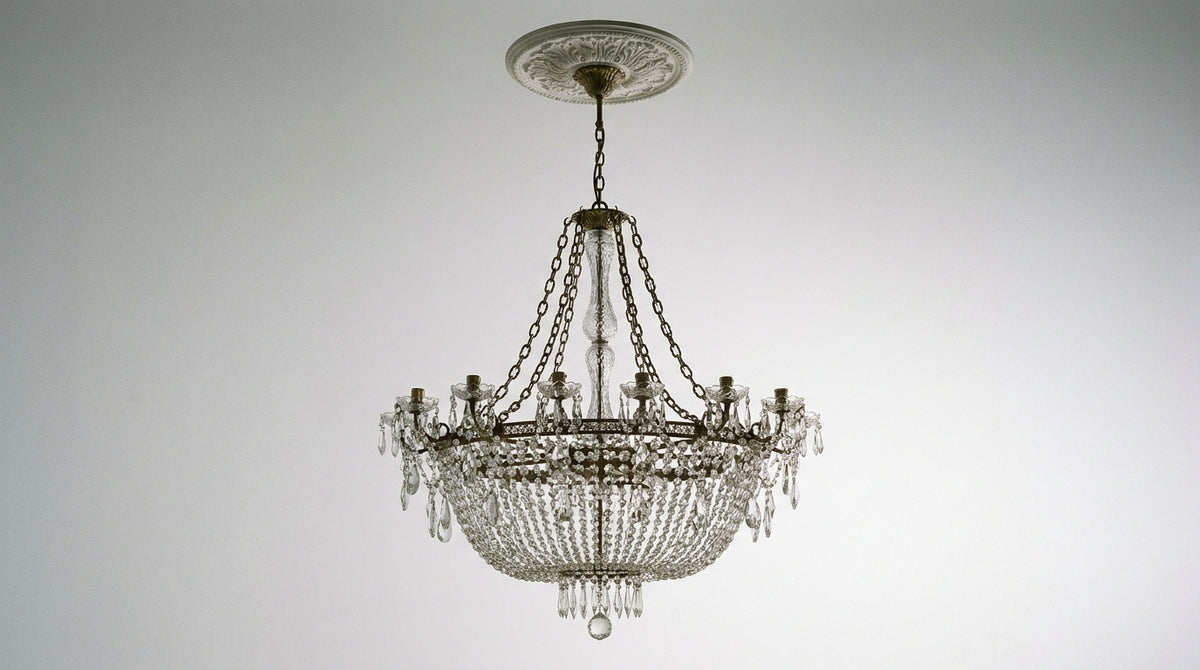
How can you tell whether a chandelier is worth anything?
Three clues are enough to decide: the actual material, the original condition and the consistency of the parts. A solid bronze that has never been repainted, complete with its drops, is worth more than the same model reassembled with arms or drip pans added later.
| Element | Raises the value | Lowers it |
|---|---|---|
| Material | Solid bronze, thick brass | Light alloy, thin sheet metal |
| Gilding | Original, darkened in the recesses | Repolished, chromed, uniform |
| Pieces | Cut, regular, complete | Replaced, mismatched |
| Condition | Patina preserved, wiring modernised | Repainted by brush |
What raises the value
- Consistency: every part dates from the same period.
- Weight: a bronze arm that does not bend under the finger.
- Completeness: drops, drip pans and original chains still present.
- The technical mark: a maker's mark, plate or letter cast into the metal.
An appraisal says what the piece is worth, not what it brings. A well-run lighting project for a living room quickly shows that a badly placed chandelier loses its point, whatever its quality.
Vocabulary matters too. A pendant sold as a chandelier can be spotted by its mounting: a single rod, exposed cable, visible socket. Our guide to telling a chandelier from a pendant lists the points to check before comparing two pieces.
What often lowers it without anyone noticing
- Repainting: an even coat of paint fills the carving and erases the patina.
- Redone gilding: too yellow, too smooth, with no shadow in the recesses.
- Hybrid mounting: old arms screwed onto a recent rod.
- Missing parts, especially replaced by mismatched models.
A tired but consistent model keeps its value. A hastily reassembled one loses it, even if it works perfectly. If replacement becomes the best option, a well-proportioned chandelier for the room does more for everyday life than a costly repair.
How do you appraise an antique chandelier, step by step?
Work in this order: switch off the power, turn a drop over to read its edge, look for a maker's mark behind the canopy, photograph the marks, then weigh an arm in your hand. Ten minutes are enough to build a reliable record, material, gilding, completeness, likely period, that will serve as the basis for any discussion.
Reading the maker's marks, plates and recessed stamps
A struck maker's mark, an engraved plate or a cast mark is worth more than a stuck-on label. Also look for serial numbers and isolated letters, often hidden behind the canopy or under a drip pan. Our signs of an authentic chandelier detail these locations one by one.
Date it by technique, not by intuition
The wiring and sockets give a more reliable range than the perceived style: fabric sheath, bakelite and thermoset plastic follow one another over time. Then compare your piece with documented models. The large chandelier collection holds 126 references as of 5 October 2026, enough to place a format or a proportion.
How can you tell whether a bronze chandelier is worth anything?
Bronze is judged by weight, sound and grain. A solid casting does not move under the hand and rings dull, while a light alloy vibrates. Old gilding darkens in the recesses and stays bright on the edges. At equal model, a heavy, complete bronze opens a clear gap with gilded sheet metal.
Original or repolished gilding: what the colour tells you
Period gilding shows differences in tone between reliefs and backgrounds. Repolished, it becomes uniform and shiny enough to erase the modelling. This is often the first clue that gives away fake bronze or brass chandeliers, even before the structure is examined.
In a survey of 72 references from the Grand Lustre collection as of 5 October 2026, 51% of the listings declare a gilded finish. If you want that tone for a current interior, the gold lighting selection gives a similar effect without going through an antique bronze.
Crystal, glass and metal: what the material changes
Crystal is judged by the regularity of the cuts and its clarity, never by the number of drops. In the same survey of 72 listings as of 5 October 2026, 61% declare metal, 29% glass and 25% steel. The mounting is suspended in 93% of cases and the E27 base in 46%, two constants that make it easy to reuse an old fixture: same bulbs, same hanging point. Compare the glass fixture parts to get a look close to antique crystal.
Chandeliers and large pendants from the collection


Should you restore it before appraising it?
No, never before the appraisal. Clean it, test it, make the wiring safe, then get a valuation. A full restoration, redone gilding or recast parts, often costs more than it adds and loses the sought-after patina. Preserve first, decide afterwards.
What can be put right without losing value
- Wiring and sockets: replace for safety, without touching the structure.
- Gentle cleaning: warm water and microfibre, no abrasive or solvent.
- Hardware: modernised screws, wall plugs and canopy, invisible once fitted.
- Hanging height: chain adjusted to the room, without cutting the original.
These are maintenance steps, not transformation. Our guide to caring for a chandelier without damaging it details the products to avoid, material by material.
What costs more than it brings in
Gilding redone by electrolysis, recut drops, a full repaint: three interventions that lower the value instead of supporting it. A simple makeover of a metal chandelier is often enough to change a piece's look without erasing its materiality.
On the removal and refitting side, the constraints are measured on site: weight of the canopy, type of ceiling, access to the light point. Our trade space for installers gathers the useful information when an electrician has to approve the refitting.
When the appraisal no longer justifies restoration, the comparison is made piece by piece: describe your ceiling and your style from the contact page, and the answer comes back with precise references.
Which fixture should replace your chandelier?
Look at the room before the style. Above a table, the fixture must stay within the width of the furniture and leave enough clearance not to get in the way of the eye. In a bedroom or hallway, a lower line and a contained diameter work better. Our guide to choosing a chandelier at the right dimensions gives the height and diameter references.
Colour temperature changes the result as much as the shape. A 2700 K warms gilding and crystal, where a 3000 K leans towards white. In the survey of 72 listings, the IP20 rating is declared everywhere: perfect for a living room or dining room, to be avoided in a damp room.
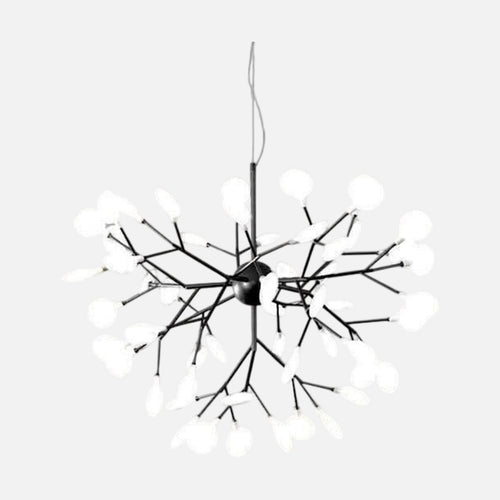
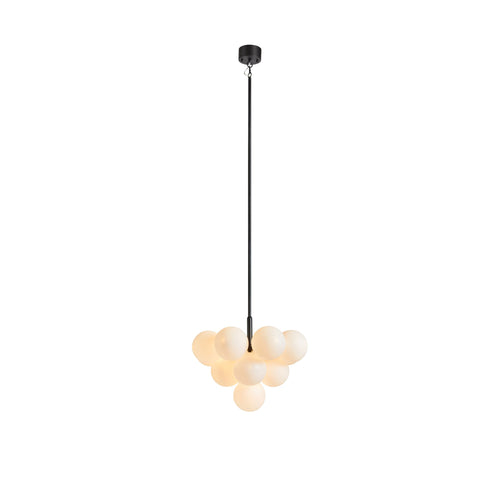
For a large table, the dining room chandelier selection covers generous formats.
In a bedroom, a more discreet bedroom chandelier better suits the scale of the room. If height is lacking, a low pendant plays the same role without taking up the volume.
When the hesitation persists between keeping and replacing, customer reviews on our Google listing can be checked in one click, with photos of installed pieces.
Your current chandelier leaves a gap: which fixture should take its place?
On the same subject
In stock · shipping costs shown at checkout · up to 30% off in your cart
Ready to turn inspiration into reality?
Tell us about your room, your style and your budget, and we will show you the pieces that truly suit your project.
Get guidance in 30 seconds →