Industrial wall lights: how to choose, room by room
This article is also available in French: Applique murale industrielle : bien la choisir pièce par pièce

The essentials
Choose the socket and the protection rating according to the room: E27 for a visible bulb, G9 or E14 for a compact format, IP20 on a dry wall, IP44 only near a water point. Colour, shape and style come afterwards.
The industrial wall light collection brings together 676 references as of 5 October 2026. That volume explains one simple thing: two wall lights that look alike in a photo can suit two very different walls. On a survey of 111 of these references, 96% are declared IP20 and 91% are wall-mounted. The choice therefore comes down to two or three decisions, not thirty.
Which industrial wall light gives good lighting?
The socket determines the type of light, the protection rating determines whether the wall light is allowed on that wall. E27 for a visible bulb and a wide beam, G9 or E14 for a tight format, IP20 in a dry room, IP44 only near a water point. Power is adjusted last.
If your wall, your height or your electrical supply does not fit any of these cases, you can still describe your wall to the Designix team: they will point you towards the model that works.
Which protection rating for your room?
- IP20: living room, bedroom, dry hallway, the vast majority of interior walls
- IP44: near a washbasin or shower, where water splashes are possible
- IP65: outdoors, terrace, wall exposed to rain
- CE: mentioned on 99% of the survey of 111 references, across 110 listings that declare it
Which socket, and do you need dimming?
| Socket | Share of the survey of 111 | Use |
|---|---|---|
| E27 | 40% | visible bulb, wide beam |
| G9 | 34% | compact format, closed diffuser |
| E14 | 9% | small diameter, accent light |
| GU10 | 8% | directed beam, wall to highlight |
These shares cover the 108 listings in the survey that declare a socket, as of 5 October 2026. Two sockets cover almost three quarters of the surveyed catalogue. A wall lamp with integrated LED does without a bulb, but prevents changing the colour temperature later.
What are the trends for wall lights in 2026?
Black holds the wall: 58% of the survey of 111 references declare it, against 37% for white and 29% for grey. In terms of shapes, square reaches 23% and tube 21%, just ahead of sphere at 20%. Gold remains a minority, at 14%.
Matte black and brushed metal
Matte black absorbs light and lets the wall exist; brushed metal reflects a discreet glow on the edges. Both age better than varnished brass in a busy entrance.
- Black: 58% of the survey, the safest value on a coloured wall
- White: 37%, discreet on plasterboard and light backgrounds
- Grey: 29%, the compromise between the two
- Gold: 14%, best reserved for a wall with little on it
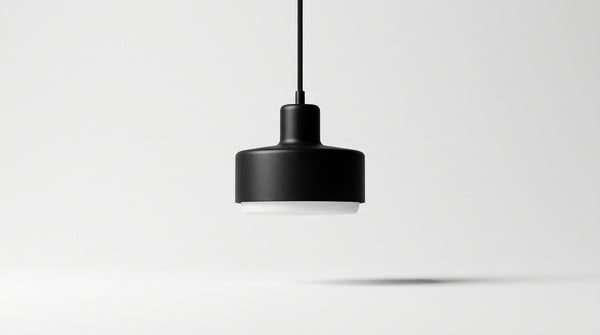
A black wall light needs a visible filament bulb or a G9 socket, otherwise the contrast loses all its point.
Square and tube replace round
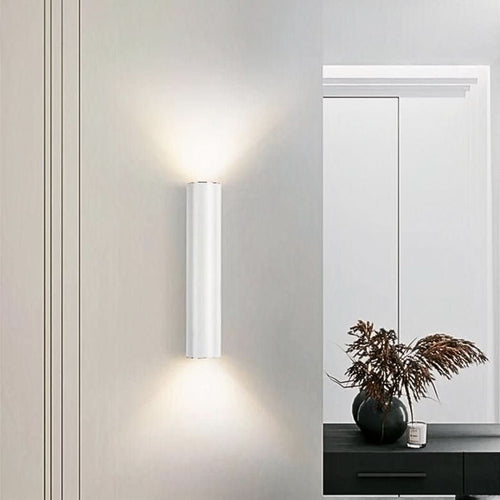
Square gives a clean frame, the tube lengthens the line. On a short wall, the tube gains height without taking up width. On a large surface, two squares are better than one wide model.
These silhouettes are found mainly among wall lights that move away from the classic repertoire.
Which wall light for the living room, bedroom or hallway?
The living room leads the survey of 111 references, cited on 94% of listings, the bedroom on 88%, the hallway on 63% and the dining room on 50%. The same wall light can also serve in several rooms. What changes is the height, the direction of the beam and the free space around the furniture.
Living room and dining room
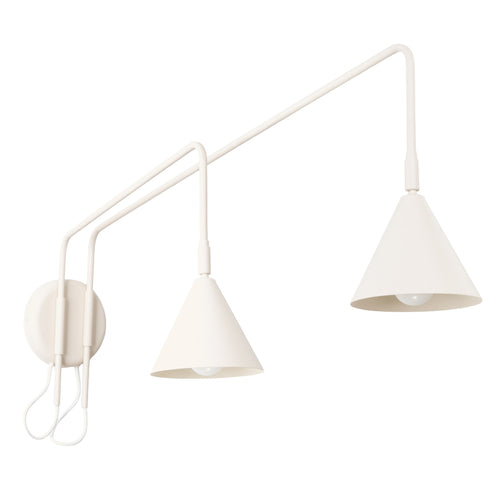
Above a splashback or a sideboard, the wall light replaces the accent lamp and frees up the worktop. An articulated arm directs the light towards the wall when the room is full of people, towards an armchair when you need to read.
The subject connects to subtle wall lighting, where a low wall light is often enough to lift the whole evening mood.
On a full renovation, it is better to plan the whole thing before drilling: a living room lighting project is thought through with the socket, the switch and the furniture. In the bedroom, the models gathered in adult bedroom wall light are mostly adjustable, useful when the bed changes position.
Circulation areas
In a hallway, you do not read: you walk. Aim for a low, wide beam, placed at mid-height, to light the floor without dazzling. A pair, one on each side, is better than a single model in the middle.
- Hallway: 63% of the survey, at least two wall lights beyond three metres
- Entrance: one wall light near the coat rack, out of direct sight
- Staircase: at hand height, never in line with the steps
- Wet room: IP44 mandatory, IP20 to avoid
For a narrow entrance, compact entrance wall lights limit the projection and prevent bumping into the door frame.
Which room do you want to equip first?
Industrial wall lights: the Designix selection


Metal, steel, glass: which material for which wall?
Metal covers 44% of the survey of 111 references, steel 30%, glass 23% and aluminium 18%, across the 111 listings that declare a material as of 5 October 2026. Metal and steel cope with busy rooms, glass is reserved for walls you look at closely.
Metal and steel
These are the most forgiving materials: powder-coated metal does not mark when a shoulder brushes past, painted steel withstands cleaning better than a glossy finish. On a wall light with an exposed bulb, heat rises and the finish must cope with it.
- Powder-coated metal: matte finish, not very sensitive to marks
- Steel: fine structure, suited to large formats
- 5-year warranty: 51% of the survey, against 45% for 2 years and 4% for 3 years
- Wall mounting: 91% of the survey, 5% surface-mounted, 2% suspended
Industrial-style lamps take up this vocabulary of material more than form: the finish makes the difference in use.
Glass, best reserved for walls on show
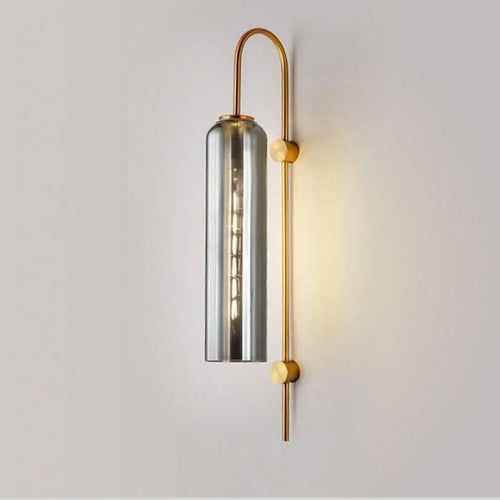
A glass globe or cylinder diffuses more softly and does not create sharp shadows. In return, they require a clean wall and a location away from traffic. It is a choice of accent lighting rather than general lighting.
At what height should an industrial wall light be installed?
Allow around 60 cm above a worktop, around 1.10 m to 1.20 m for a headboard, and at mid-height of the wall in a hallway. These reference points shift if the wall light is adjustable, if the bed is high, or if the electrical supply dictates its position.
In a hallway, the question quickly gets complicated: a hallway wall light is rarely placed at the same level as the neighbouring model when the door opens against the wall. Our wall light height guide details the most common cases.
Above a worktop
The bottom line of the shade must stay above bottles and books standing upright. Too low, it dazzles; too high, it lights nothing.
- 60 cm above the worktop: basic reference point
- Articulated arm: aim towards the wall, not towards the eyes
- Wall switch: at hand height, never above 1.20 m
- Fixing: a wall light without drilling suits recent plasterboard, not a damaged hollow wall
If drilling is not an option, the question of the wall light without drilling comes before the question of style.
At the headboard
Align the bottom of the wall light with the top of the mattress, then offset it to the side opposite the hand that turns the pages. A headboard wall light with an articulated arm avoids having to choose between reading light and ambient light.
In stock · shipping costs shown at checkout · up to 30% off in your cart
Ready to turn inspiration into reality?
Tell us about your room, your style and your budget, and we will show you the pieces that truly suit your project.
Get guidance in 30 seconds →