
Wireless LED bulbs
This selection is also available in our French store: Ampoules LED sans fil
No products in this selection.
- Tracked delivery to your country Tracked delivery
- Secure payment at checkout Multiple payment methods
- 14 days to change your mind 14-day returns
- Secure payment Secure payment
Not sure of your style? Find it in 30 seconds
A few questions, and we will show you the pieces made for you.
Frequently asked questions
How do I choose the right product?
What are the delivery times?
Can I return an item?
Can I pay in instalments?
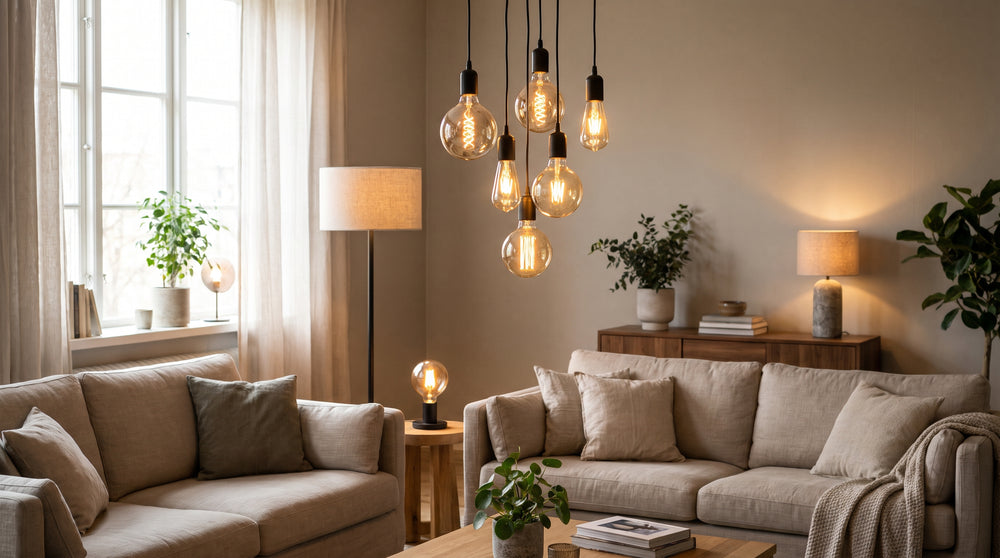
An interior that reflects who you are
Carefully selected pieces, shipped from our warehouses. Our team advises you before you buy, so you choose with confidence.
- Tracked delivery
- Pay in instalments, where available
- 14 days to change your mind
- Advice & showroom in Lyon, France
A wireless light bulb runs on a rechargeable battery and works in any socket, with no plug or wiring. First check the base of your light fitting (E27, E14, G9, GU10), then choose the colour temperature and check the protection rating if the bulb is going outdoors.
The principle is simple: the battery sits in the base, the bulb switches on by button or remote control, then unscrews for recharging. You can move the same light from the living room to the terrace, or light a cupboard that never had a socket. To build the whole set, browse our lighting catalogue and keep in mind that the socket remains the starting point for any choice.
How does a wireless LED light bulb work, with no plug or wiring?
A wireless light bulb carries a rechargeable battery in its base: it works away from any socket and switches on by button, remote control or sensor. It then recharges from the mains or by USB, and goes back into its socket, with no electrician and no work.
Rechargeable wireless LED light bulb: battery, runtime and charging
The battery replaces the mains connection. Depending on the model, charging is done by USB, on a small base or by plugging the bulb back into a dedicated holder. The routine is always the same: unscrew, recharge, screw back in.
Runtime varies from one model to another and depends on the brightness chosen. A bulb used as a night light lasts longer than one used as main lighting. That figure appears on the product sheet, not in a general table: it is the one to read before comparing two references. For daily use, plan a second bulb as backup or a regular recharge, in the evening for example.
Wireless LED light indoors: what can it really light?
Indoors, a wireless bulb gives accent light: reading in an armchair, lighting a sideboard, crossing a hallway to the switch, opening a deep cupboard. It does not replace the main lighting of a room, which needs a continuous supply. For that kind of use, compare with mains 220 V bulbs, more powerful and made to stay in place. A battery bulb is chosen precisely where the cable is missing.
Which wireless LED light should you choose for each room?
In a cupboard or a niche, a flat wireless LED spotlight is enough; near a bed or an armchair, a rechargeable bulb screwed into its socket gives accent light; on a terrace, go for a model protected against water spray. The room decides the format before the style.
Wireless LED spotlight for a cupboard, a niche or a worktop
A flat spotlight slips under a shelf, at the back of a cupboard or above a worktop, and switches on with no visible wire. The decisive criterion is not looks but the thickness of the housing: a model that is too thick blocks the cabinet door or sticks out from the strip. Also check the fixing provided, magnet, adhesive or screw, and the weight it accepts.
Wireless LED lighting with remote control: what is it for?
The remote control serves hard-to-reach areas: the top of a wardrobe, a hallway corner, a high wall light, a spotlight fixed under a low unit. It saves you from contorting to reach a hidden button. Not every model includes one: the product sheet must mention it. For fixed, everyday use with dimming, look instead at dimmable LED bulbs, designed for a standard circuit.
Wireless LED light bulb: which base to choose between E27, E14, G9 and GU10?
The base is imposed by the socket of the fitting: E27 on most living room lamps and pendants, E14 on small fittings and wall lights, GU10 and G9 on spotlights and ceiling lights. Note the existing base before buying, without trusting the apparent size of the bulb.
| Base | Fittings concerned | Point to watch |
|---|---|---|
| E27 | Pendants, living room lamps, ceiling lights, chandeliers | Large screw thread; check the bulb fits inside the shade |
| E14 | Wall lights, small lamps, chandelier candles | Small screw thread; short format often needed |
| GU10 | Spotlights and adjustable ceiling lights | Two short pins; twist to clip in |
| G9 | Small fittings, compact wall lights | Two thin pins; do not force into the socket |
| GU5.3 | Recessed low-voltage spotlights | Longer pins; check the installation voltage |
E27 base: the format of pendants and living room lamps
The large screw thread fits most table lamps, pendants and ceiling lights. It is the base that leaves the most room for a battery, so the one most often found in wireless versions. Before ordering, take a look at the E27 LED bulbs to compare shapes, globe, standard or long, and measure the height available under the shade. A bulb that is too long touches the diffuser and blocks the light downwards.
E14, G9 and GU10: the small bases of spotlights and ceiling lights
On a wall light or a small lamp, it is often an E14, with a finer thread and a short format. Small E14 base bulbs also serve as chandelier candles. The G9, with two thin pins, fits compact fittings and wall lights: see the G9 bulbs for small fittings. The GU10 and GU5.3, with pins, are for adjustable spotlights; the GU5.3 range requires checking the installation voltage, often 12 V. In every case, unscrew the old bulb and read the marking on the socket.
What light does a wireless LED light bulb give: warm white, neutral white or amber?
A 2700 K bulb gives a warm white, close to halogen, suited to the living room and the bedroom; 3000 K stays warm but a little crisper, handy above a worktop. Amber glass or filament warms the look further, without changing the stated temperature.
2700 K or 3000 K: what difference in a living room?
Around 2700 K, the light leans towards soft yellow: the look of a dinner, a read in an armchair, a headboard. Around 3000 K, the white stays warm but gains crispness, which helps tell colours apart on a worktop or a desk. Between the two, the gap is visible side by side, discreet when only one bulb is on. Compare the 2700 K bulbs and the 3000 K bulbs before deciding, and keep the same temperature in a room to avoid two different halos.
Frosted glass, filament or amber tint: what effect on the wall?
Frosted glass diffuses the light without showing the source: handy above a table where people sit. A filament bulb shows the diodes, which warms the mood when the bulb stays visible, in a low pendant for example. The amber tint colours the light and softens the effect on a pale wall. See the filament bulbs, the glass bulbs and the amber bulbs to get an idea of the look. On the technical side, note the kelvin value and check compatibility with a dimmer if your fitting has one.
Rechargeable wireless LED spotlight: where to place it and how to fix it?
A rechargeable wireless LED spotlight is fixed by magnet, adhesive or screw depending on the model, on a unit, under a shelf or in a hallway with no socket. You detach it to recharge it, then put it back: that is what sets it apart from a recessed ceiling spotlight.
The mount matters as much as the spotlight. An adhesive holds on a clean lacquered unit, less well on a textured wall or greasy tiles: degrease before sticking and leave it to set for a day. A screw means drilling, so agreement if the unit is not yours. The magnet suits metal surfaces and lets you detach the spotlight one-handed. Finally, the weight of the housing affects how well it holds over time: a light model holds better under a thin shelf.
Wireless LED spotlight with remote control: settings and range
The remote control lets you switch on, switch off and sometimes adjust brightness without touching the spotlight. It proves useful when the housing is fixed high up or deep in a corner. The range depends on the model and on what separates the control from the spotlight: it is stated on the sheet, to be checked before choosing rather than assumed. To light an entrance or a staircase with no socket, it is the simplest setup.
How do you switch the light on remotely without wires?
With no wiring, switching on goes through a remote control, a motion sensor or a remote switch supplied with the device. The bulb or spotlight must be compatible: check on the sheet that the control is included, because a model without a remote will not be controlled. No Wi-Fi network is needed for this type of control, which sets it apart from connected control. If you are looking for wireless lighting for outdoors, the outdoor bulb selection gathers the protected models.
Wireless bulb, connected bulb or LED strip: which to choose?
A wireless bulb moves and lights without a socket; a connected bulb stays on the mains and is controlled by Wi-Fi; an LED strip is installed continuously under or behind a unit. The decisive criterion is not the technology but whether there is a socket, or not, where you want it.
| Criterion | Wireless LED light bulb | Mains LED bulb | LED strip |
|---|---|---|---|
| Power | Rechargeable battery | Mains, through the socket | Dedicated power supply |
| Installation | No wiring, screws or stands | Requires a powered socket | Sticks on, cut at the marks |
| Movement | Unscrews and moves freely | Stays in its fitting | Fixed once installed |
| Brightness | Limited by the battery | Continuous | Varies with the length |
| Typical use | Backup, accent, outdoors with no socket | Main lighting of a room | Highlighting a unit or a niche |
Wireless LED light bulb or Wi-Fi connected bulb: do not confuse them
A connected bulb screws into a powered socket and is controlled from a phone. Without power, it does nothing. A wireless bulb does without a socket but cannot be controlled by an app. The choice therefore depends on the spot: if a supply exists, take a 220 V bulb or a dimmable bulb; with no supply, the battery bulb remains the only viable option.
Cuttable LED strip: how does it work?
A strip is cut at the marks printed along its length, then connected with a connector or a wire on the remaining end. Never cut outside a mark, or you lose the supply to the following diodes. It needs a dedicated power supply and stays fixed once installed. For a unit or a niche, it is a good complement; for a light you move around, the rechargeable bulb remains more flexible. Find all the references in the bulb range.
How do you install and maintain a wireless LED light bulb day to day?
You screw the bulb into the socket like a classic bulb, switch it on, and unscrew it to recharge when the light dims. A dry cloth is enough for the glass. Outdoors, check the protection rating before leaving it outside and keep the contacts dry.
What to check before buying: base, protection rating, format
Four checks are enough. The socket base, read from the marking. The format, height and diameter, compared with the space available in the shade or the housing. The protection rating, essential if the bulb is to stay outside: an IP44 resists water spray, a bulb with no rating stays indoors. Finally, the charging method and the presence of a remote control if the area is hard to reach. For a low-voltage installation, the 12 V bulb range avoids nasty surprises.
Mistakes to avoid with wireless LED lighting
The first mistake is buying without noting the base: an E27 does not fit an E14 socket, and the exchange costs a delivery. The second is leaving an unprotected bulb outside, or storing the contacts in damp conditions between uses. The third is waiting for failure to think about recharging: unscrew and recharge as soon as the light weakens, and you will not be left in the dark at the wrong moment. A bedside lamp or a hallway with no socket is prepared this way without stress. For main lighting, rely on classic LED bulbs and on bulbs designed for the living room, which offer continuous brightness.
Frequently asked questions
How do you switch the light on remotely without wires?
With no wiring, switching on goes through a remote control, a motion sensor or a remote switch supplied with the device. The bulb or spotlight must be compatible with this control: check on the sheet that the remote control is included. Wi-Fi is not needed for this type of control.
What are the 5 types of bulbs?
The main distinction is the base: E27 with a large screw thread, E14 with a small screw thread, GU10 and GU5.3 with pins for spotlights, G9 with two thin pins for small fittings. Add the shapes, globe, candle or spotlight, and the technologies, notably filament.
How does a cuttable LED strip work?
An LED strip is cut at the marks printed along its length, then connected with a connector or a wire on the remaining end. Never cut outside a mark, or you lose the supply to the following diodes. The total length depends on the power supply provided for the strip.
Rechargeable wireless LED light bulb: how long does it light?
Runtime depends on the battery capacity and the brightness chosen: it is read on the model sheet, there is no single value. A bulb used as a night light lasts longer than one used as main lighting. Plan a second bulb or a regular recharge for daily use.
Can you put a wireless LED light bulb in a chandelier or a ceiling light?
Yes, if the base matches, usually E27 on a chandelier or a ceiling light. The bulb then runs on its battery, without being connected to the room circuit. Check the format and the weight accepted by the socket, as well as the access to unscrew it when recharging.
Wireless LED lighting: what is the difference from a connected bulb?
A connected bulb stays screwed into a powered socket and is controlled by Wi-Fi or Bluetooth. A wireless bulb carries its own battery and lights without a socket, but is not controlled by an app. The choice therefore depends on whether there is a power supply where you want it.
Can a wireless LED light bulb stay outside?
Only if its sheet states a protection rating suited to outdoors, for example IP44 to resist water spray. A model with no protection rating stays indoors. Also avoid leaving the contacts in damp conditions and bring the bulb in for recharging.
How do you choose between several models without getting it wrong?
Photograph the socket, note the intended use and the room, then compare references on just three lines: base, colour temperature, protection rating. This mental sheet avoids back and forth. To widen the comparison, browse all Designix light fittings and cross-check with the E27 filament bulbs if you want a visible look, or the white bulbs for a more neutral light.
One last point: the battery ages. A battery bulb is not a final purchase like a mains bulb, it is replaced when the runtime becomes too short for the use. That is an argument for using it as accent lighting, where it really helps, and for entrusting main lighting to a 12 V bulb or a normally powered E27 base reference.
Reassurance and ordering
Secure payment, tracked delivery, returns and Designix customer service: you order with peace of mind, and the team answers if the base or the protection rating leaves you unsure. Take the time to check your socket before confirming the basket, it is the only point that really blocks an installation.
Taking action
Note the base, choose the colour temperature, check the protection rating if the bulb goes outside. All that is left is to select your reference from the retro bulbs for a warm look, or from the Designix bulb range to compare all the available models.




