
Solar motion sensor outdoor spotlights
This selection is also available in our French store: Spots d exterieur solaires à détecteur de mouvement
No products in this selection.
- Tracked delivery to your country Tracked delivery
- Secure payment at checkout Multiple payment methods
- 14 days to change your mind 14-day returns
- Secure payment Secure payment
Not sure of your style? Find it in 30 seconds
A few questions, and we will show you the pieces made for you.
Frequently asked questions
How do I choose the right light output?
At what height should the light be installed?
What type of bulb?
Compatible with LEDs and dimmers?
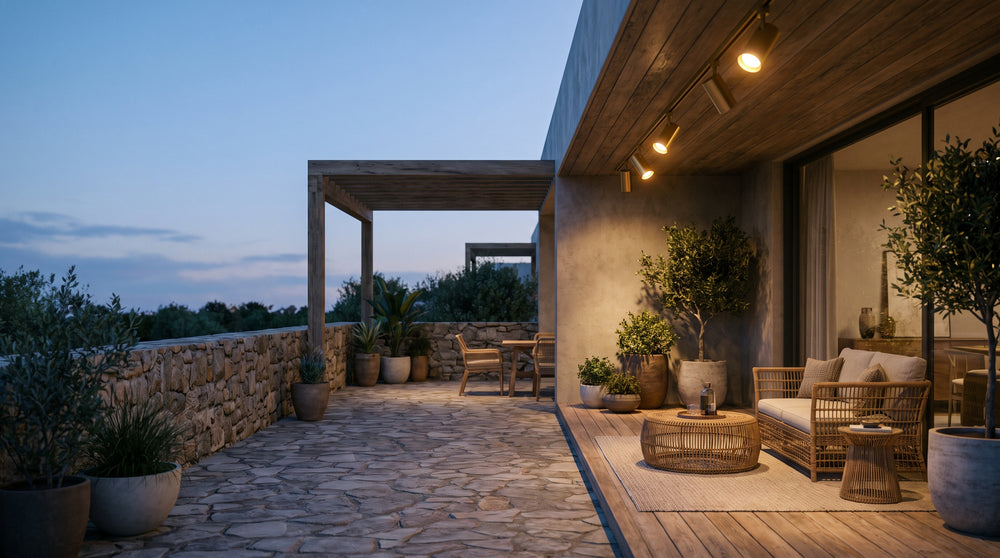
Light changes everything
From statement chandeliers to discreet wall lights, we help you choose the right brightness, height and style for every room.
- Tracked delivery
- Pay in instalments, where available
- 14 days to change your mind
- Advice & showroom in Lyon, France
The right move: angle the panel toward the sun, then aim the spotlight head at the walkway (doorstep, path, pillar) rather than at the door. A solar motion sensor outdoor spotlight installs without mains cabling: the panel recharges the battery during the day, the sensor switches the LED on when someone passes at night.
What is the best outdoor lighting with a solar sensor?
The best outdoor lighting with a solar sensor is the one whose panel stays exposed to the sun and whose beam falls on the walkway: door, path, gate, wall corner. You compare the protection rating, the sensor range, the mounting method and whether the spotlight head can be angled. Finish and design come next, across all our light fittings.
Solar motion sensor outdoor spotlights: four points to check
Panel exposure first: a south-facing wall or an unobstructed roof overhang changes everything, while a spot under foliage rules out recharging. Protection rating next: IP44 is enough under a sheltered canopy, IP65 copes better with driving rain. Then the range and aim of the sensor, set to cover the walkway without picking up the street. Finally the mounting, wall or recessed, in a bracket suited to the panel thickness.
Wide floodlight or spotlight aimed at the walkway?
A wide floodlight lights a surface: a yard, a carport, a broad entrance. A directional spotlight concentrates light on a step, a pillar, a threshold. Compare the spotlights with an adjustable head if you are unsure: the same model shifts from one use to the other depending on the angle you give the head.
| Area to light | Suitable spotlight type | Where to place the panel | Point to watch |
|---|---|---|---|
| Entrance, front door | Spotlight or wall light aimed at the threshold | Wall above the walkway, clear to the south | Glare on the door: aim at the ground |
| Garden path | Directional spotlight, adjustable head | Post or wall with no hedge shadow | The sensor must cover the full width of the path |
| Facade and wall corner | Floodlight or recessed spotlight under an overhang | Roof overhang or remote panel | High protection rating if rain hits the wall |
| Covered terrace, canopy | Recessed spotlight or wall light | Remote panel if the ceiling is shaded | Mounting and sealing of the drilled hole |
| Carport, car shelter | Wide floodlight with sensor | Shelter roof | Triggers caused by passing vehicles |
| Gate, small gate | Adjustable spotlight fixed to a pillar | Exposed pillar, no foliage masking | Sensitivity set so it does not stay on |
What is the best outdoor solar light?
The best outdoor solar light is a directional LED light, white enough to read a face and a step, without glaring onto the front door. A warm white suits facades and terrace edges, a more neutral white suits paths and circulation areas. The panel must stay clear all year round.
Warm white on a facade, neutral white on a path?
As a general guide, warm white sits around 2,700 to 3,000 kelvins, neutral white around 4,000 kelvins. Warm white brings out the stone and wood of a facade, neutral white makes steps and gravel easier to read. What matters most is matching the rest of the lighting: two different tones on the same wall are immediately visible. Solar LED models fix the tone at manufacture.
Outdoor E27 bulb or integrated LED: what difference for a solar light?
With a bulb fitting, you replace the bulb; with an integrated LED, the source is sealed in the housing and lasts the life of the product. For a solar light, the integrated LED remains the most common solution because it draws little power and is managed by the battery. If you choose an E27 fitting, pick a bulb designed for outdoor use, with a fitting protected from moisture.
How do you set up an outdoor light with a motion sensor?
Set the sensor range and aim first, then the timer, then the sensitivity, walking through the lit area to check the trigger. The brightness threshold decides when it switches on at dusk. A final walk past the entrance confirms that no nearby movement sets the spotlight off.
Range, timer, sensitivity: in what order should they be set
Start with the mechanical side: spotlight head and sensor aimed at the ground and the walkway. Then set the timer, long enough not to switch off while you look for your keys, short enough not to drain the battery. Sensitivity comes last, once the detection area is settled. The brightness threshold is set at the end of the day, when the light fades.
Avoiding unnecessary triggers on a solar sensor
A sensor that sweeps the street switches on for every car: narrow the aim toward the wall or the ground. A branch in the field has the same effect, as does an animal passing. Finally, a heavily used spotlight drains its battery faster; well-set outdoor LED lighting uses less than a wide floodlight left on standby.
Why does my outdoor motion sensor light stay on?
An outdoor sensor light stays on if the timer is long, if the sensor picks up constant movement (branch, vehicle, animal) or if constant-on mode is activated. A badly angled panel or a poorly charged battery can also disrupt the cycle. Go back through the settings one by one.
A timer or sensitivity setting that is too wide
The timer decides how long the light stays on after each detection; pushed to the maximum, it gives the impression of a fixed light. Sensitivity, meanwhile, turns a cat or a moving hedge into a permanent trigger. Reset both settings while walking outside the field, then test again. Also check that no switch is left in constant-on mode.
A badly angled panel or a poorly charged battery
A new shadow, a hedge that has grown, a dirty panel: charging drops and the sensor behaves erratically. Clean the panel glass, clear it, and observe over several days. If the problem persists after a sunny day, the battery is reaching the end of its life.
What is the difference between a motion sensor and a presence sensor?
A passive infrared motion sensor reacts to a heat source moving within its field: it switches on when someone passes, then off after the timer. A presence sensor, more sensitive and often microwave-based, keeps the light on as long as a person stays in the area, even motionless.
What a passive infrared sensor detects
It compares the heat of a moving body with the background of the scene. Hence its effectiveness on a walkway: entrance, path, small gate, where you pass through without stopping. Hence its limit too: sitting on a terrace, you move little, and the light goes out. Adjustable floodlights with an infrared sensor remain the simplest to set for this use.
When a presence sensor prevents cut-outs
On a covered terrace, a shelter or a carport where people stay, the presence sensor keeps the light on while the area is occupied. It remains more sensitive to nuisance triggers: vegetation, animals, temperature changes. The choice therefore depends on actual use: passing through or staying.
| Criterion | Motion sensor (infrared) | Presence sensor |
|---|---|---|
| Principle | Detects heat movement in its field | Detects slight movement, including a motionless person |
| Trigger | On passing, then off after the timer | Stays on while the area is occupied |
| Outdoors | Brief passing: entrance, path, gate | Areas where people stay: terrace, shelter |
| Settings | Range, sensitivity, timer | Sensitivity and timer, often finer |
| Common risk | Switching off while you look for your keys | Switching on for nuisance triggers |
How should spotlights be arranged on the ceiling of a canopy or covered terrace?
On a canopy or covered terrace, arrange the spotlights in a line along the outer edge, aimed at the ground and the walkways, without glaring onto the door. Keep regular spacing and check that the solar panel stays exposed, remote-mounted if the ceiling is shaded.
Layout along the facade or staggered
A line along the outer edge lights the useful area and leaves the back of the canopy softer. A staggered layout works when the ceiling is deep and you want to avoid a corridor of light. In both cases, each spotlight targets a living zone: table, door, path to the garden. Recessed spotlights for a canopy suit this regular line well.
Height and spacing: the references to keep in mind
Generally, a spotlight fitted under a canopy sits between 2.20 and 2.50 m from the ground, high enough not to glare, low enough to light the step. Spacing follows the actual beam range given on the product sheet: two spotlights too close create patches, too far apart they leave dark gaps. Check the dimensions before drilling.
How do you install recessed ceiling spotlights?
A recessed spotlight fits into a bracket drilled to the diameter of the fitting, with a clean cable route and careful sealing on an outdoor ceiling. For a solar version there is no mains cable: the delicate point is exposing the panel, often remote-mounted when the canopy stays shaded.
Drilling and fixing: sealing the bracket above all
Note the cut-out diameter and the support thickness accepted on the data sheet, then drill. Under a canopy, water runs and rises: a clean gasket and a housing rated IP65 in an exposed area are better than a model that only just fits. Recessed LED spotlights avoid having to change a bulb in a hard-to-reach housing.
The solar case: recessing without cable, where to put the panel?
The fitting is fixed to the ceiling, the panel goes on a remote bracket, on the facade or on the roof overhang, connected by its cable. Check that the cable reaches the sunny area before drilling. If the canopy is fully shaded, a white version on a light-coloured wall as a wall light, with the panel on the facade, will be more reliable than a poorly supplied recessed model.
To compare mounting options and finishes, browse adjustable recessed spotlights and our metal spotlights, then confirm the drill diameter and protection rating on the data sheet of the model you choose.
How can you tell whether a solar light is working?
To tell whether a solar light is working, cover the panel in full daylight: if the sensor still triggers, the battery is charged. Also check the charge indicator LED and that it switches on at dusk. A weak light after a sunny day points to the battery.
Cover the panel to test the sensor
Cover the panel with an opaque cloth: the fitting thinks it is night and should switch on when someone passes. If nothing happens, the charge is insufficient or the sensor does not see the movement. Move slowly along its axis, not sideways: an infrared sensor reacts better to crosswise movement.
A weak or absent light: charge or battery
After a sunny day, a weak light points to a tired battery or a dirty, shaded panel. Clean it, clear it, repeat the test the next day. If the result does not change, the battery is at the end of its life. The same diagnosis applies to outdoor solar spotlights whatever their shape.
Frequently asked questions
What is the drawback of solar lights?
Runtime depends on the sun: in overcast weather or in winter, the battery recharges less and the light lasts less long. Light output is generally more modest than a spotlight connected to the mains, and the panel must be angled toward the light without cast shadow.
How do you wire spotlights in series or in parallel?
A solar sensor spotlight does not connect to the mains: it runs on its battery. The question of series or parallel wiring concerns spotlights that are wired, linked to each other by the terminal block and then to the consumer unit. In series, a fault cuts the line; in parallel, each spotlight stays independent.
How many spotlights in a kitchen?
The number depends on the floor area, ceiling height and the zones to light. Count by worktop, sink and circulation rather than by whole room: better to light each useful zone than to multiply points in the centre. An open-plan kitchen needs more points than a closed one. See kitchen lighting.
Outdoor E27 bulb: how do you choose it?
When an outdoor fitting uses an E27 cap, the bulb must be designed for outdoor use: fitting protected from moisture, protection rating consistent with the fitting and colour temperature matching the rest of the facade. An indoor bulb in an outdoor fitting corrodes and lights poorly.
Outdoor terrace wall light: how do you match it to the rest?
An outdoor wall light is placed at walkway height, on the facade wall or near the door, to light without glaring. It complements a solar sensor spotlight by spreading a wider light: keep the same finish and the same shade of white. Black finishes for a facade and spotlights with a discreet design pair easily.
Ordering from Designix
Secure payment, tracked delivery, returns and Designix customer service: you can confirm your choice with peace of mind, and you can write to us before drilling if a diameter or a panel orientation leaves you unsure. On a tight budget, dimmable spotlights and entry-level models remain an honest way into the subject; for a well-finished facade, look at the range of outdoor solar spotlights and our selection of light fittings.




