
Rechargeable light bulbs
This selection is also available in our French store: Ampoules rechargeables
No products in this selection.
- Tracked delivery to your country Tracked delivery
- Secure payment at checkout Multiple payment methods
- 14 days to change your mind 14-day returns
- Secure payment Secure payment
Not sure of your style? Find it in 30 seconds
A few questions, and we will show you the pieces made for you.
Frequently asked questions
How do I choose the right product?
What are the delivery times?
Can I return an item?
Can I pay in instalments?
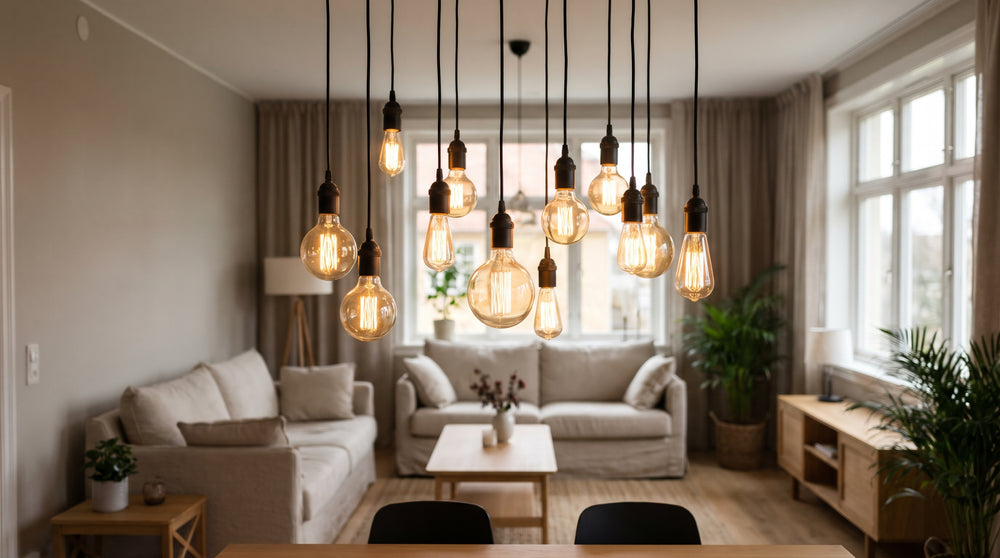
An interior that reflects who you are
Carefully selected pieces, shipped from our warehouses. Our team advises you before you buy, so you choose with confidence.
- Tracked delivery
- Pay in instalments, where available
- 14 days to change your mind
- Advice & showroom in Lyon, France
A rechargeable light bulb gives light without a socket: charge it with a USB cable, screw it into an E27 or E14 base, and it lights up even when the socket has no power. The choice comes down to three things: the fitting on your light, the colour of the light, and the runtime stated on the product page.
What is a rechargeable light bulb and how does it work?
A rechargeable light bulb contains a battery that powers its LEDs: you charge it with a USB cable, then it gives light without being screwed into a live socket. It screws in like a standard bulb in a light fitting, but also works unplugged, which makes it useful far from a socket.
A bulb with a built-in battery, how to use it
Under the globe sit a battery, LEDs and a USB port. A push button turns it on without going through a wall switch. This block is what sets a rechargeable bulb apart from an ordinary LED, and what means you have to unscrew it when the port is under the base. The base, shape and tint are chosen as elsewhere, in the full light bulb range.
Rechargeable bulbs or mains-powered bulb: what changes
On mains power, the bulb receives 220 V whenever the switch is on: it gives light with no time limit. The battery version trades that continuity for the absence of a cable, with a limited runtime and a recharge to plan for. Compare our 220V LED bulbs if the socket is already powered.
How do you run a light bulb without electricity?
You need a bulb whose battery is charged: it turns on with its button or remote control, without a powered socket. You charge it in advance from a USB socket, a computer or a power bank, then it lights autonomously for the duration stated by the manufacturer on the product page.
Rechargeable bulbs: charge first, switch on after
The routine has two steps: unscrew the bulb or leave its port accessible, plug the cable into a phone charger, a computer or a power bank, then screw it back in once charged. You switch it on with the button or the remote. In a cellar, this cycle fits around the moments when a socket is free.
What the battery cannot do
A battery does not replace a mains supply: no continuous lighting for hours, no guaranteed power at the end of the charge. Outdoors, the IP rating of the light matters as much as the bulb. For a fixed powered point, 12V low-voltage bulbs or 220 V remain simpler to live with.
Where should you install a rechargeable light bulb in the home?
A rechargeable light bulb finds its place wherever running a cable is impossible or pointless: cupboard, cellar, under the stairs, bedside table without a socket, sheltered terrace. In a living room or bedroom, it complements an existing light rather than replacing it, with a warm light of 2700 K to 3000 K.
Rechargeable bulbs for the living room
A pendant that is switched off, a dark reading corner, a shelf without power: the bulb screws into the socket and lights up when needed. At 2700 K, the light stays close to incandescent, without harshness. To furnish a whole room, browse the bulbs for lighting a living room. The warm 2700K light softens the reading corners there.
In the bedroom and small spaces
On a bedside table without a socket, the bulb charges during the day and serves in the evening. In a cupboard or under the stairs, it gets you out of trouble without running a line. The bedroom bulbs give a reference for tint, and the 3000K warm white lights a desk corner a little more sharply.
Three similar solutions, not to be confused.
| Solution | Power supply | Where it helps | Limit to know |
|---|---|---|---|
| USB rechargeable bulb | Built-in battery, cable charging | Cupboard, cellar, bedside without socket, sheltered terrace | Limited runtime, recharge to plan for |
| Mains LED bulb | 220 V mains via the socket | All correctly wired rooms | A powered socket is required |
| 12 V bulb | Low voltage via transformer | Furniture or outdoor lights | A suitable transformer is essential |
| Portable battery lamp | Rechargeable battery | Table, terrace, worksite | It is not a bulb on its own |
How do you charge a rechargeable light bulb via USB?
Charging is done with a USB cable plugged into a phone charger, a computer or a power bank, once the bulb is unscrewed or its port accessible. Charging time and connector type vary by model: check the product page before buying to know the stated lighting duration.
USB rechargeable bulbs: cable, port and power bank
Not all bulbs come with their cable, and the connector varies from one model to another. The port is sometimes on the side, sometimes under the base, which means unscrewing it for every recharge. A standard phone charger is enough. Outdoors, a power bank makes the bulb self-sufficient for an evening.
How long to charge and how long to light?
No generic duration holds: it depends on the battery capacity and the number of LEDs powered. The product page gives the charging time and the runtime stated by the manufacturer, the only figure to rely on. The light often dims at the end of the battery, which shows in a room lit only that way.
Rechargeable light bulb with remote control: what uses?
The remote control lets you turn it on, turn it off and often adjust the brightness or colour without reaching the bulb, useful for a high pendant or a lamp placed far from the sofa. It works on the models that state it: not all rechargeable bulbs are remote-controlled, the product page is the reference.
Rechargeable bulbs with remote control: brightness and colour
On a pendant hung high, the remote saves getting out the stepladder to dim the light. The models that state it switch from a warm white to a more neutral white, sometimes to a coloured tint. Not all functions are present everywhere: trust the product page, and failing that the dimmable bulbs when the socket is on mains power.
One remote control for several bulbs
The same remote often controls several bulbs of the same model, after pairing according to the instructions. The range remains that of a short radio signal, a few metres, and thick walls reduce it. Remember the remote's batteries, to be changed without dismantling the light.
What is the difference between E14 and E27 bulbs?
E27 and E14 refer to the diameter of the screw base: E27 measures 27 mm and fits most living room lights, E14 measures 14 mm and concerns small lights such as wall lights, bedside lamps or slim chandeliers. One base does not fit the other, you must check the socket before buying.
E14 rechargeable bulbs for small lights
In a wall light or a small chandelier, the socket is narrow and the size under the shade matters as much as the base: a bulb that is too long touches the glass. Measure the available height before ordering. The E14 bulbs for small lights cover this format; for large sockets, see the E27 base models.
GU10, G9 and G4: the other bases
GU10 locks in with two pins, G9 and G4 clip in, none of them screw in. These formats concern adjustable spotlights and low-voltage lights, where the transformer sets the bulb voltage. The GU10 spotlights and bulbs and the G4 and G9 bases are chosen by their fitting before their wattage.
| Base | Diameter or fitting | Lights concerned | To check |
|---|---|---|---|
| E27 | 27 mm, screw | Pendants, ceiling lights, table lamps | The size of the bulb under the shade |
| E14 | 14 mm, screw | Wall lights, small chandeliers, compact bedside lamps | The often narrow socket diameter |
| GU10 | Locking pins | Adjustable spotlights, spotlight ceiling lights | The bayonet fitting, not a screw thread |
| G9 | Pins | Chandeliers, wall lights, small lights | The length available inside the light |
| G4 | Pins | Low-voltage lights, small wall lights | The light's voltage, often 12 V |
How do you wire 3 bulbs in parallel?
Three bulbs are wired in parallel by connecting each socket to the same two wires, live and neutral: each stays independently powered and switches on separately. With rechargeable bulbs, this wiring is not needed, they work on their own, with no wire or live socket.
Wiring 3 bulbs in parallel: the principle
Two conductors run from one socket to the next, each socket connects to them as a branch: a blown bulb does not switch off the others, unlike a series circuit. Cut the power at the breaker and, if the panel is unclear, call an electrician. The equipment is chosen according to the wire cross-section and the number of points.
When wiring becomes pointless
In a cupboard with no power supply, running three lines makes no sense for supplementary lighting. A battery bulb screwed into a dead socket meets the need without any work. For a fixed point, compare with the light fittings that take these bulbs before drilling a wall.
What are the drawbacks of rechargeable LED bulbs?
A rechargeable light bulb gives light for less time than a mains bulb, must be recharged regularly and weighs a little more because of its battery. Its lifespan depends on the quality of the battery, and the price is higher than an LED bulb without a battery, for a portable use that does not otherwise exist.
Runtime and weight: what you have to accept
The battery adds weight to a socket that was not designed for it, particularly a wall light. At the end of the charge, the light dims before going out, which is noticeable when reading. You also have to accept unscrewing the bulb to recharge it. There is no free distribution of LED bulbs for the general public: the only freebies come from one-off operations.
Rechargeable bulbs: what to check before buying
Four points: the base of the light, the presence of a remote if the light is high, the type of cable and port for charging, and compatibility with a wall dimmer, never guaranteed on a battery bulb. Compare with a simple LED bulb, lighter and more economical.
How do you look after a rechargeable light bulb so it lasts?
Charge the bulb before extended storage, avoid leaving it in a light exposed to damp or near a heat source, and dust it with the power off using a dry cloth. A suitable charger and regular full cycles preserve the battery better than systematic partial recharging.
Charging without wearing out the battery
A phone charger is enough, there is no need for a more powerful one. Avoid leaving the bulb charging for several days and storing it completely flat: a battery left empty too long loses its capacity. For seasonal use, a half charge before storage is safer than a full charge.
Where to store it and when to replace it
Somewhere dry, frost-free, away from a radiator, and preferably in its packaging when the glass is thin. A visible filament bulb is as vulnerable to knocks as to dust. When the runtime drops noticeably, the battery is at the end of its life: the bulb is replaced, it is not repaired. The retro-style bulbs follow the same storage rules.
Secure payment, tracked delivery, returns and Designix customer service: the order is placed on the product page, which lists base, colour temperature and runtime. Before confirming, check your light's socket and that the cable is included in the box.
Frequently asked questions about rechargeable light bulbs
What are the 4 types of electric light bulbs?
The four families are incandescent, halogen, compact fluorescent and LED. The first three heat up to give light, the LED converts electricity into light with less loss. Rechargeable models belong to the LED family, with a battery that replaces the mains supply.
Which bulbs are the most efficient?
For comparable light, LEDs use the least electricity and last longer than incandescent or halogen. Their efficiency depends on the luminous flux relative to the wattage, stated on the packaging. A rechargeable bulb adds a battery: it remains efficient, with the charge loss inherent to any accumulator.
What is the best battery lamp?
There is no best model in absolute terms: you choose according to the light's base, the lighting duration needed and the presence of a remote control. A USB-rechargeable battery avoids buying disposable batteries, and a model whose page clearly states the runtime is easier to compare.
How do you switch on a light bulb?
A mains bulb is switched on with the light's switch or the socket's. A rechargeable bulb is switched on with its built-in button or its remote control, without depending on a wall switch. In both cases, it must be correctly screwed or clipped into its base before switching on.
Does a rechargeable light bulb work with a dimmer?
It depends on the model: a battery bulb is not designed to be dimmed by a wall dimmer, which acts on the mains supply. Bulbs intended for dimming state this explicitly on their page. Without that mention, adjust the brightness with the remote control when there is one.




