
Vintage glass ceiling lights
This selection is also available in our French store: Plafonniers en verre vintage



- Tracked delivery to your country Tracked delivery
- Secure payment at checkout Multiple payment methods
- 14 days to change your mind 14-day returns
- Secure payment Secure payment
Not sure of your style? Find it in 30 seconds
A few questions, and we will show you the pieces made for you.
Frequently asked questions
How do I choose the right product?
What are the delivery times?
Can I return an item?
Can I pay in instalments?
An interior that reflects who you are
Carefully selected pieces, shipped from our warehouses. Our team advises you before you buy, so you choose with confidence.
- Tracked delivery
- Pay in instalments, where available
- 14 days to change your mind
- Advice & showroom in Lyon, France
A vintage glass ceiling light comes down to three simple markers: the type of glass, the socket and the protection rating. Opal or cream glass softens the light, smoked glass filters it without dimming it, and the room decides the format: several globes for a living room, a compact model for a hallway.
- What light does a vintage glass ceiling light give
- Which room to install it in
- Choosing the size according to the room
- Materials and finishes
- Socket and wattage
- Installation
- Matching materials
- Ceiling light or pendant
What light does a vintage glass ceiling light give?
The glass decides the effect. An opal or cream globe softens the output and prevents glare when you look up at the ceiling. Smoked glass filters it while keeping a clean silhouette. Coloured glass makes a stronger statement and takes its place in an entryway or above a dark piece of furniture.
Opal, smoked or cream glass: what effect in the room?
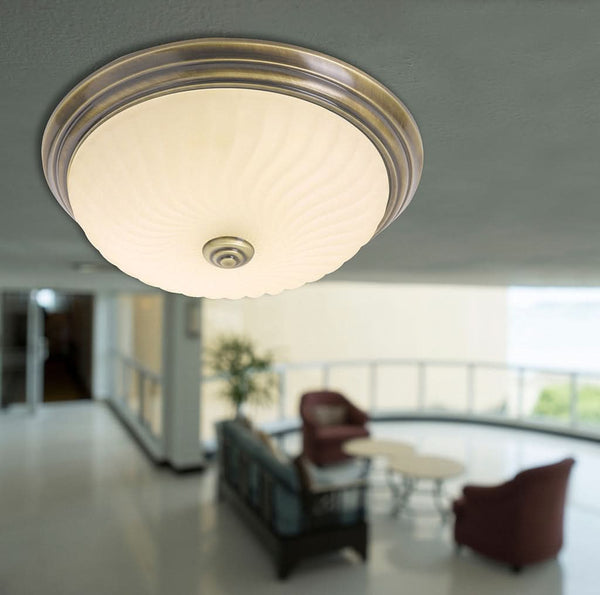
Opal glass gives an even light with no visible hot spot: this is the expected effect in a bedroom or a hallway. Smoked glass lets the source show through and lowers the level slightly, which suits a living room in the evening. Striped cream glass, as on Bronzinia, traces fine lines of light across the ceiling. To stay with a subdued mood, look at the smoked glass models and the warmth of the amber tints.
Soft light in the evening: which model to look at?
Look for frosted glass and a low-output source. The Gulliver ceiling light and its four globes spreads the light over several points instead of one, which lowers perceived glare. Cilvaro and its smoked globes do the same job in a filtered version. Bronzinia shows a warm white of 2700 to 3500 K.
| Type of glass | Light effect | Room where it works well | Model |
|---|---|---|---|
| Opal glass on globes | soft diffusion, no glare | living room, bedroom, hallway | Teslineta |
| Smoked glass | filtered light, graphic silhouette | living room, dining room, office | Cilvaro |
| Striped cream glass | warm, diffuse light | living room, bedroom, hallway | Bronzinia |
| Coloured or white glass | marked tint depending on the finish | entryway, kitchen, dining room | Silnorina |
| Four-globe glass | spread lighting, graphic look | living room, dining room | Gulliver |
Which room to install a vintage glass ceiling light in?
The living room, bedroom, hallway and entryway are the rooms where these models are most often fitted, with the kitchen also coming up often. IP20 is enough in a dry room. Near a water point or in a damp passage, an IP44 protection rating is preferable.
Living room and dining room: several globes or one large diffuser?
Over a large area, several globes spread the light better than one big volume, and the look stays graphic even with the light off. A large round diffuser lights more evenly and gets dirty more slowly. For the living room, see the vintage ceiling lights designed for the living room; for dining, a model with globes on fine rods avoids creating a mass above the table.
Kitchen, hallway, entryway: when to choose IP44?
As soon as the light is close to a sink, a hob or a damp room, IP44 becomes the right choice: it adds protection against splashes. Elsewhere, IP20 is fine. Silnorina, the IP44 version, comes in aluminium and glass for exactly this case, and the models suited to the kitchen collection gathers the compact formats. For a long hallway, look at the ceiling lights for hallways.
| Room | Recommended format | Protection rating | Socket | Dominant style |
|---|---|---|---|---|
| Living room | several globes or a large round diffuser | IP20 | E14 or E27 | vintage and retro |
| Dining room | globes on gold rods | IP20 | E14 | retro and modern |
| Bedroom | small round diffuser or three globes | IP20 | E14 | vintage and minimalist |
| Kitchen | compact format near work areas | IP44 if close to a water point | G9 or E14 | modern |
| Hallway and entryway | compact vertical format or globe model | IP20 | E14 | vintage and minimalist |
How to choose the size of a vintage glass ceiling light according to the room?
The diameter determines the lit area, the height the space available under the ceiling. A large round diffuser like Bronzinia, 30.5 cm diameter by 11 cm high, suits living areas. A compact vertical format like Silnorina, 12 cm diameter by 21 cm high, fits in a hallway or a small entryway.
Small format or large diameter: what area to light?
The wider the diffuser, the more the light spreads flat and the more evenly lit the room appears. A small size concentrates the output and mainly serves to mark a passage. In a living area, the diameter is what counts; in a hallway, the headroom decides. The rest of the selection can be seen in the full lighting catalogue.
Low ceiling or narrow hallway: which size to choose?
Under a low ceiling, a flat model or a vertical format that slips into the width of the passage avoids creating a visual obstacle. You always keep a comfortable distance between the light and the floor, without ever dropping into the line of sight. Modern LED ceiling lights often offer more contained sizes.
Glass, metal, aluminium: what materials are these ceiling lights made of?
Glass dresses every model in the selection. Metal carries most of the brackets, rods and rings, and aluminium appears on the IP44 model, lighter and protected against moisture. The gold rods and bronze rings structure the design without affecting the diffusion.
How to clean glass without scratching it?
A soft, slightly damp cloth is enough on glass, with no abrasive or scouring pad, and you dry straight away to avoid marks. Metal parts are dusted dry: a liquid product can dull a gold or bronze finish. Switch off the circuit before removing a globe to wash it, and put it back once perfectly dry.
Gold, bronze or black: which finish for which interior?
Gold warms up an interior with light woods, bronze matches dark furniture and patinated leather, black fades away and lets the glass take the stage alone. One metal finish per room is enough to stay clear. Brass and glass often go together, while the black version blends into a more understated decor.
Which socket and wattage to choose: E14, E27 or G9?
Three sockets coexist in the collection: E14 on Gulliver, Cilvaro and Teslineta, E27 on Bronzinia, G9 on Silnorina. The wattages listed range from 8 W to 40 W depending on the light. Always check the socket and wattage on the product page before buying the bulb.
E14, E27, G9: how to recognise your light's socket?
E14 is a small screw thread, E27 the large standard screw thread, G9 a two-pin base you push in. The simplest thing is to read the product page, or look at the socket before buying. An adapter is never a good solution on a glass globe: the added length can stop the globe from screwing back on.
LED or screw-in bulb: what does each model allow?
The E14 and G9 models in the selection are listed as LED, which opens the way to low-consumption bulbs. Bronzinia, in E27 with 40 W listed, takes a classic screw-in bulb as well as an LED at the same wattage. To adjust the brightness, take a look at the dimmable models; for a bedroom, the LED ceiling lights designed for the bedroom favour low wattages.
How to install a vintage glass ceiling light?
Installation follows that of a classic ceiling light: cut the circuit at the fuse box, fix the bracket to the existing box, connect the wires, then fit the glass last. On models with several globes and gold rods, it is better to be two so as not to strain the glass.
Fixing and wiring: the steps in order
First check that the ceiling box can hold the weight of the light, identify live, neutral and earth, then tighten the connectors without pulling on the wires. The glass is screwed or fitted right at the end, by hand, never with a tool. Do not tighten hard: a globe cracks faster than it unscrews.
Fitting several light points without getting it wrong
On a model with several globes, keep the rods straight and check the alignment before tightening for good. For a hallway, place the light points along the axis of the passage, keeping a regular space between them. An office is treated separately, with models designed for work.
Vintage glass ceiling light and vintage decor: how to match materials?
Vintage glass goes with warm materials, leather and wood, and with the black, bronze or gold metals of the brackets. In a room already furnished in leather and glass, choose opal or smoked glass to tie the volumes together, and keep to a single family of glass tints.
Which glass with a glass table or a vintage leather armchair?
A glass table reflects light: above it, opal or cream glass lights without creating a hard reflection on the top. Facing a leather armchair, smoked glass gives more depth and brings out the patina. A new light is often enough to refresh an already furnished room, without changing everything. Compare the white glasses with a modern black finish depending on the effect you want.
One or several glass tints in the home?
A single family of tints per room gives a calm reading, especially if the ceiling light sits near wall lights or a bedside lamp. If you mix, keep the same metal from one light to the next: that is what creates the visual link. For living areas, the models for living rooms cover most moods.
Vintage glass ceiling light or pendant: what to choose according to height?
A ceiling light stays close to the ceiling: it frees up the passage, fits in a hallway or a small entryway and is easy to clean. A pendant drops into the room and is reserved for high spaces. When space is tight, the ceiling light avoids the mass effect above people's heads.
Room with a low ceiling: ceiling light or pendant?
Under a low ceiling, a pendant eats up the headroom and gets in the way of movement: the ceiling light is almost always the answer. It leaves the view clear and comes in a flat or compact vertical size. It is also the right choice in a stairwell or a storeroom, where you often pass with your arms full.
Dining corner with a glass table: where to place the light?
Above a glass table, a ceiling light in opal or cream glass lights the surface without making it shine, as long as it does not drop into the diners' line of sight. Cilvaro, with its three smoked globes on gold rods, spreads the light instead of concentrating it at one point, which limits reflections on the top.
Secure payment, tracked delivery, returns and Designix customer service: your order can be followed from basket to fitting. Most of the selection is guaranteed for two years, against five years on some of the models.
Unsure between a large round diffuser and a globe format? Identify the room and the socket, then choose your model from our glass lights: the glass, size and protection rating are given product page by product page.
Frequently asked questions
What is a vintage light?
A vintage light takes the codes of past decades: opal, smoked or striped glass, fine rods, gold or bronze finishes. Here, glass dresses every model and metal carries the globes, with E14, E27 or G9 sockets and mostly LED sources.
How to choose between a glass ball wall light and a glass tube wall light?
Both are fitted to the wall and take up no floor space. The glass ball diffuses widely around it and suits an entryway or a hallway. The tube version stretches the light along the wall, useful on a long wall. Keep the same family of glass as the ceiling light.
Which glass shade to choose for a bedside lamp?
On a bedside lamp, a glass shade needs a low-output source to stay comfortable for reading: this is the case with E14 and G9 sockets, especially in opal glass which softens the light. Smoked glass gives a more subdued mood, best kept for indirect reading.
How to refresh a glass table with wood and light it?
Adding wood under or around a glass table warms up the room. For light, a ceiling light in opal or cream glass placed above the table lights the surface without making it shine. Avoid a light that hangs too low, which would enter the diners' line of sight.
Can you paint a glass table to match a vintage ceiling light?
Painting on glass is a DIY project in its own right, with its own constraints. For light, the match is mainly about tints: cream or opal glass goes with a light glass table, smoked glass with a darker top.




