
Oriental bedside table lamps
This selection is also available in our French store: Lampes à poser oriental de chevet

- Tracked delivery to your country Tracked delivery
- Secure payment at checkout Multiple payment methods
- 14 days to change your mind 14-day returns
- Secure payment Secure payment
Not sure of your style? Find it in 30 seconds
A few questions, and we will show you the pieces made for you.
Frequently asked questions
What table size for how many people?
Which tabletop material should I choose?
Extendable or fixed?
How do I care for the tabletop?
The right furniture, in the right place
Check the dimensions with our fit checker and receive pieces made to last. Unsure? Our team will answer your questions.
- Tracked delivery
- Pay in instalments, where available
- 14 days to change your mind
- Advice & showroom in Lyon, France
Choose the height first: 45 cm for a bedside table, 72 cm for a console or the floor. Both oriental bedside table lamps in the collection take an E27 bulb in a dry room (IP20), one in sculpted bronze resin, the other in cream and black ceramic with a pleated shade.
What light does an oriental bedside table lamp give?
These lamps give a filtered light: the pleated shade of the Ping ceramic softens the halo, the sculpted resin of the Sabi plays shadows over its reliefs. Both take an E27 bulb, up to 40 W for the Sabi and 60 W for the Ping, to be chosen according to the mood you want.
What a pleated shade changes in a bedroom
A pleated shade does more than filter: it cuts the light into fine bands and breaks up the point source, which avoids glare when you read lying down. On the Ping lamp in cream and black ceramic, the smooth base throws a clear light downwards, the textile softens the rest. For a bedroom where you want to read without switching on the ceiling light, it is the simplest setting.
An E27 socket to keep your choice of bulb
The E27 socket is common to both models: the bulb is chosen separately, replaced, and changed in temperature according to the season or the use. A trade tip for reference points: around 2700 K you get a warm end-of-day light, towards 4000 K a crisper white for working. If you would rather not think about it, the LED versions for the bedroom in the shop follow the same socket logic.
Where to place an oriental bedside lamp in the bedroom and the living room?
In the bedroom, the Sabi (W 25 cm, H 45 cm) fits on a bedside table or a chest of drawers; the Ping (Ø 46 cm, H 72 cm) needs a wider surface and sits near an armchair or on a living room console. Both are for dry interiors, protected to IP20.
On a narrow bedside table, where the lamp goes
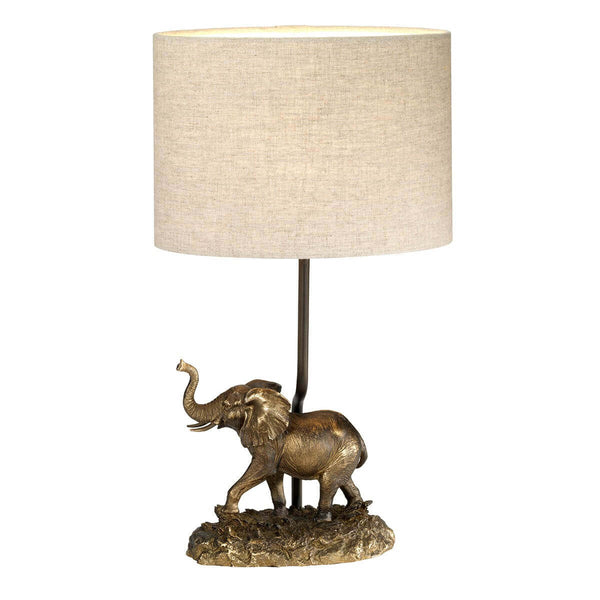
The place of a bedside lamp is decided on the floor: 25 cm wide and 17 cm deep for the Sabi bedside lamp with sculpted elephant, that is the footprint of a book laid flat. It leaves room for the alarm clock or the glass of water, and its 45 cm height puts the shade roughly at shoulder level when you are sitting on the mattress. One point to remember: IP20 means dry room, so bedroom and living room, never the bathroom.
In the living room, placing the lamp on a console
The Ping, with its 46 cm diameter shade, needs clearance: allow about ten centimetres free around it so the textile does not sit against the wall. On a console behind a sofa or next to an armchair, it lights the seating area without lighting the whole room. For other volumes, compare with the design lamps for the living room and the lamps designed for the bedroom.
How to choose between a sculpted resin lamp and a ceramic lamp?
Resin is worked into sculpted volumes, like the elephant motif of the Sabi: it gives a piece with relief, to be dusted with a soft cloth. The ceramic of the Ping forms a smooth base, cream and black, under a pleated shade. The choice comes down to the look, sculpted motif or textile volume.
Sculpted resin: a motif you can see
An original bedside lamp is often recognised by what it shows when it is switched off. The elephant motif in bronze resin works in hollows and bumps: raking light catches shadows there, the piece gains relief on a pale chest of drawers. Clean with a soft dry cloth, no abrasive, because too firm a rub would round off the edges of the motif.
Ceramic and pleated shade: a softer volume
Ceramic gives a smooth, even base, visually calmer, which the cream and black duo makes graphic. The whole weighs visually more than a bare model, which matters on a chest of drawers that is already busy. To place the two families, the collection of ceramic table lamps shows the same principle of a solid base, and the ceramic bedside lamps give the compact variants.
| Model | Material | Colour | Dimensions | Socket and max wattage | Rooms | Protection |
|---|---|---|---|---|---|---|
| Sabi, sculpted elephant | Resin | Bronze | W 25 cm x D 17 cm x H 45 cm | E27, 40 W max | Bedroom, living room | IP20 |
| Ping, pleated shade | Ceramic | Cream and black | Ø 46 cm x H 72 cm | E27, 60 W max | Bedroom, living room | IP20 |
What size of oriental lamp for which piece of furniture?
Height dictates use: 45 cm for the Sabi, at mattress height when the lamp sits on a bedside table; 72 cm for the Ping, which lights higher and is better placed on a console or on the floor. The shade diameter, 46 cm on the Ping, needs space around it.
45 cm or 72 cm: which to choose?
The height of a bedside lamp is measured against the seat, not against the wall. Sitting on the bed, you want the shade at shoulder level or just below, which a 45 cm lamp on a standard table gives. A 72 cm lamp on the same piece would light above the head and lose its reading role. On an 80 cm console, on the other hand, the Ping places the light higher and lights the back of the sofa.
Shade diameter and clearance from the wall
A 46 cm diameter shade projects a wide halo: allow free clearance around it so the textile touches neither the wall nor a tall piece of furniture. On a narrow bedside table, that diameter overflows: this is where the Sabi and its 25 cm width remain the right option. The adjustable lamps in the shop meet another need, that of directing the beam rather than diffusing it.
| Location | Suitable lamp | Why |
|---|---|---|
| Narrow bedside table | Sabi (W 25 x D 17 cm) | Small footprint, 45 cm height |
| Living room console | Ping (Ø 46 cm) | Large pleated shade, 72 cm height |
| Chest of drawers or desk | Sabi | Visible sculpted motif, E27 socket |
| Floor, near an armchair | Ping | Tall volume, light filtered downwards |
How to match an oriental bedside lamp with the rest of the decor?
The bronze of the Sabi goes with warm woods, terracotta tones and matte textiles; the cream and black duo of the Ping settles more easily in a pale or graphic room. In both cases, keep one strong piece per piece of furniture and repeat the colour in a cushion or a frame.
Which colour to choose, bronze or cream and black?
Choosing the bronze colour places a bedside lamp in a bedroom with mid-tone woods, warm walls, and a raw wool throw. The cream and black colour works better on a white or light grey background, where the contrast of the base reads clearly. A simple guide: if the room already has three warm materials, black and white contrasts and rests the eye. The gold and black pieces extend this contrasting logic.
One strong lamp per piece of furniture, the rest as support
Placing an original bedside lamp is enough to hold a corner of a bedroom. Repeating its motif or colour twice in the same room dilutes the effect: better to pick up its shade in a frame, a cushion or a rug than to multiply sculpted objects. For pale rooms, the white ceramic lamps stay more discreet, and the black models for the living room play the opposite role.
How to connect several lamps to a single power supply?
To connect several lamps to a single supply, start from a suitable power strip or terminal block connected to the control point, then distribute the lamps without exceeding the maximum wattage of each: 40 W for the Sabi, 60 W for the Ping. Switch off the power before any work and keep the connections in a dry room, as IP20 does not protect against moisture.
Distributing the wattage between several lamps
Wiring a bedside lamp is a matter of addition: two 40 W lamps and one 60 W lamp on the same cord, it is the sum that flows, not the value of one alone. So read the maximum wattage marked on each socket before connecting, and do not add a heating appliance to the same power strip. A correctly rated power strip remains the simplest solution for a bedside with two lamps.
Switching off the power before connecting
With the breaker open, check that there is no voltage before touching the wires. The connection is made on a closed box or terminal block, never on bare wires lying on the floor. If the supply has no earth, stick to luminaires of a suitable class and have the assembly checked by an electrician. On the installation side, the black metal bedside lamps are connected in the same way.
How to arrange ceiling spotlights around a bedside lamp?
Around a bedside lamp, spotlights are placed back from the wall to avoid reflection on the shade and the shadow cast by the bed. Align them on the axis of the furniture, evenly spaced, and aim them at the floor or the wall rather than at the lamp, so as not to oppose two strong sources.
Avoiding reflection on a pleated shade
A spotlight placed just above a textile shade sends light back through the pleats and creates a bright patch on the wall. Shift the light point 30 to 40 cm towards the centre of the room, depending on ceiling height, so the beam falls beside the furniture. This is the bedroom lighting setting that changes evening comfort the most.
Aligning the spotlights on the axis of the bed
Two spotlights aligned on the width of the bed, at equal distance from each table, prevent one side being brighter than the other. Aim them at the floor or the back wall, not at the pillow. For softer lighting, the design LED table lamps complement the spotlights without doubling them, and the modern models for the living room play the same role in the living space.
How to install and care for an oriental bedside lamp day to day?
A soft dry cloth is enough on sculpted resin as on ceramic; avoid abrasive products that mark the reliefs and dust the pleated shade with a soft brush. The bulb is changed with the power off, once the lamp has cooled, keeping the E27 socket and the original maximum wattage.
Cleaning sculpted resin without damaging the reliefs
On the elephant motif, dust builds up in the hollows. A feather duster or a soft-bristled brush dislodges it without rubbing the surface; finish with a dry microfibre cloth. No alcohol or detergent, which would leave matte marks on the bronze. For other natural materials, see the design wooden table lamps, which need similar care.
Dusting a pleated shade and changing the bulb
The pleats are dusted dry, with a soft brush or feather duster, without ever dismantling the textile structure. To change the E27 bulb, switch off the power, let it cool, then screw in a bulb that does not exceed the maximum wattage of the model. Unsure about the material or the size? The Designix customer service answers before you buy.
Secure payment, tracked delivery, returns possible and Designix customer service: everything you need to choose the lamp that will go on your bedside table without unpleasant surprises. The large shade of the Ping lamp in cream and black ceramic suits a console, the sculpted motif of the Sabi a narrow bedside. To widen the comparison, browse our lighting universe and all the ceramic bedside lamps in the shop.
Frequently asked questions about oriental table lamps
Original bedside lamp: how to move away from the classic model?
Look for a detail that shows when switched off: a sculpted motif like the elephant of the Sabi in bronze resin, or a pleated shade on a ceramic base like the Ping. The silhouette then works even without light, and the E27 socket keeps control over the choice of bulb.
Can an oriental bedside table lamp be used in a living room?
Yes. The Sabi (H 45 cm) sits on a console or a chest of drawers, the Ping (H 72 cm, Ø 46 cm) near an armchair or on the floor. Both are rated for the living room as for the bedroom, at IP20, so dry rooms only. For a bathroom, a different protection rating is needed.
Which bulb should go in an E27 bedside lamp?
The E27 socket is what the two lamps share: the bulb is chosen separately, according to the mood you want. Simply stay below the maximum wattage indicated by the model, 40 W for the Sabi and 60 W for the Ping, and switch off the power before changing it.
How to care for a sculpted resin bedside lamp?
A soft dry cloth passes through the reliefs of the motif; avoid abrasive products and standing water that mark the surface. For the pleated shade of the Ping, a soft brush or a feather duster is enough, without rubbing the pleats or dismantling the structure.
What height of bedside lamp for a bed?
The Sabi measures 45 cm high by 25 cm wide and 17 cm deep: it sits on a bedside table without hiding the wall. The Ping, at 72 cm with a 46 cm diameter shade, takes up more volume and is better suited to a console or the floor.




