Minimalist ceiling light
- Tracked delivery to your country Tracked delivery
- Secure payment at checkout Multiple payment methods
- 14 days to change your mind 14-day returns
- Secure payment Secure payment


Not sure of your style? Find it in 30 seconds
A few questions, and we will show you the pieces made for you.














Frequently asked questions
How do I choose the right product?
What are the delivery times?
Can I return an item?
Can I pay in instalments?
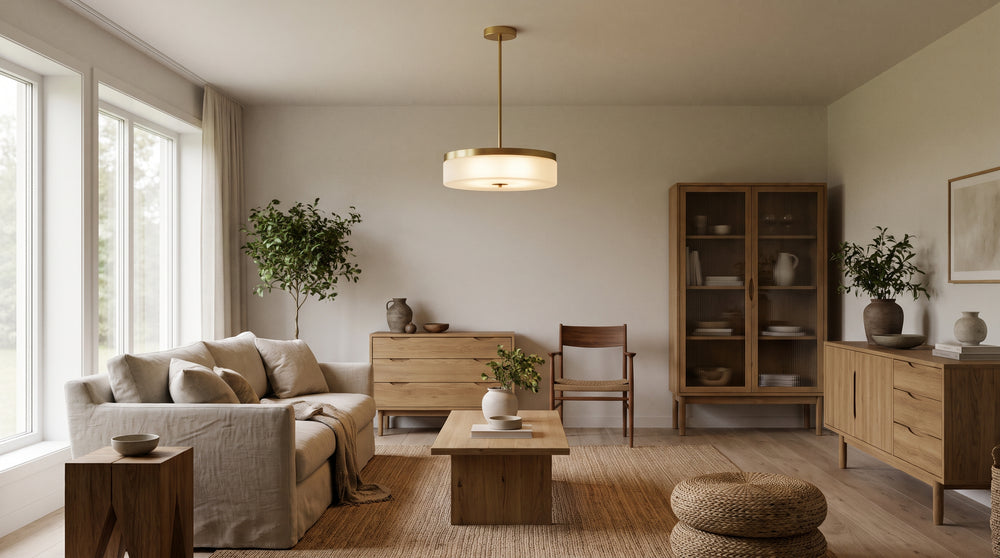
An interior that reflects who you are
Carefully selected pieces, shipped from our warehouses. Our team advises you before you buy, so you choose with confidence.
- Tracked delivery
- Pay in instalments, where available
- 14 days to change your mind
- Advice & showroom in Lyon, France
A minimalist ceiling light is chosen first for its shape and socket: round, globe or tube, in E14 for a soft and diffuse light, in GU10 to direct the beam, in GX53 to sit flush with the ceiling. Allow one to five light points depending on the surface area, and keep the same family of finishes from one room to the next to avoid breaks.
What is a minimalist ceiling light?
A minimalist ceiling light is a luminaire fixed to the ceiling whose shape stays simple: disc, globe, tube or cube, with no added decoration. In this selection, all rely on a metal structure, often complemented with steel or glass, in black or white, with an E14, GU10 or GX53 socket or an integrated LED.
Minimalist luminaire: what it changes in a room
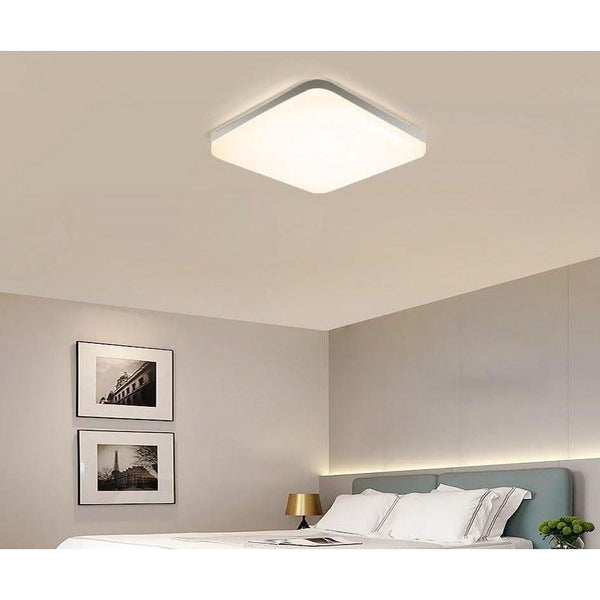
The shape does not catch the eye, the light does the work. A 3 cm thick disc or a fine canopy frees up ceiling height, which matters in a room with a low ceiling. The visual volume decreases, the room appears taller. This is what sets a minimalist ceiling luminaire apart from a multi-arm model.
Why the material matters more than the shape
Metal provides the structure, glass and acrylic decide the finish. An opal glass diffuses without glare in direct view, a graphite glass stays more graphic and lets the source show. In glass ceiling lights, this choice completely changes the mood with an identical shape.
Which minimalist ceiling light for the living room?
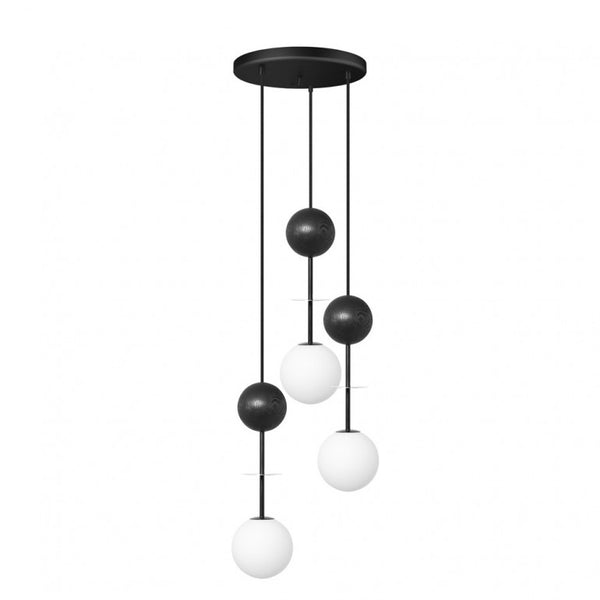
In this selection, several models suit the living room. Round shapes, globes and tubes in black or white metal blend in most easily, with one, three or five light points depending on the surface area. A large living room is covered with five lights, a more compact room with a single 24 cm model.
| Room | Share of the suitable selection | Most common shapes | Example models |
|---|---|---|---|
| Bedroom | 90 % | globe, round, opal glass | Opus 3 lights, Kairo 3 lights |
| Living room | 83 % | round, globe, tube | Baster 5 lights, Nano 5 lights |
| Kitchen | 73 % | tube, round | Nano 3 lights, Solar 1 light |
| Dining room | 70 % | globe, square | Fragment 4 lights, Maga 4 lights |
| Office | 67 % | tube, square | Mizu 3 lights, Nano 4 lights |
Black minimalist ceiling light or white minimalist ceiling light?
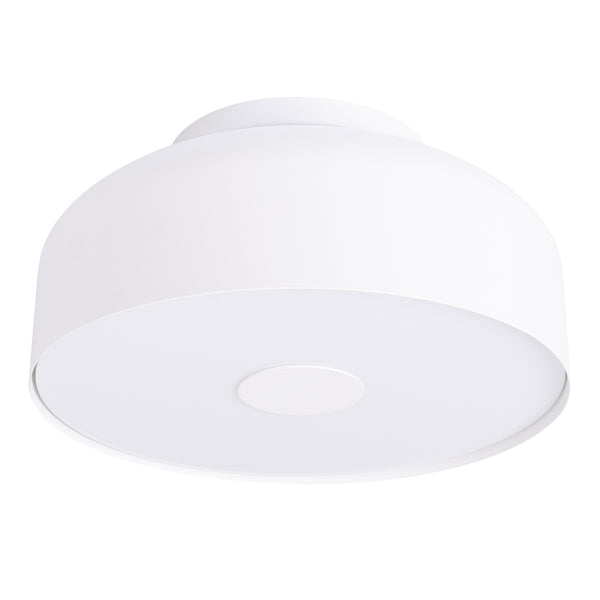
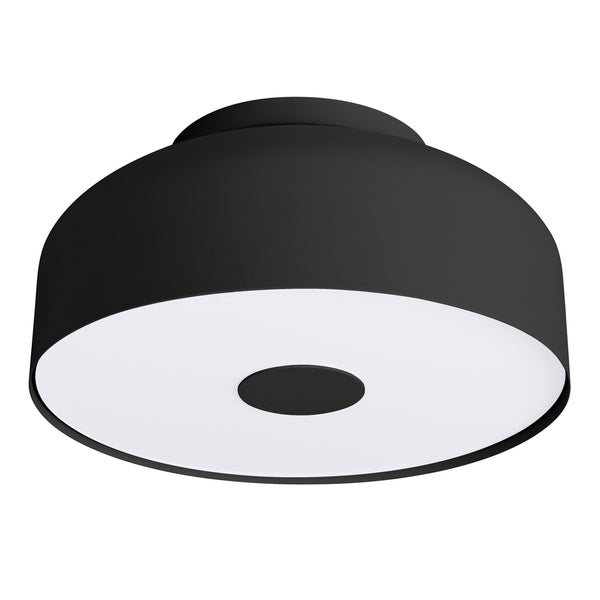
On a light ceiling, black draws a sharp contrast and becomes a graphic element. White disappears into the ceiling and lets the room breathe. The matte black models and the white finishes share the selection. Neither is more right, it depends on what you want to see when you look up.
Large living room ceiling light: how to avoid the crushing effect?
You play on the thickness, not the diameter. Solar 1 light hangs only a few centimetres from the ceiling. A five-source model such as Nano 5 lights white spreads the light through adjustable GU10 spots, which lights the walls without adding volume. For the living room, also see living room lighting.
Which minimalist ceiling light for the bedroom?
90 % of the models in the selection can be installed in a bedroom. The choice mainly comes down to diffusion: an opal glass or an acrylic softens the light, a graphite glass or a bare metal gives a more graphic finish. A ceiling light with one to three lights with an E14 socket remains the most common option.
Bedroom ceiling light: one or several lights?
One source is enough in a 10 to 12 m² bedroom. Beyond that, two or three points avoid shadow areas around the bed. Kairo 3 lights combines black metal and opal glass on a 14 cm diameter, with three E14 bulbs replaceable one by one. Find these formats in bedroom ceiling lights.
Which diffusion for a good night's sleep?
An opal glass or a graphite finish breaks the brightness of the bulb and avoids glare when lying down. For light temperature, a warm white around 2700 to 3000 K stays comfortable in the evening, while a neutral white between 3500 and 4500 K suits a work room better. The adult bedroom ceiling lights use these soft finishes.
Kitchen ceiling light and on-trend kitchen ceiling light: what to choose?
73 % of the models suit a kitchen. Tube and round shapes, in white or steel, match most simply with light fronts as well as with dark furniture. In an open kitchen, keep the same family of finishes as the living room. The collection is IP20: install in a dry area, away from splashes.
Minimalist kitchen ceiling light: which finishes?
On light furniture, a matte black tube or round draws a sharp contrast. On dark furniture, white or steel blends in better. Mizu 3 lights uses three GX53 modules that stay flat on the ceiling, handy when working standing near the worktop. See the kitchen luminaire.
Kitchen open to the living area: which continuity?
Repeat the same family of materials from one space to the next: metal and steel in both areas, or opal glass everywhere. Changing shape remains possible, changing finish breaks the reading. The metal ceiling lights and the modern ceiling lights make it possible to keep this consistency over large open surfaces.
Designer minimalist ceiling light: which shapes and sockets?
The shapes are divided between round, globe, tube, square and globe. The socket determines the use: E14 for a diffuse ambient light, GU10 to direct the beam, GX53 for a flat module that sits flush with the ceiling, integrated LED when you do not want to replace anything. The most common wattages are 10 W and 12 W.
| Source | Socket | What it changes | Models |
|---|---|---|---|
| Integrated LED | no socket | nothing to replace, fixed flux | Zephyr Sky |
| Screw bulb | E14 | replaceable bulb, slim socket | Opus 3, Kairo 3, Solar 1, Hunter 2, Imago |
| Spot | GU10 | adjustable beam, directed light | Nano 1, Nano 3, Nano 4, Nano 5, Baster 5 |
| Flat module | GX53 | sits flush with the ceiling, low thickness | Fragment 4, Mizu 3 |
E14, GU10, GX53 socket or integrated LED: what is the difference?
The E14 socket lets you replace the bulb and adjust the colour temperature. The GU10 directs the beam towards a wall or a worktop. The GX53 fits into 3 cm of thickness, ideal under a low ceiling. The integrated LED version fixes the flux but requires no source maintenance.
Modern minimalist ceiling light: which wattage to plan for?
Wattage is read per source, not per luminaire. A 10 W model with three bulbs consumes three times more than a 10 W model with one bulb. For a large room, it is better to multiply the light points than to push a single source. For adjustable lighting, see the dimmer-compatible models, about one in ten.
Which ceiling light for a small living room, hallway or office?
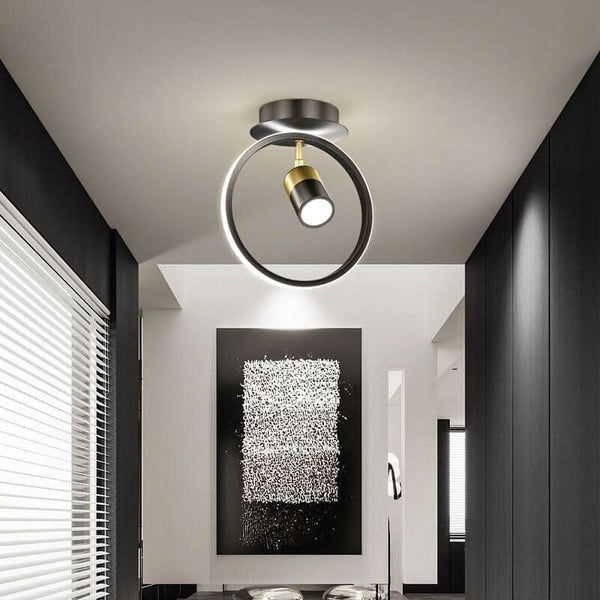
In a small living room or a hallway, a compact model with one to three lights is often enough, without multiplying the sources. Zephyr Sky comes in several sizes and Nano 1 light stays discreet on the ceiling. For an office, Mizu 3 lights in GX53 stays flat, and an adjustable GU10 spot lets you direct the beam.
Minimalist ceiling light for a small living room: which format?
Over 8 to 12 m², a diameter of 12 to 24 cm covers the room well without crushing it. An opal glass avoids glare when sitting under the luminaire. For a room without natural light, an adjustable spot model that sends the beam towards the walls is preferred. See the round shapes.
Hallway and office ceiling light: direct or diffuse?
In a hallway, diffusion is enough: you light a passage, not a precise task. In an office, direction matters, but you avoid reflections on the screen. A flat module and a neutral light between 3500 and 4500 K limit eye strain. The hallways and entrances and the office lighting gather these models.
Nordic, wabi sabi or industrial minimalist ceiling light: how to match it?
The finish mainly comes down to the material and the shade. Matte black and metal make up an industrial spirit, white and opal glass a nordic mood, rattan and neutral shades a wabi sabi effect. Repeating the same family of finishes from one room to the next avoids breaks in an open interior.
Nordic minimalist ceiling light: which materials?
White, opal glass and light metal. You look for a soft and even light, with no marked reflection. Globe and round shapes dominate, with a fine structure that reads little on the ceiling. The contemporary collections and the full catalogue of ceiling lights cover these understated finishes.
Wabi sabi minimalist ceiling light: which finish?
Rattan and neutral shades bring a warm texture without a pattern, which matches pared-back furniture. Maga 4 lights combines rattan and metal to keep a fine line on the ceiling. Avoid mixing too many different materials in the same room. The gold finishes give a warm touch close to this spirit.
Wooden minimalist ceiling light: which alternative here?
Wood does not appear in this selection, which relies on metal, steel, glass and acrylic. Rattan comes close to its warmth, a gold finish comes close to its shade. For a matte and natural finish, look instead at the metal structures in black or white.
How to install and maintain a minimalist ceiling light?
All the models in the collection are IP20, protected against contacts and dust: they are installed in a dry area, away from water splashes. Ceiling mounting is direct, with a canopy that hides the wires. A soft cloth is enough for maintenance, and the warranty is 2 years.
Can an IP20 ceiling light be installed in a damp room?
No for a bathroom or a room exposed to splashes. The IP20 rating protects against solids and contacts, not water. In a kitchen, keep the luminaire in a dry area, away from the sink and the hob. For a damp room, no reference in this selection is suitable, a different protection rating is needed.
How to maintain a minimalist ceiling light?
Cut the power before any work, then dust with a soft, dry cloth. The glass is cleaned with a non-abrasive product. Matte black metal needs a microfibre cloth to avoid marks. E14, GU10 and GX53 bulbs are replaced without dismantling the luminaire.
Frequently asked questions
What are the alternatives to a ceiling light for lighting a room?
When a single point on the ceiling is not enough, combine several sources: pendants above a table, wall lights in circulation areas, adjustable spots, floor lamps. In a room with a low ceiling, several small luminaires spread out light more evenly than a single imposing model.
Which ceiling light for a small living room?
A compact model with one to three lights is enough. Zephyr Sky comes in several sizes and Nano 1 light stays discreet on the ceiling. If the room lacks natural light, an adjustable GU10 spot spreads the beam towards the walls, and an opal glass avoids glare in direct view.
On-trend kitchen ceiling light: how to choose it?
Look first at the fronts and the worktop. On light furniture, a tube or round ceiling light in matte black draws a sharp contrast; on dark furniture, white or steel blends in better. The selection is IP20: install in a dry area.
Powerful LED ceiling light: which wattage to aim for?
In this selection, the most common wattages are 10 W and 12 W, spread over one to five light points. The displayed wattage is read per source: several 10 W lights do not light like a single one. For a large room, it is better to multiply the points than to push a single source.
How to maintain a minimalist ceiling light?
Cut the power before any work, then dust with a soft, dry cloth. The glass is cleaned with a non-abrasive product; matte black metal is happy with a microfibre cloth to avoid marks. Bulbs with an E14, GU10 or GX53 socket are easy to replace, the warranty is 2 years.
How to choose: the method in three steps
Start with the room, then the socket, then the finish. The room sets the number of light points, the socket sets the flexibility of use, the finish sets the match with existing furniture. When in doubt, a round shape, an opal glass and an E14 socket remain the most versatile choices in the selection.
The criteria that really decide
- The surface area: one point up to 12 m², three beyond that, five for a large living room.
- The thickness on the ceiling: 3 cm for a flat module, useful under a low ceiling.
- The socket: E14 for ambiance, GU10 to direct, GX53 for thinness, integrated LED for lack of maintenance.
- The diffusion: opal glass or acrylic to soften, graphite glass for a more marked finish.
- The finish: black for contrast, white to disappear, gold for warmth.
Mistakes to avoid
Choosing too large a diameter in a small room crushes the room. Taking a single-source model in a 25 m² living room leaves shadow areas. Installing an IP20 in a bathroom is not suitable. Finally, mixing two families of finishes in the same room breaks the consistency, whereas the affordable models make it possible to treat several rooms with the same line.
Secure payment, tracked delivery, possible returns and Designix customer service: you can compare the luminaires with peace of mind before making your choice. One last guide to decide: measure the diagonal of the room, divide by ten, you get the consistent diameter for the ceiling.