
Jute floor lamps
This selection is also available in our French store: Lampadaires en jute



- Tracked delivery to your country Tracked delivery
- Secure payment at checkout Multiple payment methods
- 14 days to change your mind 14-day returns
- Secure payment Secure payment
Not sure of your style? Find it in 30 seconds
A few questions, and we will show you the pieces made for you.
Frequently asked questions
How do I choose the right product?
What are the delivery times?
Can I return an item?
Can I pay in instalments?

An interior that reflects who you are
Carefully selected pieces, shipped from our warehouses. Our team advises you before you buy, so you choose with confidence.
- Tracked delivery
- Pay in instalments, where available
- 14 days to change your mind
- Advice & showroom in Lyon, France
Start by choosing the area to light, then the height of the shade: sitting in an armchair, a jute floor lamp whose fabric reaches eye level lights reading comfortably without glare. A woven fabric shade filters the bulb's light and makes it diffuse, which turns it into warm accent lighting rather than general illumination.
- What kind of light a jute floor lamp gives
- Which room to put it in
- Which size and height to choose
- Floor lamp, ceiling light or chandelier
- Matching jute with the rest of the living room
- Bulb, socket and light
- Installing and caring for it
- Frequently asked questions
What kind of light does a jute floor lamp give?
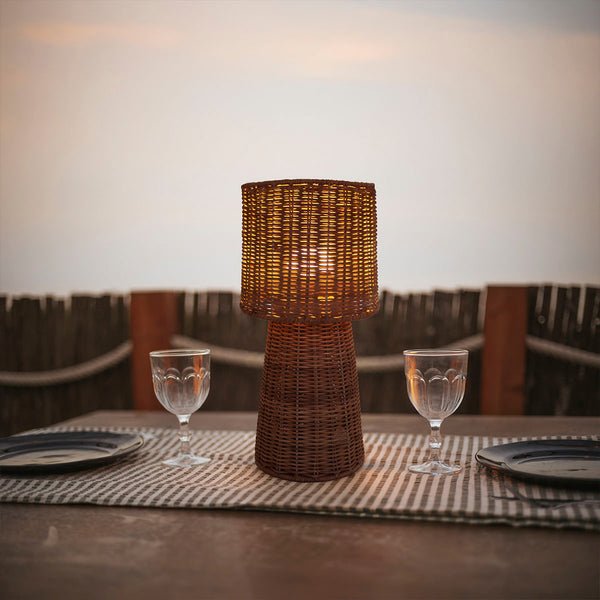
A jute shade filters the bulb's light: it becomes diffuse, with no bright point, and lights the room gently. The result stays warm with a warm-light bulb, more neutral with a white bulb. Darker weave dims more than natural jute.
Jute fabric floor lamp: soft light for the evening
The woven mesh scatters light across its whole surface instead of letting it travel straight. The result: no glare when you look at the shade, light rising toward the ceiling and falling toward the floor, and a soft halo on the wall behind. That is exactly what you want for a reading corner or a living room corner in the evening. To picture the difference, a glass shade lets light through more sharply and casts stronger shadows, as with a glass shade for the living room.
Natural or dark-dyed jute: what changes in the result
Natural jute bounces back a pale, almost beige light and brightens the wall it stands against. A darker dyed fabric absorbs part of the light: the halo is tighter, the mood more hushed. On a light wall, natural jute blends into the decor; on a dark wall, it stands out. Neither is better, it all depends on how much light you want at floor level. To compare with other materials, browse see all our lighting.
Which room to put a jute floor lamp in?
A jute floor lamp goes where you want warm accent light: a living room reading corner, a bedroom corner, a hallway or a corner of a study. Its woven fabric diffuses without glare, which makes it comfortable next to a sofa or an armchair.
Wood and jute floor lamp for a living room or reading corner
Next to the sofa, you want a wide base and a shade height that lands at eye level once you are seated. Wood matches both light and dark furniture: see wood models for the living room. In a living room full of daylight, a dimmable model lets you lower the intensity in the evening without changing the bulb, one option among LED floor lamps for the living room.
A standing floor lamp for the bedroom and hallway
In a bedroom, place it near the head of the bed or in the corner opposite the bed, with a warm bulb. A closed shade limits light going upward and keeps the room dark for sleeping. In a hallway or corridor, a slim stem and a compact shade take up little space: bamboo floor lamps for the living room play the same natural card with a small footprint.
| Room | Stem size | Shade | Type of light | Where to place it |
|---|---|---|---|---|
| Living room, reading corner | Tall stem, wide base | Large woven shade | Warm accent light | Next to the sofa or armchair |
| Bedroom | Medium stem, discreet base | Closed shade | Soft evening light | Near the head of the bed |
| Hallway, corridor | Slim stem, small footprint | Compact shade | Night light or accent | In a corner or along the wall |
| Study | Adjustable or articulated stem | Tight shade | Directed light | Next to the desk |
| Large room with a high ceiling | Very tall stem | Wide shade | General supporting light | Near a wall, out of the way |
How do you choose a jute floor lamp by size and height?
The right size is chosen on the spot: a floor lamp whose shade lands at eye level once you are seated lights reading comfortably, a taller model lights a wider area. Measure the floor space and the distance to the wall before settling on the shade diameter.
Choosing stem height for seated or standing use
For reading while seated, the shade usually sits around shoulder height once you are in the armchair, a marker to adjust to your own seat. To light an area while standing, go one notch higher. Measure from the floor to your shoulder, add the seat height, and you get an approximate target. An adjustable model solves it differently: see adjustable floor lamps.
Large shade or compact size: how much floor space
A large shade casts a wide halo and dresses up a living room corner, but the width of the fabric needs clearance around the stem. A compact size slips between a piece of furniture and a wall. Think about the distance to the wall: fabric pressed against the partition bounces back flat light. On a desk, a tighter model is more effective, like the models designed for the study.
Jute floor lamp, ceiling light or chandelier: which to choose?
A jute floor lamp brings movable accent light, easy to move from one room to another. A jute ceiling light illuminates the whole room from above, and a jute chandelier spreads light across several points above a table. The three combine in the same room.
Jute ceiling light: general lighting for a room
Fixed to the ceiling, it washes the whole room and serves as the base when evening falls. Check the weight the fixing point can bear and the ceiling height before choosing. In a living room, it complements a floor lamp placed near the sofa without replacing it: designer LED floor lamps for the living room show what that combination looks like in a contemporary interior.
Jute chandelier: several light points above the table
Above a table, a jute chandelier or pendant brings light down to the level of the guests and creates a warm island. Centre it on the tabletop and adjust the cable length. To light a large room in several zones, several sources beat one powerful point; the full lighting catalogue gives you what you need to build that set.
| Solution | What it lights | Ideal room | Installation | What to check |
|---|---|---|---|---|
| Standing jute floor lamp | A precise area, movable | Living room, bedroom, study | No drilling, socket nearby | Base stability and shade height |
| Jute ceiling light | The whole room | Bedroom, hallway, small living room | Ceiling fixing | Weight supported and ceiling height |
| Jute chandelier or pendant | The table and its surroundings | Dining room, dining area | Ceiling fixing, above the table | Cable length and centring over the table |
How do you match a jute floor lamp with the rest of the living room?
Jute matches wood for a natural set, black metal for a crisp contrast, and gold-tone metal for a more dressed-up note. Keep to a single colour thread.
Wood and jute floor lamp: the natural match
Both materials share a warm tone that suits Scandinavian interiors and bohemian moods. Stay with light woods and natural jute, darker woods with a dyed fabric. See Scandinavian spirit for the living room. For a more understated result, the more restrained Nordic lines cut back on ornament without losing the warmth of the fabric.
Jute with black or gold metal: playing the contrast
A black frame underlines the light fabric and gives a crisp marker in the room: see the black metal versions. A gold finish warms the whole piece and catches the light: gold finishes. Avoid mixing the two on the same wall. Bamboo and glass remain easy neighbours to complete the decor.
Which bulb and socket for a jute floor lamp?
This collection currently contains no floor lamps: no product page states a socket or maximum wattage. Advice on light temperature or dimming therefore does not apply.
Checking the socket and maximum wattage on the model page
The socket changes from one model to another, as does the maximum permitted wattage. Note both details before ordering, then choose a bulb whose shape fits inside the shade without touching it. A bulb too close to the fabric heats it, which you always avoid. An LED limits that heat build-up.
Warm or white bulb: what changes on the fabric
A warm light, around 2700 K, keeps the hushed mood of jute; a whiter light, around 4000 K, makes the room more neutral and easier to read in for work. This marker holds for any lighting, not just our models. For a study corner, a whiter result helps concentration: LED lights with a modern design.
How do you install and care for a jute floor lamp?
Assembly needs no special tool: screw on the stem, steady the base, run the cable along the wall and screw in the bulb. For care, a dry cloth or a soft brush is enough; avoid water, damp and direct heat sources.
Assembling and steadying the floor lamp
Assemble the stem on a flat floor, screw the base on until it is tight, then check that the whole thing does not tip when you brush past the shade. Run the cable along the wall or under a rug so no one trips on it, and keep the socket within reach. A stable model near a walkway beats a large shade badly placed.
Cleaning a jute shade without damaging the fabric
Dust it dry, from top to bottom, with a soft cloth or a light brush. Do not use water or abrasive products, which distort the weave. Keep the floor lamp away from a radiator and damp rooms, and check the base stability from time to time. Other materials are happy with a soft cloth, like a floor lamp with vintage charm or the industrial-style metal versions.
Frequently asked questions about jute floor lamps
Which jute floor lamp should you choose for a living room?
For a living room, choose a jute floor lamp whose shade lands at eye level once you are seated, with a base wide enough to stay stable next to the sofa. A large woven shade gives wide accent light; a more compact size suits a corner.
Does a jute fabric floor lamp give enough light to read?
A jute shade diffuses light instead of concentrating it: it suits accent or mood lighting, to be completed with a directed reading lamp for long sessions. For reading alone, a tighter shade or an adjustable light is preferable.
Can a wood and jute floor lamp stay in a bedroom?
Yes, a wood and jute floor lamp belongs in a bedroom: its soft light suits the evening and the wood matches both light and dark furniture. Place it near the head of the bed or in the corner opposite the bed, with a warm-light bulb.
Do you need a special bulb for a jute floor lamp?
No, no specific bulb is needed: check the socket and maximum wattage stated on the model page, then choose a warm-light bulb to keep the jute mood. An LED bulb also limits how much the fabric heats up.
How do you spread light around a living room with a jute floor lamp?
Combine two sources: a jute floor lamp near the sofa or armchair for accent light, and a ceiling light or pendant higher up for general light. Avoid stacking two sources of the same intensity in the same spot, which flattens the room.
Jute is chosen on the spot, at seated eye level and with a shade width suited to your corner of the room. Once those two markers are set, browse our lighting for the home and keep the socket noted on each page in mind before ordering the bulb.
Designix supports the order from start to finish: secure payment, tracked delivery, possible returns and a customer service team you can reach for any question about a model, a dimension or a socket.




