
IP44 light bulbs
This selection is also available in our French store: Ampoules IP44
No products in this selection.
- Tracked delivery to your country Tracked delivery
- Secure payment at checkout Multiple payment methods
- 14 days to change your mind 14-day returns
- Secure payment Secure payment
Not sure of your style? Find it in 30 seconds
A few questions, and we will show you the pieces made for you.
Frequently asked questions
How do I choose the right product?
What are the delivery times?
Can I return an item?
Can I pay in instalments?
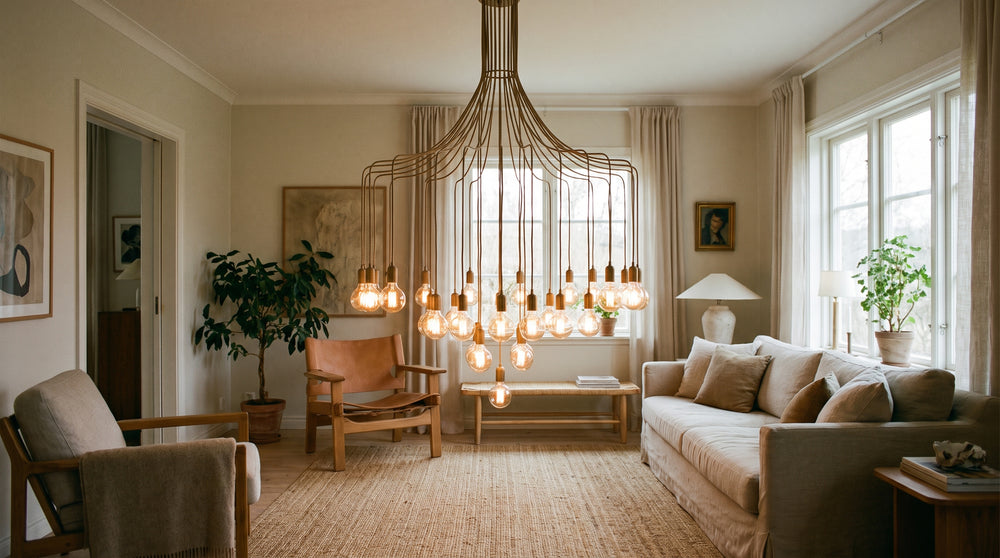
An interior that reflects who you are
Carefully selected pieces, shipped from our warehouses. Our team advises you before you buy, so you choose with confidence.
- Tracked delivery
- Pay in instalments, where available
- 14 days to change your mind
- Advice & showroom in Lyon, France
IP44 bulbs are chosen first by the socket already in place, then by the colour temperature suited to the room. They resist water splashes, which makes them suitable for the bathroom, the utility room and a sheltered outdoor area, but never for immersion.
An IP44 socket follows the same logic: it is used outdoors under shelter or in a bathroom, and its rating must match that of the light fixture.
What exactly is an IP44 bulb?
The IP44 rating is read in two digits: the first, 4, protects against solid bodies larger than one millimetre; the second, 4, against water splashes from all directions. An IP44 bulb therefore resists splashes, not a high-pressure jet or being passed under water.
IP44 meaning: decoding the two digits
The first digit deals with dust and small objects, the second with water. A 4 in second position means "splashes", not "immersion": a bulb dropped into bathwater may be lost. Jet cleaning on the socket is also to be avoided, as water pushed under pressure eventually gets past the seal.
IP44 bulb versus IP44 fixture: where the protection lies
On a closed appliance, it is the seal and the cover that provide watertightness; the protected bulb adds its own resistance. An open fixture cancels this benefit, even with an IP44 bulb screwed into it. The logical path therefore goes through our lighting catalogue before choosing the bulb, then through all bulbs sorted by cap.
IP44 bulb in the bathroom: in which zones should it be installed?
In a bathroom, an IP44 bulb is suitable for points away from the bathtub, the shower tray and the washbasin, where only splashes are possible. In direct contact with water, a higher rating and an appliance designed for that use are required.
Real use cases, from mirror to ceiling
Above the mirror, a compact wall light with E14 bulbs for wall lights lights the face without glare. On the vanity unit, a low point serves for shaving and make-up. A ceiling light outside the shower zone provides general light. In the adjacent dry rooms, the field opens up: bulbs designed for the living room on the lounge side, bedroom bulbs for softer evening lighting.
Think about the whole setup, not just the bulb
An IP44 bathroom ceiling light must have its seal in place, its diffuser properly clipped on and its terminal block closed. The appliance class matters as much as the rating: a class 2 fixture needs no earth, which simplifies wiring in a room with many pipes.
Which IP protection to choose between IP44 and IP65?
IP44 stops water splashes, IP65 stops dust and withstands jets: the higher the second digit, the more the appliance resists water. For a bathroom away from the shower or a sheltered outdoor area, IP44 is enough; near water, IP65 is safer.
The lighting families are the pendant, the ceiling light, the wall light, the recessed spotlight, the table lamp and the floor lamp; in IP44, you mainly find ceiling lights and wall lights. A class 1 fixture has an earth connection, class 2 is indicated by the double square.
| IP rating | Solids | Water | Typical use |
|---|---|---|---|
| IP21 | Solid bodies larger than 12.5 mm | Vertical drips | Dry room, near a washbasin without splashing |
| IP44 | Solid bodies larger than 1 mm | Splashes from all directions | Bathroom outside the shower zone, sheltered outdoor area |
| IP65 | Dust, total protection | Water jets | Shower, exposed terrace, poolside |
What the second digit changes
Going from 4 to 5 crosses a threshold: a directed jet, typical of cleaning or driving rain, becomes tolerable. The first digit deals with dust. For everyday use under a canopy or in a well-ventilated shower room, 220V LED bulbs rated IP44 cover the need.
Sheltered or open air: which rating to choose
Under a canopy, against a wall protected from the rain, IP44 holds. On a terrace swept by showers or at the edge of a pool, the higher rating avoids repeated replacements. Slanting rain is the real test: if water can reach the socket, go up a level.
IP44 bulb E27, G9 or GU10: which cap to choose?
The cap is chosen according to the fixture's socket: E27 for the large screw thread, E14 for the small one, GU10 for spotlights, G9 for compact pin sockets. An IP44 bulb with the wrong cap will not fit, whatever its quality.
| Cap | Fitting | Common fixtures | To check |
|---|---|---|---|
| E27 | Large screw thread | Ceiling lights, pendants, floor lamps | Socket and available width under the shade |
| E14 | Small screw thread | Wall lights, small pendants, accent lamps | Depth of the socket |
| GU10 | Two locking pins | Recessed spotlights, tracks, adjustable ceiling lights | Direction of the quarter turn when fitting |
| G9 | Two thin pins | Wall lights and compact ceiling lights | Pin spacing and diffuser height |
IP44 bulb E27: the large screw cap
E27 fits most ceiling lights and pendants. It is the format that allows the most freedom in glass shape. E27 cap models are screwed in by hand, without forcing, and checked before switching the power back on.
IP44 bulb G9 and GU10 spotlights: compact sockets
GU10 spotlights lock with a quarter turn: a half-inserted fitting causes loose contacts. G9, with its thin pins, requires checking the spacing before inserting the bulb. For these formats and others, see the compact G9 and G4 sockets.
IP44 LED bulb: which light for a damp room?
In a bathroom, an IP44 LED bulb at 2700K gives a warm light, close to halogen, pleasant in the evening; 3000K, more neutral, suits the mirror and make-up. LED gives off little heat, which matters in a small, confined and poorly ventilated space.
2700K or 3000K: the result before the spec sheet
2700K leans towards amber and relaxes a room in the evening. 3000K slightly whitens the complexion, which helps with shaving and make-up without becoming cold. warm white 2700K bulbs and more neutral 3000K bulbs mix easily in the same room, provided you keep one temperature per zone.
Dimmer: check compatibility before ordering
A bulb can only be dimmed if it is designed for it and the dimmer accepts it. The symptom of an incompatible pair is flickering at the low position or a humming noise. dimmable bulbs state this compatibility in their specification, to be cross-checked with the reference of the dimmer already installed.
How to install an IP44 bathroom pendant?
A pendant should only be installed in a bathroom if the fixture and the bulb are protected and placed away from direct splashes. Switch off the power at the circuit breaker, fix the support, connect according to the terminal block, then screw in the IP44 bulb before restoring power.
Precautions before drilling
Switch off at the circuit breaker and check that there is no voltage. Identify live, neutral and earth, then check that the support lands on a solid point of the ceiling and not on a void. Height matters: a pendant hung too low in a small room gets in the way of the eye and obstructs movement.
Which bulb in a bathroom pendant
Prefer a closed shape or thick glass, more tolerant of humidity than a thin globe. glass bulbs give a crisp result, while filament bulbs bring a warmer, more decorative light. Check the supported weight and the diffuser diameter. At the slightest doubt about the wiring, call an electrician.
How to wire 3 bulbs in parallel?
In a parallel setup, each socket receives the same voltage from the same supply: the three bulbs are powered separately. The live wires are connected together and the neutrals together, then the terminal block is closed. If one bulb blows, the other two keep lighting.
The diagram to follow
A single supply enters the first terminal block, comes out towards the second, then the third. Live with live, neutral with neutral, earth on the casing if the appliance is class 1. Each socket thus remains in parallel on the line, and the current is distributed without the voltage dropping.
Parallel or series: the difference in everyday use
In series, the bulbs share the voltage and all go out if one fails. In parallel, each works at full voltage and remains independent. This is why LED bulbs on a track or a multi-point ceiling light are always wired in parallel.
IP44 outdoor bulb: how to keep the protection over time?
Protection comes as much from the seal and the cover as from the bulb: a cracked seal, a poorly screwed cover or condensation let humidity in. Clean with a soft cloth, check the seal once a year and replace the bulb with the power off.
The mistakes that break the watertightness
A bulb too large for the diffuser prevents the cover from screwing on fully. A dry or pinched seal lets slanting rain through. Persistent condensation signals an appliance that breathes badly: trapped air cools at night and water settles inside.
Cleaning and checking without damaging the seal
Soft, slightly damp cloth, never a direct jet or abrasive product on the seal. Once a year, remove the cover with the power off, wipe it, and replace the seal if it has hardened. In the shop, orders are placed with secure payment, tracked delivery, possible returns and Designix customer service to confirm a cap before purchase. Find the bathroom light fixture that will host the bulb, then the IP44 bulbs from the shop to complete the installation.
Frequently asked questions
Which bulb should be used outdoors?
A protected bulb, IP44 minimum, installed in a closed fixture and under shelter. LED withstands temperature variations better than halogen and gives off less heat. Avoid sockets exposed to driving rain and check that the appliance has its seal and cover.
What are the 4 types of bulbs?
Four families coexist: incandescent, halogen, compact fluorescent and LED. LED is now the standard, as it gives off little heat and uses less energy. Halogen remains common in G9 and GU10 but gives off a lot of heat, which matters in a small damp room. Incandescent and compact fluorescent have become marginal.
What are the 3 types of lighting?
General lighting lights the whole room, accent lighting highlights a wall or an object, and task lighting is for reading or getting ready. In a bathroom, a ceiling light provides the general light and a wall light near the mirror provides the task light.
Which bulbs give the best light?
It is not the wattage that tells the brightness, but the luminous flux in lumens: at comparable power, a recent LED often gives more light than a filament bulb. Also consider the colour temperature, which changes the feel, and the quality of the fixture, which directs the light.
Should the IP44 rating always be preferred?
Not systematically. IP44 is enough in an ordinary damp room and in a sheltered outdoor area, and it leaves more choice of caps and shapes. In an area highly exposed to water, a higher rating is preferred. The rating is chosen by use, not on principle.




