Crystal table lamps
This selection is also available in our French store: Lampes à poser en cristal

















- Tracked delivery to your country Tracked delivery
- Secure payment at checkout Multiple payment methods
- 14 days to change your mind 14-day returns
- Secure payment Secure payment
Not sure of your style? Find it in 30 seconds
A few questions, and we will show you the pieces made for you.
Frequently asked questions
What table size for how many people?
Which tabletop material should I choose?
Extendable or fixed?
How do I care for the tabletop?

The right furniture, in the right place
Check the dimensions with our fit checker and receive pieces made to last. Unsure? Our team will answer your questions.
- Tracked delivery
- Pay in instalments, where available
- 14 days to change your mind
- Advice & showroom in Lyon, France
A crystal table lamp comes down to three measurements: the shade diameter, the total height and the socket. On a narrow bedside table, a 14 to 16 cm diameter base is enough; on a console, you go up to 30 cm and more. Then check the socket, E14, E27 or G9, before ordering the bulb.
What is a crystal table lamp and what light does it give?
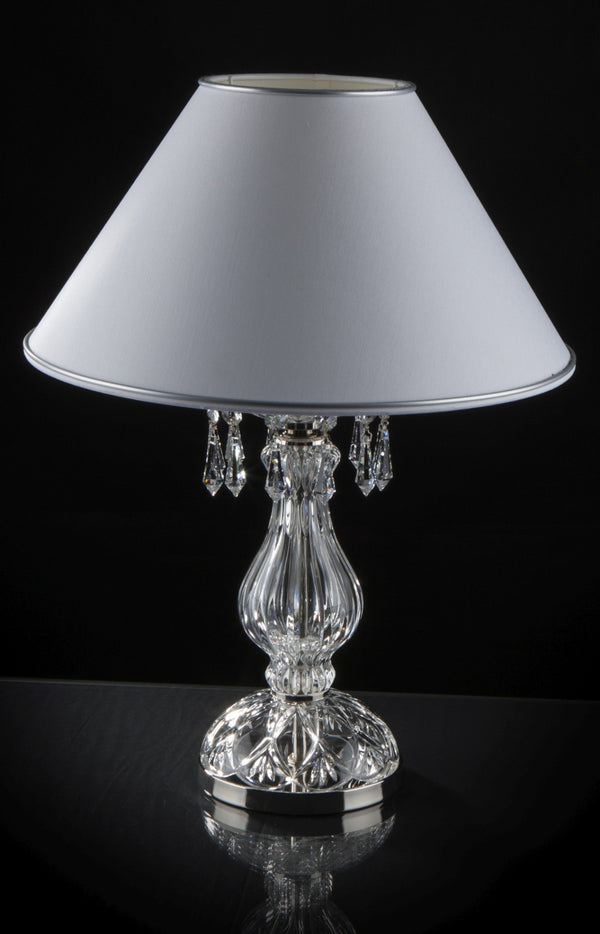
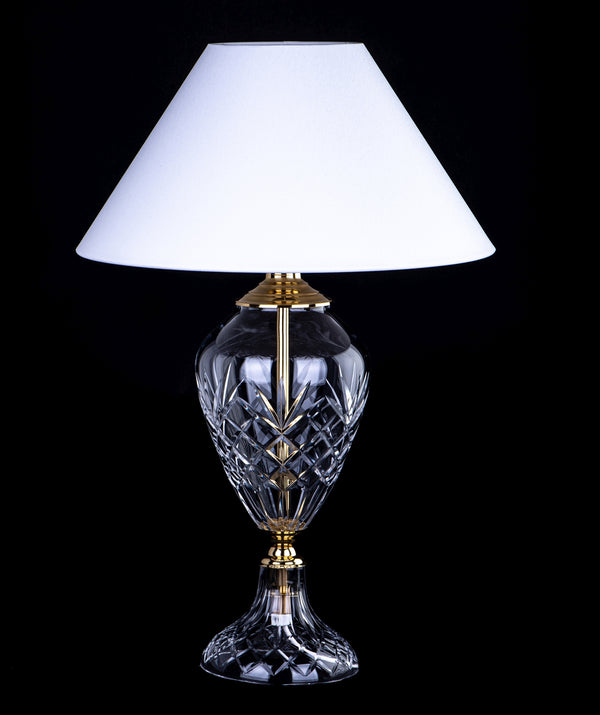
Crystal bounces the bulb's beam into sharp reflections on the wall and furniture: it is warm, directional accent lighting, not general lighting. The base, cut, solid or stepped, concentrates those reflections, the shade filters them. The whole selection is rated IP20 and guaranteed for two years.
Crystal table lamp: what the material changes about the light
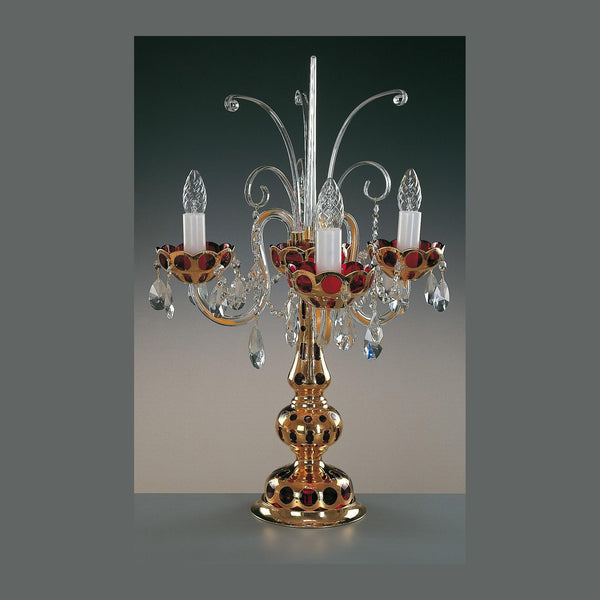
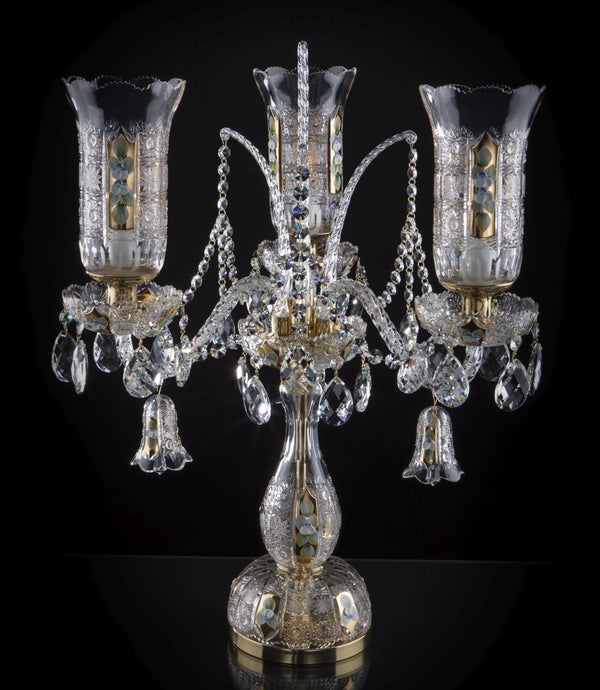
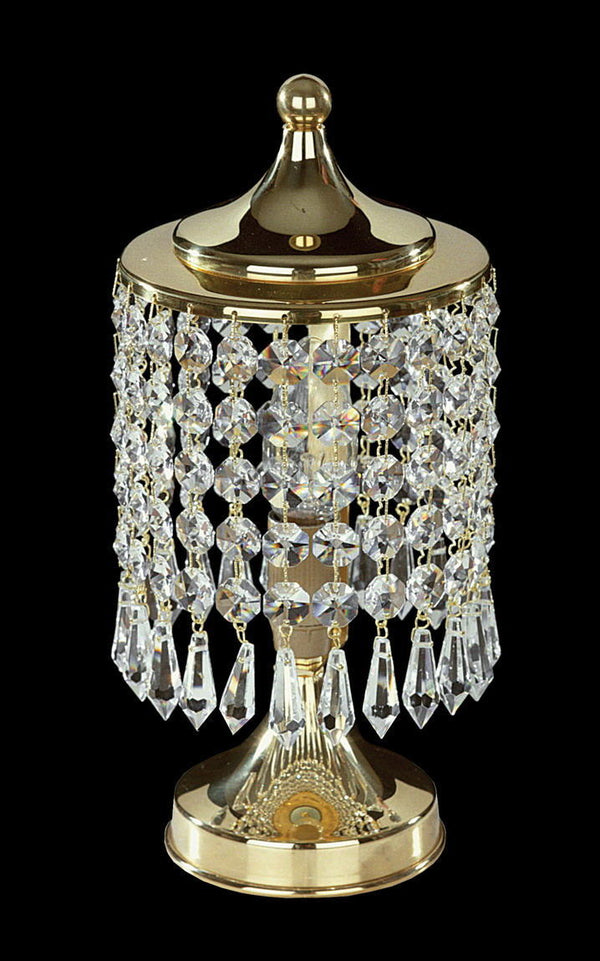
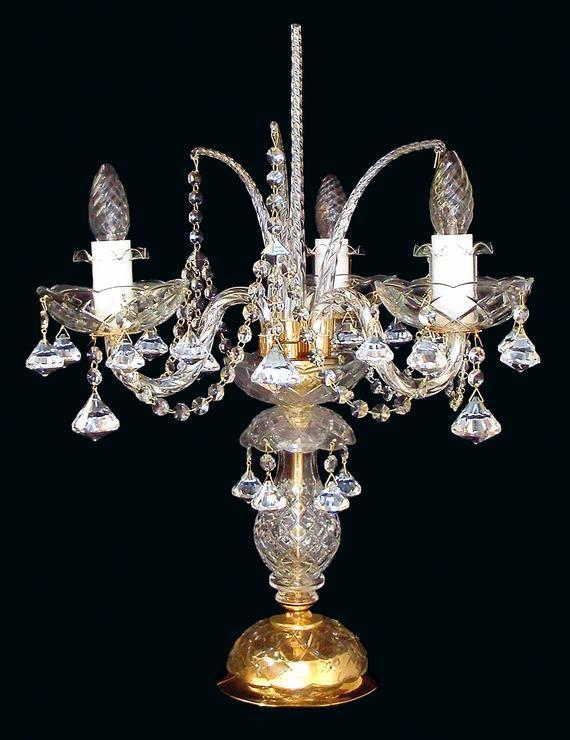
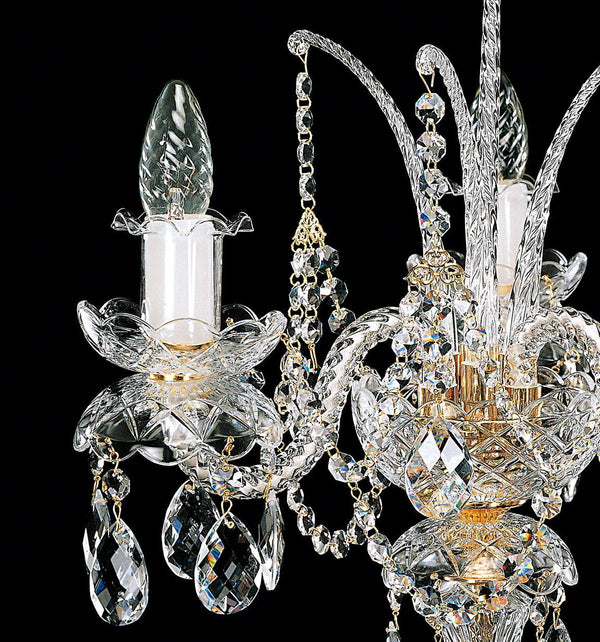
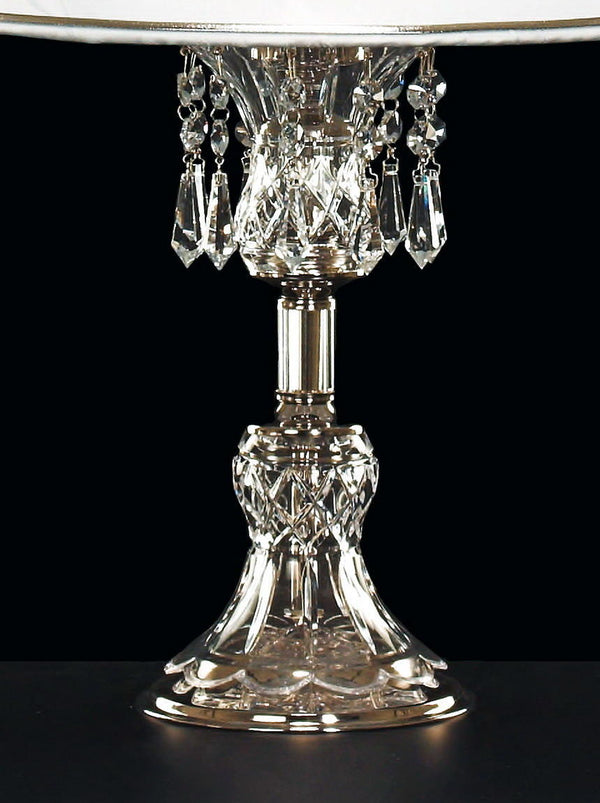
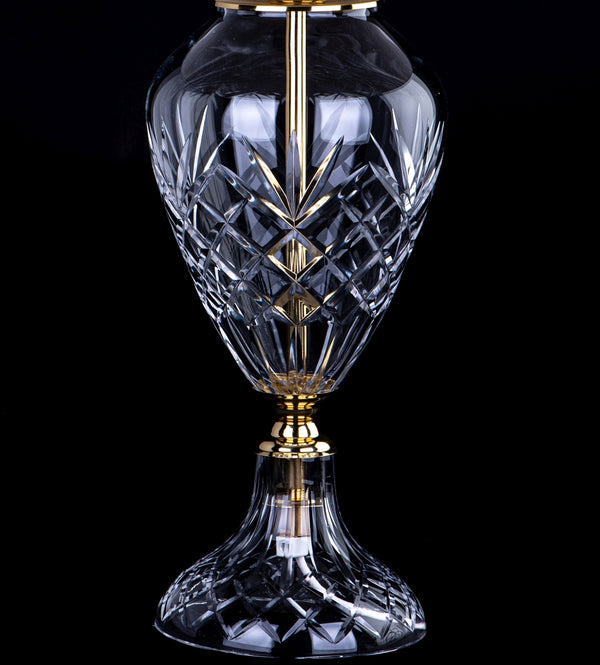
A solid base returns a denser light than a shaft of cut crystals, which breaks the beam into small points. Pendants and bobeches add moving glints as you move around the room. That is what sets a three-arm gold lamp with bobeches apart from a simple cylindrical shaft: the same crystal, two results. Crystal works best with a warm-light bulb; the house's design table lamps also show other materials if you want a more matte finish.
IP20: which rooms can take a crystal lamp?
IP20 means protection against solid objects, with no protection against water: the room must stay dry. Bedroom, living room, office, hallway and corridor all work. A bathroom, a damp conservatory or a covered terrace exposed to splashes should be ruled out. For a night-time room, see the design bedside lamps for the bedroom, made for that kind of use.
How to choose a crystal table lamp
Start from the furniture that will host it: the shade diameter gives the footprint, the height gives the reach of the light. This selection runs from 14 to 45 cm in diameter and 28 to 70 cm in height. The socket is checked afterwards, once the size is settled.
Crystal table lamp: height or diameter first?
Diameter first, because it decides whether the lamp fits on the furniture: on a 40 cm bedside table, a 36 cm shade already takes up almost the whole surface. Height comes next, depending on whether the light should fall on a book, a keyboard or a wall. A model around 30 cm lights up close, a model of 55 cm and more lights further away.
Floor lamps and table lamps: what is the difference?
A floor lamp stands on the ground and serves as general or reading light; a table lamp sits on a piece of furniture and stays an accent. Crystal suits table models best, as they are lighter to move. For a beam you can aim, look instead at the adjustable lamps.
| Model | Style | Socket | Diameter | Height | Colour |
|---|---|---|---|---|---|
| Cristallin, three arms and bobeches | Baroque | E14 | 45 cm | 65 cm | Gold |
| Lunvesina, square base | Baroque | E27 | 36 cm | 70 cm | Silver and gold |
| Zenvesessa, stepped base | Baroque | E27 | 36 cm | 55 cm | Silver and gold |
| Servesissa, trapezoidal shade | Baroque | E27 | 31 cm | 57 cm | Silver and gold |
| Lorvesano, cut crystal base | Baroque | E27 | 33 cm | 46 cm | Silver and gold |
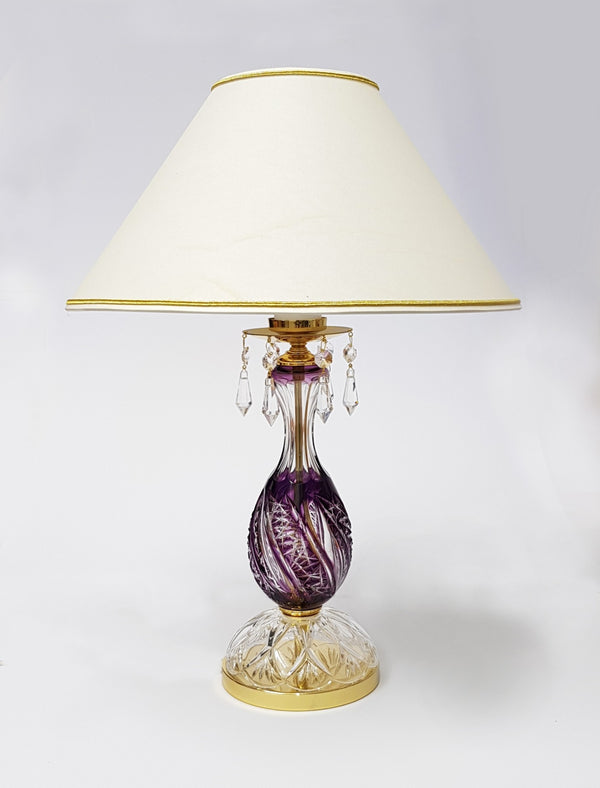
| Wenceslas, pleated conical shade | Modern | E14 | 16 cm | 30 cm | Gold |
| Valvesissa, crystal pendants | Modern | E14 | 14 cm | 39 cm | Silver |
Secure payment, tracked delivery, accepted returns and Designix customer service: you order the right reference, and you can change your mind. Compare the sizes in our full lighting range before settling on your diameter.
Ball, dome, drop or square: which crystal lamp shape to choose?
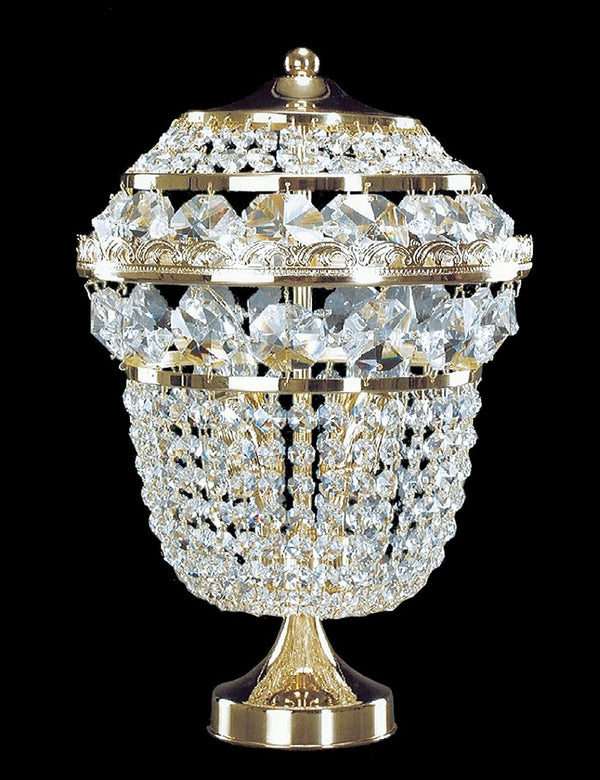
The shape decides the volume taken up and the way the light comes out. A ball concentrates reflections in a small space, a dome spreads them wider, a drop stays narrow and vertical, the square and the tube give a graphic silhouette. The choice is made on the free surface around the furniture.
Design ball table lamp
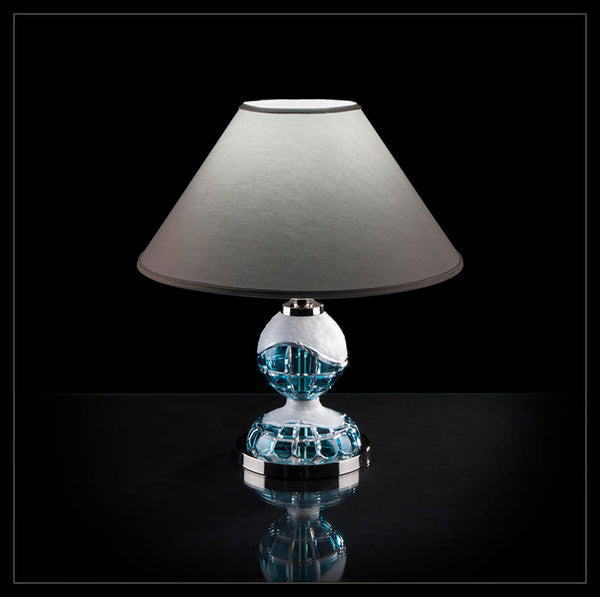
The ball works on a shelf, a small piece of furniture or a clear bedside table: it lights little surface but creates a very readable luminous mass. A pink crystal ball base lamp plays on the contrast between the sphere and a light shade. If you prefer a textured fabric to visible crystal, linen shades give a more matte light.
Dome, drop, square and tube: the more discreet silhouettes
The dome lights wider and forgives a narrow piece of furniture; the drop slips into a corner or a niche; the square and the tube take on clean lines, useful when the rest of the decor is already busy. These silhouettes pair well with gold and black colours.
| Shape | What it changes | Where it works best |
|---|---|---|
| Ball | Concentrated reflections, compact volume | Bedside table, shelf, small furniture |
| Dome | Wider spread, softer light | Living room console, desk |
| Drop | Fine, vertical silhouette | Narrow bedside table, window sill, niche |
| Square | Graphic lines, stable base | Desk, sideboard, hallway |
| Tube | Slim format, slips along a wall | Room corner, side table, desk |
Baroque or modern: which crystal lamp style for your interior?
The baroque style relies on pendants, visible bobeches and pleated shades: the result is busy, warm, very decorative. The modern style keeps the crystal but strips it back, with a solid or stepped base and a cylindrical or conical shade. Both live happily with gold as with silver.
Baroque crystal: pendants, bobeches and pleated shade
This style goes for effect: several visible light points, pendants that catch the light, a shade that filters without flattening. It needs space around it and a decor that accepts symmetry. On a sideboard or a living room console, it is a fine replacement for a more ordinary piece.
Italian design table lamp or modern silhouette: which lines to look at
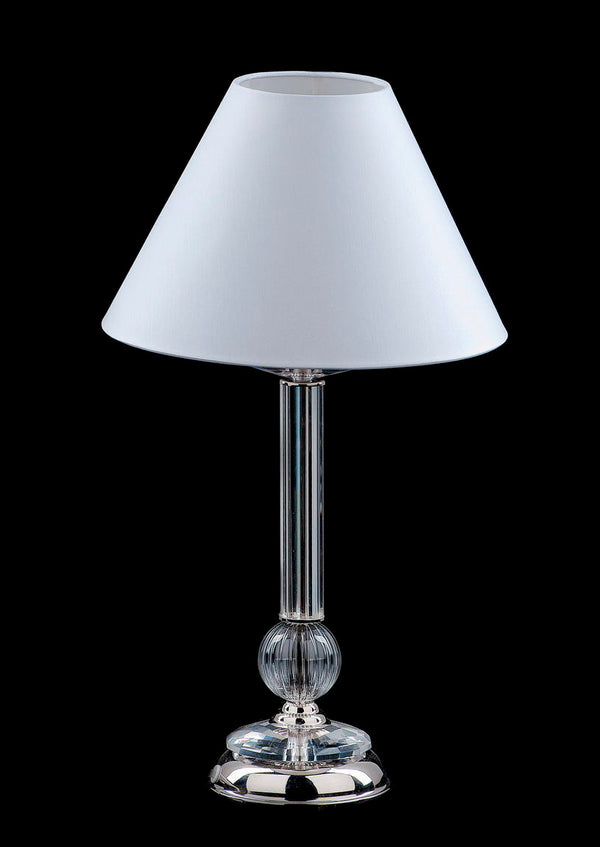
Look at the base before the shade: solid base, square base, stepped base, shaft of cut crystals. A square base holds better on a narrow piece of furniture, a stepped base plays on transparency. For a pared-back interior, the modern models for the living room and the nordic style offer comparable lines in other materials.
How to wire several lamps on a single electrical supply?
Several lamps can share one supply provided they are wired in parallel: live with live, neutral with neutral, earth with earth. Each then receives the same voltage and they switch on together if there is a single switch. Have the diagram and cable cross-sections checked by an electrician.
Wiring 3 lamps to 1 switch
You start from the junction box: one run to the first socket, then on to the next, and so on. The switch cuts all the points at once. Each lamp keeps its own connection, which lets you replace it without touching the others. The final connection is checked with the power off.
What the number of lamps on one line changes
The more points there are, the more the consumption adds up and the more a long cable run can drop the available voltage. The cross-section to allow for depends on the existing circuit, never on a figure read on a product page. An electrician checks compatibility with the breaker in place; the Designix lighting catalogue gives the sockets and bases of each model.
How to lay out ceiling spots and where to place your lamps?
A crystal table lamp completes the general lighting: place it at hand height, near a wall or in a corner, so the source is not in your eyes. Ceiling spots are spread in regular lines, set back from the walls, without aiming straight at a seat.
How to lay out ceiling spots
A regular grid beats a tight alignment: space the points about one metre to one and a half metres apart depending on the surface, and keep a distance from the wall to avoid hard shadows. In a kitchen or a corridor, line them up on the circulation axis. In a living room, keep the grid away from seating areas so faces are not lit from above.
The most beautiful living room lamps: three placements that work
On a console against the wall, next to the sofa for reading, or on a side table at the entrance to the room. Each time, the lamp stays below eye level. For the bedroom, the table lamps for the living room and the LED bedroom lighting usefully complete the upper layer.
How to care for a crystal lamp and change its bulb?
For crystal, a soft slightly damp cloth is enough; abrasive products dull the cuts. A pleated or cylindrical shade is dusted dry. For the bulb, note the socket of the model then replace it cold, with a bulb of equivalent power.
Changing the bulb: E14, E27 or G9?
The socket is written on the holder and repeated on the product page. E14, the small screw socket, fits narrow shafts and pleated shades; E27, the large screw socket, goes with wide bases and taller models; G9, with pins, appears here and there. Unscrew cold and refit without forcing.
Cleaning a crystal base and a pleated shade without dulling them
Dust dry first so you do not spread dust into the cuts. Then run a barely damp microfibre cloth over the crystal, without product. For a fabric shade, use a soft brush or a suitable roller. A bedside lamp with a cut crystal base is cleaned this way in a few minutes, like a black metal bedside lamp.
How to recognise real crystal glass?
Real crystal rings clear and sustained when struck, reflects light strongly and shows clean cuts; ordinary glass stays more matte and lighter. On a lamp, you also look at the weight of the base and the regularity of the pendants, which betray careful finishing.
Cut crystal, glass, imitation: what shows to the naked eye
In daylight, tilt the piece: cut crystal throws sharp glints off the edges, an imitation blurs them. The edge of the cuts is sharp on crystal, rounded on moulded glass. The weight is felt in the hand, especially on a solid base.
Pendants and bobeches: the vocabulary of a crystal lamp
Pendants are the hanging drops, bobeches the small cups that receive the light. Their regularity, their number and how they are fixed say a lot about the care taken in assembly. You will find them on design desk lamps as on LED desk lamps, in other forms.
Our lighting range brings together crystal and other materials, with the current price shown on each product page. Designix customer service for any question about a socket, a dimension or a return.
Frequently asked questions about crystal table lamps
How do you turn a vase into a lamp?
You need a socket that fits the neck of the vase, a stable support or a hollowed base, and a clean cable route. An opaque vase is drilled with a bit suited to its material; a crystal vase is better entrusted to a professional. The result remains accent lighting.
What is the price of crystal?
The price depends on the material, cut or moulded, on the number of pieces and on the finishing work: an accent lamp in cut crystal stays more affordable than a designer piece. Our models show their current price on each product page and the selection covers very different budgets.
What are the table lamp trends for 2026?
In this selection, crystal remains the reference material, with a clear dominance of gold, then silver, and a split between baroque silhouettes with pendants and modern models with pleated or cylindrical shades. Compact formats sit alongside taller three-arm pieces.
Which lamps are in fashion right now?
Crystal bedside lamps with a cut base and pleated shade, in gold or silver, are the most in demand, along with baroque models with bobeches and pendants. Modern silhouettes with a square or stepped base appeal for a more understated result.
How do you wire several lamps in parallel?
Parallel wiring connects all the lamps to the same live, the same neutral and the same earth: they receive the same voltage and work together. That is the arrangement to plan for several points on a single line. The connection must be checked by an electrician.