
RGB light bulbs
This selection is also available in our French store: Ampoules RGB
No products in this selection.
- Tracked delivery to your country Tracked delivery
- Secure payment at checkout Multiple payment methods
- 14 days to change your mind 14-day returns
- Secure payment Secure payment
Not sure of your style? Find it in 30 seconds
A few questions, and we will show you the pieces made for you.
Frequently asked questions
How do I choose the right product?
What are the delivery times?
Can I return an item?
Can I pay in instalments?
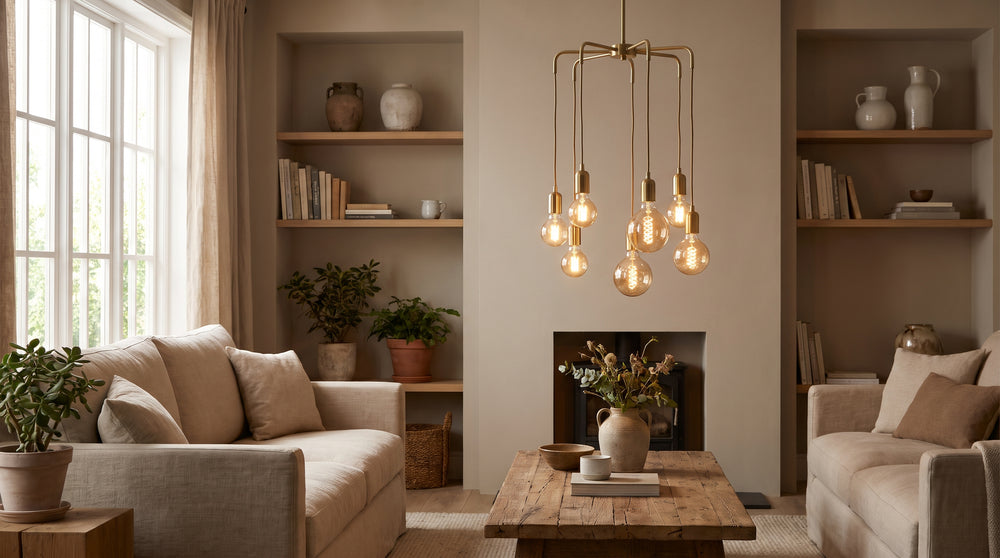
An interior that reflects who you are
Carefully selected pieces, shipped from our warehouses. Our team advises you before you buy, so you choose with confidence.
- Tracked delivery
- Pay in instalments, where available
- 14 days to change your mind
- Advice & showroom in Lyon, France
A colour changing bulb screws into the socket of an existing light fitting and adds controllable coloured light without replacing the fixture. Three practical points decide the choice: the socket base, the control method (remote, app, smart home protocol) and whether there is a true white alongside the colours.
What is an RGB bulb and what light does it give?
An RGB bulb emits controllable coloured light, plus a white that is more or less present depending on the model. It screws into a standard socket and is adjusted from a remote, an app or a voice assistant. Its use: mood, decor, visual signal, not the main lighting of a work room.
Colour, saturation, intensity: the three settings of RGB light
The hue chooses the colour (red, green, blue and their mixes), saturation sets its purity, intensity sets the power. A highly saturated colour at low intensity gives a clean halo behind a piece of furniture or on a wall; the same colour pushed to full tints the whole room and tires the eye. To dress a corner of a living room, a strong colour at low intensity is often enough, and bulbs designed for the living room cover this use case. The result also depends on the fitting: an opaque shade concentrates light downwards, a glass diffuser spreads it. Before ordering, check the opening of your fitting in the Designix lighting catalogue.
What an RGB bulb does not replace
A colour bulb cannot do the job of work lighting: reading, cooking or working on a screen needs a stable, even white. So keep a white light point in the room, ceiling light, desk lamp or wall light, and reserve colour for accents. A fixed colour for one evening also does not replace a warm-to-neutral white variation, which remains the right tool for going from dinner to tidying up.
What is the difference between RGB and RGBW LEDs?
An RGB bulb mixes three colours, red, green and blue, to produce reconstructed hues and whites. An RGBW bulb adds a dedicated white channel: whites are cleaner and colours stay crisp. RGBW suits better a room where you alternate coloured mood and everyday white light.
RGBW: white in addition to colours
On a plain RGB bulb, white comes from mixing the three channels: it often leans blue or greenish, rarely towards a comfortable warm white. The dedicated white channel corrects this and lets you light normally without changing bulbs. Some models add a white adjustable in temperature, from warm around 2700 K to neutral around 3000 K: that is the most versatile formula for a living room. For a white result without colour, compare with white-coloured bulbs.
When RGB alone is enough
If the bulb is only for mood, behind a piece of furniture, under a display cabinet or in a corner, the dedicated white channel is superfluous and complicates control. Plain RGB then remains the most direct choice. For everyday lighting at home, a well-chosen classic LED bulb in the right temperature stays simpler to use than a colour you will only switch on occasionally.
Connected RGB bulb, remote or Bluetooth: how to control it?
Three families coexist: the remote supplied with the bulb, control by app over Wi-Fi or Bluetooth, and smart home protocols such as Zigbee, which require a compatible bridge. All let you choose colour, saturation and intensity; the difference lies in range, the number of bulbs controlled together and compatibility with voice assistants.
Connected RGB bulb: Wi-Fi, Zigbee or Bluetooth?
Wi-Fi links the bulb to the home network: you control it from anywhere, and several bulbs can be grouped in the same scene. Bluetooth works without a hub, but only at close range and with a limited number of points. Zigbee requires a compatible bridge: it handles a large number of bulbs better and stays responsive, at the cost of an extra box. So Zigbee, Wi-Fi or Bluetooth bulbs are also chosen according to the installation already in place. A dimmable LED bulb remains the solution when you only want to adjust intensity at the wall, without an app.
RGB bulb with remote: the solution without an app
The supplied remote avoids the phone, the account to create and the network: you press, the colour changes. It suits a single bulb in a floor lamp or a bedside lamp, and those who do not want connected control every day. Check that the bulb keeps its last setting after being switched off at the wall, otherwise the colour is lost at every power cut. On the voltage side, a 220 V bulb replaces the old one directly, with no transformer to change.
RGB bulb E27, E14 or GU10: which base to choose?
The base depends on the fitting, not the colour: E27 for large screw bases, E14 for small ones, GU10 for bayonet spots on track or ceiling light. Check the base and the maximum wattage marked on the socket before ordering an RGB bulb.
RGB bulb E27: the large screw base
E27 fits most pendants, floor lamps and ceiling lights. A colour bulb in E27 screws in like an ordinary bulb. Two points to check: the maximum wattage the socket tolerates, often engraved inside, and the size of the globe, which must fit under the shade. Wide-globe models give a broader halo; find them among E27 base bulbs.
RGB bulb GU10 and E14: spots and small fittings
GU10 is found on track spots and recessed ceiling lights: the socket is bayonet, a quarter turn is enough. E14, slimmer, fits wall lights and bedside lamps, where space is short. For small pin sockets on a wall light or an older fitting, see other bases, G4 and G9, and for directional spots GU10 spots for track and ceiling.
| Base | Where you find it | To check before buying | Typical use |
|---|---|---|---|
| E27 | Pendants, floor lamps, ceiling lights | Maximum socket wattage, globe size | Visible mood bulb |
| E14 | Small fittings, wall lights, bedside lamps | Globe diameter and available height | Bedroom mood |
| GU10 | Track spots, recessed ceiling lights | Bayonet socket, compatibility with a wall dimmer | Directional lighting, wall accent |
| GU5.3 | Low-voltage spots | Presence and compatibility of the transformer | Decorative spot |
| G9 | Small pin fittings | Type of pin socket | Wall light, designer fitting |
Where to install an RGB bulb at home?
An RGB bulb finds its place where you want to change the mood without redoing the lighting: living room lamp, reading corner, headboard, display cabinet, or a floor lamp to mark a corner. It complements the white lighting of the room rather than replacing it.
In the living room: floor lamp and RGB lamp
In a living room, colour is used as an accent: halo behind the sofa, dark corner, or under a low piece of furniture. An RGB LED floor lamp aimed at the wall gives a broad, soft patch of colour without glare. Avoid lighting the reading area or coffee table in colour: keep white light there. To equip these fixtures, browse our fittings ready for a colour bulb.
In the bedroom and reading corners
In the bedroom, colour works at low intensity, as a night light or a halo behind the headboard; a pale tint tires the eye less than a saturated red before bed. In a hallway or entrance, a colour bulb at low intensity serves as a night marker, provided you keep a white light point for moving around. Models with a visible globe suit bedside lamps well: see those suited to the bedroom and, for a more elaborate look, retro bulbs. In a damp room, the protection rating of the fitting decides, not the bulb.
| Room | What you are looking for | Recommended setting | Point to watch |
|---|---|---|---|
| Living room | Mood behind furniture or in a corner | Marked colour, low intensity | Do not light the reading area in colour |
| Bedroom | Soft light, gradual wake-up | Pale colour or warm white | Avoid bright light before bed |
| Kitchen | Worktop lighting | Neutral white | Colour reserved for decor |
| Entrance and hallway | Visual signal, night light | Low intensity | Keep a white light point for moving around |
| Office | Concentration | White around 3000 K | Colour as accent only |
How to wire 3 bulbs in parallel?
On a 230 V circuit, three sockets are connected in derivation: the live wire arrives at the first socket then goes on to the next, same for neutral, and earth follows the same path. Each bulb then receives full voltage. In series, they would glow dimly. Cut the power before working.
The derivation connection, wire by wire
Parallel wiring, also called derivation, reproduces what already exists in a wall: each socket is connected directly to the incoming supply. Identify live (often brown or red wire), neutral (blue) and earth (green-yellow), then run from each socket to the next with the same markers. The order of the sockets along the path does not matter. For a movable setup, a 220 V LED bulb works on this circuit without a transformer.
What to check before connecting
Switch off the breaker and check that there is no voltage before touching a wire. Add up the wattage of the three bulbs and compare it with the circuit rating and the maximum wattage of each socket. Fixed wiring in a wall or ceiling is a job for a professional: junction boxes, wire connectors and earth are not improvised. At low voltage, with 12 V low-voltage bulbs, the transformer must be sized for all the points.
Do LEDs use a lot of electricity?
An RGB LED uses less than a halogen or incandescent bulb of comparable brightness; its real consumption is the wattage stated on the packaging multiplied by the time it is on. Control electronics and standby add a small continuous consumption, outside lighting.
Stated wattage and real consumption
The wattage on the packaging is the bulb's consumption in operation, not an equivalence. A low-wattage colour bulb gives little light: that is the usual compromise of these models, where colour is decorative. If a stated lumen figure seems inconsistent with the wattage, rely on the wattage alone and do not base your choice on that figure. For everyday use, a low-voltage LED bulb or a standard model already in place remains the reference. To compare two models, read the lumen output on the spec sheet: at equal wattage, a white model gives more light than an RGB one. Aim for more lumens for main lighting, fewer for mood.
What control adds to consumption
A connected bulb stays slightly powered when off, to listen for commands: that is its electronics on standby, small but continuous over a year. A bulb with a remote or a simple wall switch has no such load. The useful habit stays the same: switch off when the room empties, and avoid leaving a mood colour on all day for no reason.
How to match an RGB bulb with the rest of your lighting?
So the colour does not clash, keep a white base in the room: warm white around 2700 K for the living room and bedroom, more neutral around 3000 K for a work room. Reserve colour for one accent point, one zone at a time, at moderate intensity.
Warm white 2700 K, neutral white 3000 K: which base to choose?
The white of the room sets the overall tone, colour only punctuates it. A living room in warm white light around 2700 K accepts an amber, orange or dark red accent well; a work room in more neutral white at 3000 K will better support a strong blue or green. Filament bulbs, often in warm white, give a base consistent with a visible fitting: see filament bulbs.
Mixing colour and white without a disco effect
The rule is one sentence: one coloured zone per room, at a time. Two halos of different hues in the same field of view create a disorder that the eye reads as party decor. Lower the colour intensity below that of the white, choose a hue close to the room's white, and keep the rest of the lighting unchanged. To vary without changing everything, all available bulbs can be compared by base and by temperature; on the fitting side, the choice of diffuser matters as much as the bulb.
Designix reassurance: secure payment, tracked delivery, returns accepted and Designix customer service for any question about a base or compatibility before ordering. Note the base and maximum wattage of your socket: that is the information that prevents the most returns.
Frequently asked questions
Connected RGB bulb: do you need a hub or Wi-Fi?
Not always. Wi-Fi and Bluetooth models are controlled directly from a smartphone, while Zigbee models go through a compatible bridge. Check the protocol stated on the product sheet and compatibility with the voice assistant you already use at home.
Does an E27 RGB bulb work in any socket?
Yes, provided the base matches. E27 is the large screw base, found on most pendants, floor lamps and ceiling lights. An E27 RGB bulb screws in like a classic bulb, respecting the maximum wattage marked on the socket.
Can you use an RGB bulb without a remote or an app?
It depends on the model. Some RGB bulbs are controlled only by the supplied remote, others by app or voice control, and a few keep wall operation: on and off, with no colour change. The control method is listed in the product specifications.
Do LED bulbs give warm or cool light?
A white LED bulb is made in a specific tint: around 2700 K it gives warm light, towards 3000 K it looks more neutral, and higher it leans towards cool white. An RGB bulb adds colours to that white without necessarily replacing it.
What are the drawbacks of LED bulbs?
A colour LED bulb needs extra control, remote or app, which adds a step to switching on. Its result is not that of a white bulb: coloured light is not suitable for reading. Finally, not all models support a wall dimmer.




