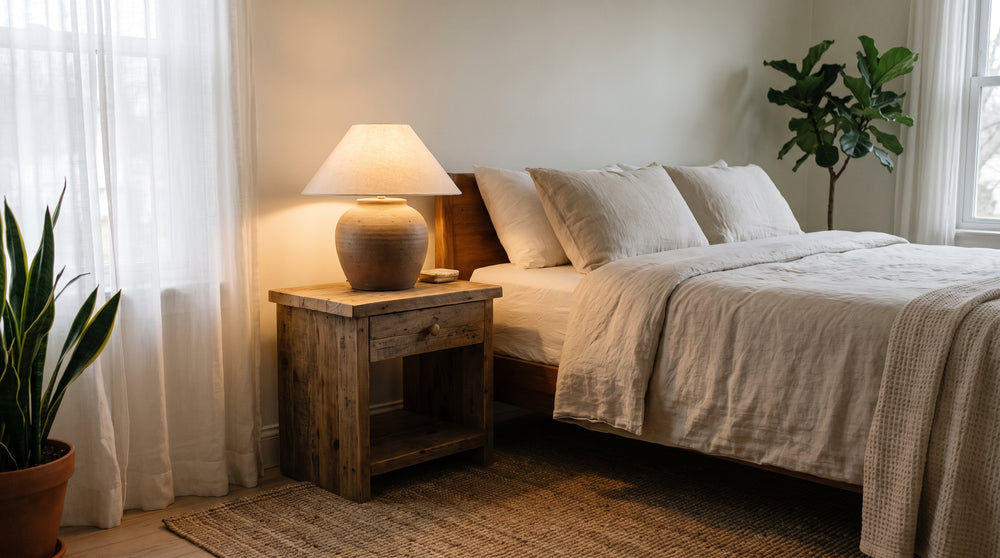
Ceramic bedside lamp
This selection is also available in our French store: Lampe de chevet céramique
- Tracked delivery to your country Tracked delivery
- Secure payment at checkout Multiple payment methods
- 14 days to change your mind 14-day returns
- Secure payment Secure payment


Not sure of your style? Find it in 30 seconds
A few questions, and we will show you the pieces made for you.


Frequently asked questions
What table size for how many people?
Which tabletop material should I choose?
Extendable or fixed?
How do I care for the tabletop?
The right furniture, in the right place
Check the dimensions with our fit checker and receive pieces made to last. Unsure? Our team will answer your questions.
- Tracked delivery
- Pay in instalments, where available
- 14 days to change your mind
- Advice & showroom in Lyon, France
Start by measuring the free space on the bedside table: a ceramic table lamp here measures 16 to 30 cm in diameter or footprint, in matte white, beige or black, with an E14, G9 or LED module base and a warm white light of 2700 to 3500 K. This comparison brings together five leading models, sometimes combined with glass or metal, all rated IP20.
Which ceramic table lamp should you choose for a bedroom or office?
A ceramic table lamp sits on a bedside table or desk. The models in this selection combine ceramic, sometimes glass or metal, a warm white light of 2700 to 3500 K, IP20 protection and, depending on the model, a dimmer. Sizes range from 16 to 30 cm in diameter or footprint. For a softer feel, a linen shade diffuses a gentle light; remember to check base compatibility if you are looking for an E27 lamp.
White ceramic table lamp: which bedside table is it for?
Measure the usable depth before choosing. A 16 cm diameter model needs about 20 cm of free space, while a 30 cm model takes up almost the entire surface. The matte white Fiorenza, at 26 cm by 13.6 cm, leaves room for a book. For a narrow top, look at the small bedside formats.
On a desk: which size should you choose?
On a desk, the lamp often sits next to a screen: a compact base and warm light are more comfortable at the end of the day. The beige Omaggio in ceramic and glass, at 16 cm, slips into a corner without getting in the way of the keyboard. To compare other heights, browse the table lamps.
The following table summarises the models in the collection.
| Model | Materials | Base | Light temperature | Dimensions | Power | Dimmer |
|---|---|---|---|---|---|---|
| Fiorenza, matte white with gold button | Ceramic | LED | Warm white 2700-3500 K | W 26 cm, D 13.6 cm | 14 W | Yes |
| Halora, white, mushroom shape | Ceramic | LED | Warm white 2700-3500 K | W 26 cm, D 13.6 cm | 14 W | Yes |
| Omaggio beige | Ceramic and glass | G9 | Not specified | Ø 16 cm | 28 W | Yes |
| Memory white | Metal, ceramic and glass | E14 | Not specified | Ø 30 cm | 40 W | Not indicated |
| Memory black | Metal, ceramic and glass | E14 | Not specified | Ø 30 cm | 40 W | Not indicated |
How do you recognise a real salt lamp?
A real salt lamp is carved from a block of rock salt, often orange-pink, whose light leans towards red. A ceramic table lamp is made of glazed terracotta: the colour stays stable, the surface is not affected by water and cleaning is done dry.
Salt lamp, red light: why is the colour different?
The red tint comes from the material itself, a crystal that filters the light and colours it. A glazed ceramic, on the other hand, does not alter the colour of the bulb: with a warm white source of 2700 to 3500 K, the light stays warm without turning red. Whether you are looking for how to recognise a real salt lamp, the markers are the same: translucent block, weight, irregular veining.
Ceramic or salt: which should you choose as a bedside lamp?
For reading in bed, ceramic keeps the light readable and the colour stable, while salt gives a coloured atmosphere that is less comfortable for reading. For maintenance, ceramic can be dusted dry and tolerates a slightly damp cloth, while salt dislikes humidity. See the bedside lamps and, if you like a warm atmosphere, the vintage inspiration.
E14, G9 or LED: which base and which light for a ceramic table lamp?
Three options coexist: an integrated LED module, an E14 socket or a G9 socket. The choice depends on the bulb you want to be able to replace and the space available. Warm white light of 2700 to 3500 K suits a bedroom; with IP20, the lamp is reserved for dry rooms.
E14 or LED: which bulb for a bedside lamp?
The LED module in the Fiorenza and the Halora cannot be replaced: the light is ready, at 14 W. The E14 socket of the Memory (white or black) lets you choose the shade and change the bulb later. The G9 of the Omaggio is a compact format, suited to small spaces. More options in the LED source models.
Does a dimmer change everyday use?
Yes, on the models that have one: you lower the light to wind down for bed and raise it to read. Three of the five models in the selection state this, while the black Memory at 30 cm does not. Check this point before choosing if adjustable brightness matters to you.
| Base | Source required | What it changes | Models concerned |
|---|---|---|---|
| LED | Integrated LED module | No bulb to change, light ready to use | Fiorenza, Halora |
| E14 | E14 bulb | You choose the shade and can replace the bulb | Memory white, Memory black |
| G9 | G9 bulb | Compact format, suited to small spaces | Omaggio beige |
How do you connect several lamps to a single electrical supply?
Several lamps can share one supply if the total power remains compatible with the circuit and the connections are protected. The simplest option is a power strip or a switched socket. For a fixed recessed connection, call an electrician rather than multiplying connector blocks.
Several lamps on a switched socket: how do you do it?
Add up the power ratings: 14 W for the Fiorenza or the Halora, 28 W for the Omaggio, 40 W for the Memory. Two or three bedside lamps remain in modest orders of magnitude, nothing like a heating appliance. A switched socket then turns on both bedside lamps with one movement, without touching the fuse box. More configurations in the bedroom lamps.
When should you call an electrician?
As soon as a cable needs to be recessed, a load-bearing wall drilled or a line reworked behind the switch, going through a professional avoids visible connections and overloaded boxes. For a simple plug-in connection, a lamp with a modern style only needs a free wall socket, with no work required.
Italian design bedside lamp, Italian design table lamp: which signs should you look for?
Italian design is recognised by simple volumes, smooth ceramic, sometimes glass or a thin metal, and a warm light. In this selection, the Fiorenza and the Halora go for matte white ceramic, while the Omaggio combines ceramic and beige glass.
Italian design table lamp: which volumes should you look at?
Look at the silhouette before the detail: a wide, low body, a discreet dome, a base that sits flush with the table. The mushroom-shaped Halora is a clear example, at 26 cm wide. Other pieces in this style can be seen in the strongly designed pieces.
Ceramic, glass or metal: what effect?
Matte ceramic absorbs light and gives a soft effect, with no reflection on the bedside table. Glass lets the halo through and lightens the silhouette, while metal brings a clean line. Combining the three, as on the Memory, plays on contrast. To complete an interior, take a look at the entire lighting catalogue.
Vintage, white, beige or black ceramic table lamp: which finish should you choose?
White matches all woods and lights discreetly; beige warms a bedroom with natural tones; black stands out more against a light wall. Matte ceramic avoids reflections. If you are looking for ceramic and linen, note that these models combine ceramic with glass or metal instead.
Beige ceramic table lamp: with which woods?
Beige works with light woods, oak or ash, and with ecru fabric headboards. It softens a dark bedside table. Conversely, on already very warm furniture, it fades away. The Omaggio, at 16 cm, combines ceramic and beige glass. For materials, compare with the wooden bedside lamps.
Black ceramic table lamp: on which wall?
Black stands out against a light wall, pale wallpaper or a grey headboard. On a dark wall, it disappears and leaves only the halo. The black Memory, at 30 cm with an E14 base, takes up a large table. To play with transparency, see the black variants and the models that combine ceramic and glass.
What is the best bedside lamp and what are the bedside lamp trends for 2026?
There is no single best lamp: everything depends on the space on the bedside table, the bulb you want and whether you need a dimmer. This selection keeps coming back to matte ceramic, ball or mushroom shapes, IP20 and warm white light. Rely on these criteria rather than a passing trend.
What are the bedside lamp trends for 2026?
What lasts, in this selection, are full shapes in matte ceramic, compact bases for small tables and adjustable warm sources. Glass or metal combinations add a more contemporary touch. Nothing ephemeral: these lines cross the seasons, as the vintage inspiration shows.
Original bedside lamp: which shapes are in the selection?
The ball or mushroom shape of the Halora, the gold button base of the Fiorenza, the ceramic and glass duo of the Memory: these silhouettes move away from the classic cylinder without becoming hard to match. To go further, explore the original shapes.
Chic living room lamp and floor lamp: where should you place a ceramic lamp?
A ceramic table lamp goes on a bedside table, a desk or a living room console, where it provides accent lighting. A floor lamp stands on the floor and lights a wider area: the two uses do not replace each other. For a living room, aim for a stable model with warm light.
Chic living room lamp: how do you match it to the furniture?
On a console or sideboard, a lamp of 16 to 30 cm is enough to mark a corner. Match the colour of the base to the woods and fabrics in the room, and keep to a single colour family. A wide base prevents imbalance. More guidance in the lamp section.
Floor lamp or table lamp: what is the difference?
A floor lamp lights an entire area from the floor, near an armchair or sofa. A table lamp, on the other hand, concentrates light on a small space and can be moved as needed. The two complement each other in a living room. For accent lighting, see the bedside lamps that can be reused on a console.
Reassurance and ordering
Secure payment, tracked delivery, accepted returns and Designix customer service: you order with no risk. Take the time to check the available diameter on your bedside table, then choose the matte white Fiorenza, the mushroom-shaped Halora or the beige Omaggio in ceramic and glass.
Frequently asked questions
What is the best bedside lamp?
The best bedside lamp is the one that fits on your bedside table, offers the bulb you want to be able to replace and, if needed, a dimmer. Here, matte ceramic, warm white light of 2700 to 3500 K and IP20 for a dry room are the common markers.
What are the bedside lamp trends for 2026?
In this selection, the recurring lines are matte ceramic, ball or mushroom shapes, combination with glass or metal, warm white light and a dimmer depending on the model. It is better to choose according to your bedside table and your lighting needs than to follow a specific trend.
How do you recognise a real salt lamp?
A real salt lamp is carved from a block of rock salt, with an orange-pink tint and light that leans towards red. A ceramic table lamp is made of glazed terracotta: stable colour, non-soluble surface, dry cleaning. The two objects are not used in the same way.
How do you connect several lamps to a single electrical supply?
Several lamps can share one supply if the total power remains compatible with the circuit and the connections are protected. A power strip or a switched socket is often enough. For a fixed recessed connection, entrust the installation to an electrician rather than multiplying connector blocks.
Where should you place a floor lamp in a living room?
A floor lamp stands on the floor, near an armchair or sofa, and lights a wider area than a table lamp. A ceramic lamp of 16 to 30 cm is enough for a console or a table. The two uses complement each other, one for general atmosphere, the other for accent lighting.