
Wood lamps: choosing one for the right room and light
This article is also available in French: Lampe bois
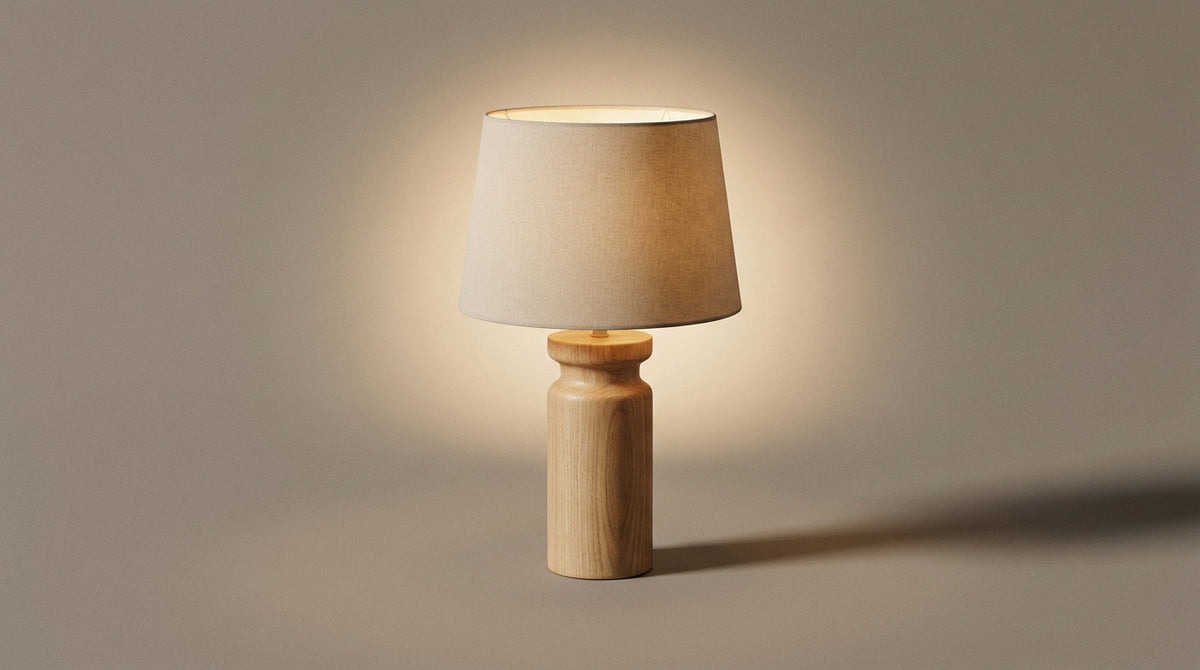
A wood lamp is chosen in this order: the room to light, the mounting height, then the wood tone. Shape decides the light output, colour comes after. Our collection holds 257 references as of 6 October 2026; across a sample of 29 of them, the bedroom is the most commonly declared room, at 72%.
Which wood lamp for which room?
The room sets the format. In the living room, a large piece placed on the floor or on a side piece of furniture. In the bedroom, a compact model whose brightness can be dimmed. On the ceiling or the wall, a lamp that lights without taking up floor space. Three uses, three mounting heights.
Every product page for our wood lamp states its room and its style, so you do not have to guess before ordering.
Wood lamp for the living room: which shape to favour?
The living room comes just after the bedroom in our sample, declared on 62% of product pages. It is the room where light is composed in layers rather than from a single point.
A wood floor lamp lights a reading corner without drilling into a wall, and follows the sofa when it moves.
Wood table lamp in the bedroom: which format to choose?
In the bedroom, light should fall low. A natural wood lamp whose shade sits below eye level lights a book without glare, and a narrow base fits on a modest bedside table.
Our selection of wood bedside lamps is best read by height, a more useful marker than diameter when the table is small.
Wood lamp on the ceiling or the wall?
Above a table, a hanging volume structures the room: a wood chandelier brings the light down to tabletop level and avoids the flat glare from the ceiling.
Where no furniture can hold a lamp, the light moves to the wall. A wood wall light frees up the useful surface and throws its light upwards.
A single piece rarely lights a whole living area: complete it with a second design light fixture chosen for its role, reading or circulation.
- Living room: broad, low source, never in line with the sofa
- Bedroom: variable brightness, shade below eye level
- Ceiling or wall: closed shade, bulb invisible from the seat
Solid wood or driftwood: which material for which light?
Solid wood absorbs light and returns it as a halo; driftwood, irregular, cuts it into shards. A closed shade lights mainly downwards, an open driftwood piece lets light filter through its gaps. The material decides the result before the colour.
| Finish | Light output | Where it works best |
|---|---|---|
| Dark wood (walnut, brown) | Warm halo, contained light | Living room, study |
| Light wood (beige, white) | Broad diffusion, room made larger | Bedroom, small room |
| Driftwood | Fragmented light, marked shadows | Entrance, reading corner |
Walnut wood lamp: which light for a dark tone?
Walnut absorbs more: at equal power, the light appears warmer and lower. Allow for a slightly more generous bulb, or dimming to bring back brightness during the day.
Wood and white lamp: the contrast that structures
Brown remains the most commonly declared colour in our sample, at 45%, ahead of beige and black, at 41% each. A dark base under a light shade brightens the room without changing the lamp.
Driftwood lamp: irregularity as a diffuser
The shapes recorded are mainly the sphere, at 45%, and the tube, at 34%. Driftwood steps outside this geometry: its roughness casts shifting shadows, which suits an entrance or a reading corner.
A wood lampshade can be changed without changing the lamp, and is often enough to move from dense light to open light.
Trending lamps play heavily on this detail: a taller shape, a lighter tone, and the character of the room shifts.
To light a worktop or a narrow table, the Scandinavian wood pendant keeps a fine line and leaves the wood visible from below, where it is looked at most.
- Diffusion: closed for a halo, open for a burst
- Visual weight: a dark tone feels dense, a light tone feels light
- Care: a varnished finish dusts off, a raw finish needs nourishing
Wood lamps: the Designix selection


At what height and with which bulb should you place a wood lamp?
Allow 75 to 85 cm between the shade and the tabletop for a pendant, and seated eye level for a table lamp. As for the bulb, the E27 cap is declared on 72% of our sample, which leaves a wide choice of replacements.
Which cap for a wood lamp?
Of the 27 product pages in our sample that declare a cap, E27 leads by far with 72%, then LED at 10%, E14 at 7% and G9 at 3%. A wood lamp is therefore easy to re-bulb, including with a filament bulb for a warm result.
The choice of bulb matters as much as the choice of lamp: our guide to types of bulbs details caps, wattages and light outputs.
Which colour temperature warms wood?
| Temperature | Effect on wood | Room |
|---|---|---|
| 2700 K | Pulls the grain towards amber | Bedroom, living room in the evening |
| 3000 K | Keeps the original tone | Living area, study |
| 4000 K and above | Cools the material | Circulation areas, work |
IP20: what does it change in a wet room?
IP20 is declared on 100% of our sample: these lamps are protected against solid bodies, not against water. At a distance from a sink or a bathtub, no problem; right next to them, another model is better.
- E27: the most commonly declared cap in the sample, bulbs easy to find
- 2700 K: the temperature that warms wood
- IP20: dry rooms only
- Dimming: to check page by page
In which room will your wood lamp live?
If you are still hesitating between two shapes, describe the room and the available height to us: you can talk about your project with the team before ordering anything.
How to choose a handmade wood lamp?
Three checks are enough: weight, edges, socket. Solid wood is heavy for its volume and shows its grain on the edges; a veneer is recognisable by its sharp edges and its lightness. The 2-year warranty is declared on 100% of our sample.
Solid or veneered wood: what weight reveals
A solid base transmits fewer vibrations and takes on a patina over time. A veneer on a stable backing stays straighter for longer in a very warm room. The test takes one gesture: lift it, compare, look at the edges.
What the warranty and the CE marking say about a product page
In our sample, the 2-year warranty is declared on all 29 product pages and the CE marking on 28 of them. These details can be checked before purchase, as can buyer reviews, available on the Designix Google listing.
A handmade piece should also be judged switched on: accent lighting reveals the grain and the finishing flaws that frontal light hides.
- Weight: solid wood is heavy for its volume
- Edges: the grain stays visible on the edges of solid wood
- Socket: clean face, no play in the holder
- Details: 2-year warranty and CE declared on the product page
How to care for and make a wood lamp last?
A barely damp microfibre cloth, never abrasive or alcohol on a varnished finish. Dust the shade dry, from top to bottom, without pressing. For the bulb, switch off the power, let it cool, then unscrew by the cap and not by the glass.
Cleaning a wood lampshade without damaging the finish
Wood tolerates humidity in the air, not standing water. A quick wipe, without soaking the joints, is enough. If the finish marks, the repair often goes through the shade: a new wood lampshade restores clean light without changing the base.
Changing the bulb without marking the socket
A socket gets marked when you screw too hard or pull crooked. A bulb fitted without forcing lasts a long time, and replacement is done with the power off, when cold. A dimmable model requires a compatible bulb, otherwise the dimming hums or trips.
- Microfibre: barely damp, never soaked
- Dry: shade dusted from top to bottom
- Cold: bulb changed with the power off
- Without forcing: screw in until contact, no further
In stock · shipping costs shown at checkout · up to 30% off in your cart


Ready to turn inspiration into reality?
Tell us about your room, your style and your budget, and we will show you the pieces that truly suit your project.
Get guidance in 30 seconds →




