
White light fittings: choosing the right colour and light
This article is also available in French: Luminaire blanc
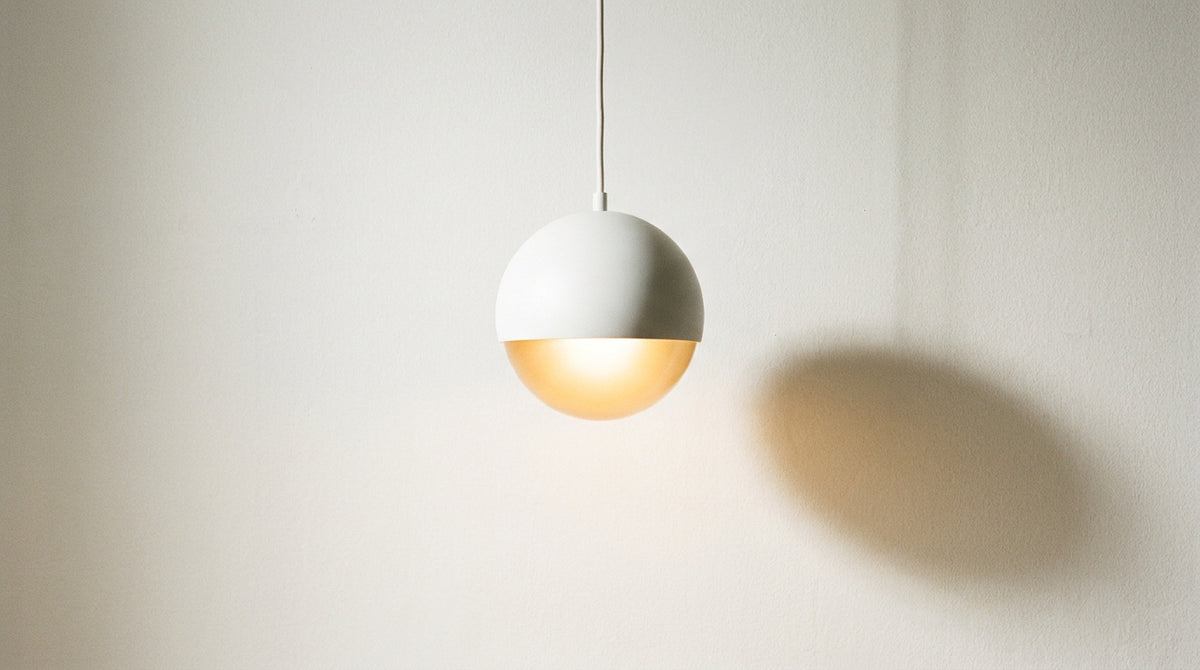
There are two whites behind a white light fitting: the colour of the housing and the temperature of the light. Decide the temperature first, 2700 to 3000 K in a living room, 4000 K above a worktop. The colour of the housing comes second, depending on the wall it sits against.
Is 4000 K white or yellow?
4000 K is white. A neutral white, with no trace of yellow or blue, like an overcast day. On a white-housed light fitting it gives a crisp room and faithful colours, but little atmosphere once night falls.
The result also depends on the diffuser. Opal glass softens, a metal shade concentrates. That is why a pendant light at 4000 K seems softer than a spotlight of the same value.
What is the difference between 4000 K and 3000 K?
3000 K leans warm, 4000 K stays neutral. On a white wall the nuance shows immediately: 3000 K gilds it slightly, 4000 K leaves it as it is.
| Criterion | 3000 K | 4000 K |
|---|---|---|
| White wall | slightly golden | frankly white |
| Atmosphere | warm, muted | crisp, functional |
| Rooms | living room, bedroom, dining room | kitchen, study, hallway |
| Pale wood | warmed | faithful rendering |
To decide room by room, our guide to colour temperature by room details the values that work for each use.
What is the difference between warm white and neutral white?
Warm white contains a hint of orange, neutral white no longer does. The boundary sits around 3300 K, and most bulbs on the market fall clearly on one side or the other.
- 2700 K, warm white, the most common value in interiors
- 3000 K, bright warm white, still warm but easier to read by
- 3500 K, soft white, the balance zone between the two
- 4000 K, neutral white, crisp, with no colour cast
- 6500 K, cool white, best kept for garages and workshops
The choice comes down to what you want to see in the evening: your sofa lit as if in broad daylight, or as if by candlelight. Our article on warm or cool light describes that shift.
What is the difference between white light and yellow light?
None, in nature. What we call yellow light is a very warm white light, between 2200 K and 2700 K. White starts around 3000 K. Yellow and white therefore describe two points on the same scale, not two opposite colours.
Yellow is not a colour, it is a point on a scale
A filament bulb does not emit yellow. It emits a very warm white that the eye files under yellow. The phenomenon comes from the temperature of the filament, never from a coloured filter.
- 2200 K, orange, the look of a flame
- 2400 K, amber, typical of retro bulbs
- 2700 K, pale yellow, the standard warm white
- 3000 K, slightly warm white, almost neutral
This scale, set out in our article on white or yellow light, is the reference point for every other setting.
Why a white light fitting can give yellow light
The housing decides nothing. The bulb carries the temperature. A white lacquered housing fitted with a 2200 K bulb gives orange light; the same housing with a 4000 K bulb gives blue-white light.
Designer light fittings often exploit this contrast: crisp white by day, amber light in the evening, with a dimmable bulb.
Which white light fitting in each room?
A white goes anywhere, but not at the same temperature. Across a sample of 250 references from our catalogue on 6 October 2026, 84% carry the Living room tag and 46% the White tag. The two therefore cross very often.
A white light fitting is chosen first for its shape, then for its light. White wall lights and pendants do not occupy the same volume, even at the same temperature.
White light fitting for the bedroom
Aim for 2700 K. A white housing imposes nothing on the light: the bulb sets the atmosphere, and the bedroom calls for the warmest.
A headboard calls for a low light source. A white wall light placed at mattress height lights the book without waking the other person.
Mounting heights, wattages, direction: our guide to bedroom lighting is a reference point before you drill.
White light fitting for the kitchen
Switch to 4000 K. A worktop reads best in neutral white, especially if it is dark or stainless steel, where warm light turns brown.
An LED ceiling light in matt white covers the room from a single point.
For the island, a kitchen pendant hangs at eye level and takes over at the end of the meal.
As for the socket, the base is only given on 222 of the 250 product sheets sampled on 6 October 2026: among them, 26% are E27, 21% integrated LED and 14% E14. Check the socket before buying the bulb.
White light fitting and wood
White and pale wood go together at 3000 K. Oak keeps its blondness, the white does not turn grey. At 4000 K, the same wood cools down.
White light fitting and gold
Gold brings the warmth that white refuses. White housing, gold socket or trim: the room gains depth without changing temperature.
A white light fitting is therefore judged on two levels: what it shows when switched off, and what it gives when switched on.
White light fittings: the shop selection
 Pendant light | Bravara
 Pendant light | Harmonie Florale
 Pendant light | Mirdanissa
 Ceiling light | Dorica
 Ceiling light | Cylira
 Living room floor lamp | Foglia
See the whole selection: Alternative to Luminaire.fr: designer lighting shop | Designix
The choices behind the selection can be seen on our Google listing, if you prefer to read buyer reviews before deciding.
If you are still torn between two temperatures, describe your room to the team: the answer often comes down to one sentence.
White outdoor light fittings: what white does not forgive
A white housing outdoors forgives neither dirt nor water. Across the sample of 250 references from our catalogue on 6 October 2026, 94% carry an IP20 rating, an indoor rating. Outdoors, aim for IP44 at minimum, and IP65 on an exposed facade.
Which IP rating outdoors?
The IP rating describes resistance to dust and water, not how well the colour holds up. Two digits are enough to sort them.
- IP20, dry indoor use only, under a canopy for example
- IP44, protected against splashes, covered terrace, porch
- IP65, resists water jets, exposed facade, poolside
- IP67, temporary immersion, large planter, pond
Our guide to outdoor lighting sets out these ratings by type of installation.
A white housing on a pale facade
White on white render disappears in broad daylight. Look for contrast with stone or wood, or embrace the blending effect.
Damp also leaves marks on matt white. Satin or powder-coated white is easier to clean. In the same sample of 250 references on 6 October 2026, 89% carry a 2-year warranty, which leaves time to judge how it holds up over a full winter.
A successful white comes down to three decisions: the bulb temperature, the IP rating, the shade of the housing. The rest is lighting decor, where every light source matters as much as the furniture it lights.
In stock · shipping costs shown at checkout · up to 30% off in your cart


Ready to turn inspiration into reality?
Tell us about your room, your style and your budget, and we will show you the pieces that truly suit your project.
Get guidance in 30 seconds →




