What bulb wattage do you need to light a living room?
This article is also available in French: Quelle puissance ampoule pour salon
Read the maximum wattage printed on each light fixture before buying the bulb: that is what counts, never the box. Then spread the light over three points, ceiling, wall and floor, with moderate bulbs. For a 20 m² living room, a 10 to 13 W LED per point is enough in most cases.
What bulb wattage do you need for a living room?
Allow 10 to 13 W in LED per light point, around 1,000 lumens per bulb. This benchmark applies to the ceiling light that provides the general lighting. An accent point, a reading lamp or a wall light, is fine with 5 to 8 W. The fixture's rating plate remains the reference you must not exceed.
Each designer light fixture sets its own upper limit. Beyond it, the socket heats up, the shade yellows and the warranty is void. This limit is expressed in watts, including for an LED.
What lighting wattage for a living room?
Watts no longer measure the light produced since LEDs became standard. What counts is the flux in lumens and the actual illuminance on the floor, in lux. The difference between lux and lumens comes down to a surface ratio: the same bulb lights a room half as brightly when the room is twice as big.
- 10 to 13 W in LED for a general lighting ceiling light
- 5 to 8 W for a wall light, a reading lamp or an accent floor lamp
- 1,000 lumens roughly per main point, flux to read on the packaging
- IP20 is enough in dry interiors, no living room needs waterproofing
Which LED bulb to light a living room?
Out of a sample of 136 references from our Living Room Decoration catalogue on 28 September 2026, 63% mention LED and 82% are guaranteed for three years. The default choice is therefore an LED with a standard base, in 2,700 K, whose flux is stated in black and white.
Second figure from the same sample: 88% of these references are IP20. In other words, they target dry rooms such as the living room, with no waterproofing requirement.
One strong ceiling bulb or several spread-out points?
Several moderate points, almost always. Three sources of 800 to 1,000 lumens look better than a single one of 3,000 lumens: the eye finds relief, shadows double up, each area keeps its use. A very strong ceiling bulb flattens the room and tires the eye faster late in the evening.
A central chandelier keeps its place above the coffee table or the sofa area, provided it does not stay the only source. It is the combination that creates the atmosphere, not the performance of a single bulb.
What spot wattage for a living room?
A recessed spot rarely goes below 4 W and rarely exceeds 7 W. In GU10, that means fluxes of 350 to 500 lumens per spot. Multiply by the number of spots on the track, then compare the total with the need of the central point they replace.
If you are hesitating between the two solutions, a wide LED ceiling light covers the room with even light where four directed spots leave shadow areas on the floor.
How to spread the light between ceiling, wall and floor?
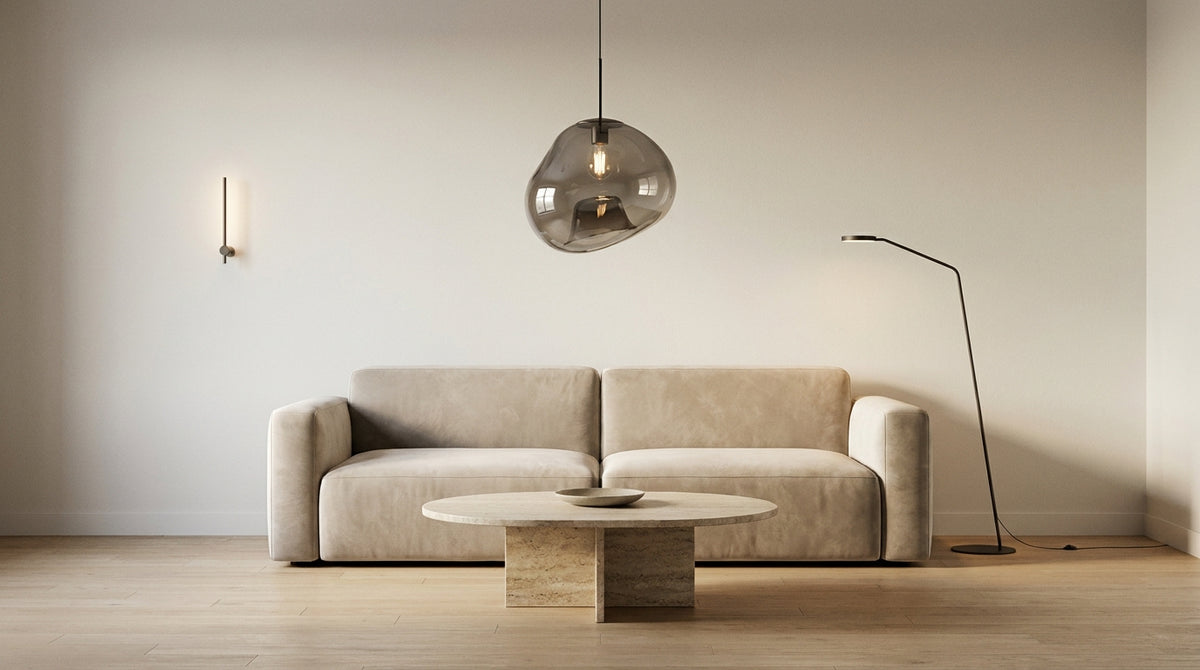
The method comes down to three layers. The top layer provides the general lighting, the middle layer lights the uses, reading, screen, meals. The bottom layer warms the atmosphere as the evening goes on.
A floor lamp placed near the sofa is often enough to create this third layer, without touching the electrical installation.
The principle is detailed step by step in our article on the art of lighting your living room in three layers, with the heights and wattages for each level.
If you prefer to base the wattage on your actual room rather than an average, the team can quote your living room renovation project.
What is your living room like?
Is 60 watts a lot?
Yes for incandescent, no for LED. A 60 W filament bulb delivered around 700 lumens; a 60 W LED sends out several thousand. In a living room, 60 W of LED on a single point is therefore largely excessive. The figure to remember is no longer consumption, but flux.
| Original bulb | Target flux | LED equivalent |
|---|---|---|
| 40 W incandescent | 400 to 450 lm | 4 to 5 W |
| 60 W incandescent | 700 to 800 lm | 7 to 8 W |
| 100 W incandescent | 1,300 to 1,500 lm | 13 to 15 W |
Can I replace a 40 watt bulb with an LED?
Yes, whatever the base. A 4 to 5 W LED replaces a 40 W incandescent in the same E27 socket. Only the consumption changes. Caution lies elsewhere: the shape of the bulb must fit under the shade and stay compatible with the fixture's limit.
The gain is even clearer from a halogen: replacing a halogen bulb with an LED removes most of the heat sent towards the ceiling and the back of your neck.
What happens if I use a bulb that is too powerful?
The socket and the wire heat up beyond what they can take. With an incandescent, the excess shows as a yellowed shade, a cracked socket or a tripping circuit breaker. With LED, the margin is wider: 15 W of LED heats less than 40 W of filament. The ceiling remains the one printed on the fixture's label.
The same bulb does not give the same result from one room to another. For a table, the bulb wattage for a dining room is set lower, because the pendant hangs close to the tabletop.
Which base and colour temperature for a living room?
First identify the base: E27 on the screw bulbs of chandeliers and floor lamps, GU10 on recessed spots, G9 on the small pin bulbs of decorative wall lights. Then choose 2,700 K to 3,000 K for a warm white living room. These two criteria are checked before the wattage.
Which bulb to light a living room: E27, GU10 or G9?
| Base | Where to find it | What it implies |
|---|---|---|
| E27 | Chandeliers, ceiling lights, floor lamps | The widest choice of wattages and temperatures |
| GU10 | Recessed spots and tracks | Directed beam, lower wattage per point |
| G9 | Small wall lights, decorative fixtures | Compact format, flux limited by the size |
Switching from one base to another means changing the fixture, not just the bulb. Our guide to the different types of bulbs helps identify the right format before ordering.
If in doubt, measure the socket: the bulb base size is read in millimetres, and an E14 does not fit into an E27.
Which colour temperature to get it right?
Warm white remains the safe value for a living room. 2,700 K recalls the light of a filament: woodwork, fabrics and skin tones benefit. 3,000 K suits a very contemporary interior, brighter but still warm. Above 4,000 K, the room takes on an office tint.
- 2,200 to 2,500 K: cosy atmosphere, reading corner
- 2,700 K: warm white, living room standard
- 3,000 K: bright warm white, light interiors
- 4,000 K and above: best kept for work rooms
Keep the same temperature on all the points of the same area. Two mixed temperatures in the same room are immediately visible. To validate a complete plan, you can talk about your project with the team, who go through the room point by point.
Living room bulbs and fixtures to match
 Roxanne Pendant Ø28 cm – Elegant decorative blown glass pendant
 Léonor Vertical Pendant – Colourful designer glass
 Tiffany Floor Lamp – Integrated LED, dimmable, gold finish
 Grace Wall Light – Wall light
 Venise Pendant – Designer pendant with a luminous water drop effect
 Tiffany Vertical Diamond Pendant – Elegant dimmable LED designer fixture
The mistakes that ruin a living room's light
Four faults come back again and again: a single source in charge of lighting the whole room, mixed colour temperatures, a wattage chosen on watts rather than lumens, and a bulb incompatible with the dimmer already in place. None of them is fixed by going up in wattage.
Why do two bulbs of the same wattage look different?
Because watts measure consumption, not the light produced. Two 9 W bulbs can show 600 and 1,050 lumens depending on their efficiency. The beam angle and the shade do the rest: a frosted globe spreads, a reflector concentrates.
Colour rendering quality also plays a part. A high rendering index keeps woods and textiles faithful. A low index dulls the shades and leaves a living room flat, even at high wattage.
When in doubt about the result, the simplest thing is still to see the light switched on. The Designix Google listing gives access to the workshop and to buyer feedback on the selection.
Dimmer: what to check before buying
An old dimmer and an LED bulb do not always get along. Two details must appear: a dimmer compatible with LED, and a bulb marked dimmable. Without them, the light flickers, buzzes or refuses to go below a certain threshold.
A dimmable LED in 2,700 K covers most evening uses: full power for reading, half for a film, ten percent to finish the day.
On the same subject
In stock · shipping costs shown at checkout · up to 30% off in your cart


Ready to turn inspiration into reality?
Tell us about your room, your style and your budget, and we will show you the pieces that truly suit your project.
Get guidance in 30 seconds →