Black metal pendant light: how to choose it, hang it and light it
This article is also available in French: Suspension métal noir
Which bulb base should you choose for a black metal pendant light?
Start with E27 unless you have a reason not to: it covers 68% of the 241 listings in our survey that state a bulb base, as of 6 November 2026. Integrated LED follows at 21%, E14 at 7% and G9 at 3%. A standard base keeps the bulb replaceable, so you can change the colour temperature and wattage without buying a new light.
E27: the bulb can be changed, and so can the light
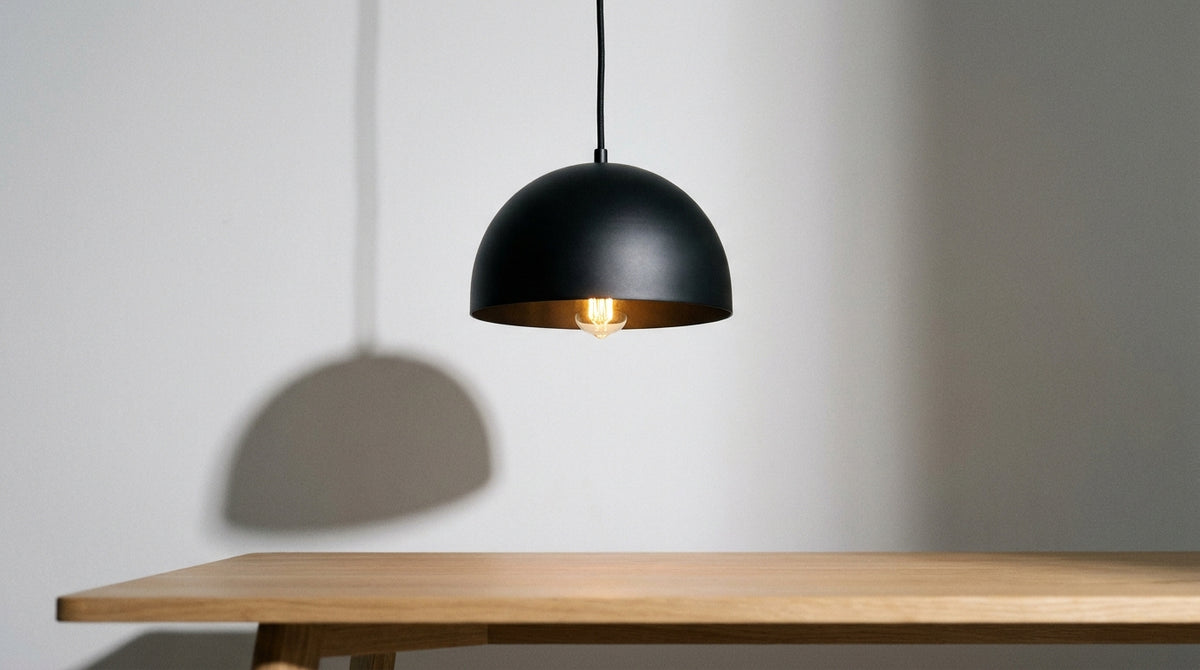
A filament LED at 2700 K gives black metal that warm light which takes the chill off steel. A dimmable bulb lets you lower the brightness in the evening without touching the fixture. The base also accepts a more powerful bulb if the room lacks brightness.
Integrated LED: nothing to replace
A sealed module, even light, no bulb sticking out of the shade: this is the choice for tube shapes and slim lines, such as the tube pendant light. The trade-off is simple to state: when the module fails, it cannot be replaced. In our survey, 81% of the 245 listings state a two-year warranty, 10% three years and 9% five years.
E14 and G9, for small diameters
These two bases are found on narrow shades and clusters of several sockets. 10% of the survey is split between them. Check the maximum wattage per socket and the size of the bulb before ordering.
Once the base is settled, all that remains is choosing the position. Our guide to the black pendant light for the living room details the diameters that work above a sofa without overwhelming the room.
If you are still torn between two diameters, browse the selection of black metal pendant lights by room and by base: you will immediately see the one that fits your space.
At what height should you hang a black metal pendant light?
Set the drop by the bottom of the shade, never the top: that is the measurement the eye reads. Measure the clear height between the ceiling and the desired lowest point, then lock the cable. Standing directly beneath the fixture, your view across the room should not be blocked.
Above a dining table
The bottom of the shade frames the tabletop: the light falls on the plates, not into the eyes of seated guests. The wider the diameter, the lower the drop needs to be to stay readable. Choose the dining room light based on the width of the tabletop first, not the catalogue photo.
One figure is surprising: in the survey, the living room is ticked on 100% of listings, the bedroom on 80%, the study on 76% and the dining room on 5%. The table is not the most frequent destination for these pendant lights, which makes measuring the drop all the more useful.
Hallway and entrance: shorter than you think
In a passageway, you are looking for light, not an obstacle. Set the lowest point above the eye line of someone walking through, and keep the passage clear even with a box in your arms. A tube or arc shape works better than a flared shade.
High ceiling: the drop must not float
On a very high ceiling, the drop gains length without losing its connection to the floor. Our guide to the high-ceiling pendant light covers these spaces, including the question of the connection and the fixing point.
Industrial black metal, black and gold or black and wood pendant light: how do you decide?
Decide based on the room and the light you want, not on the trend. Industrial matte black embraces the steel and brings the light down; black and gold warms up an already dark interior; black and wood softens a bright space. Black appears on 98% of the 245 listings in the survey, gold on 11%, beige and white on 9%.
The industrial-style lamps play on the exposed structure and visible screws; the others rely entirely on the shape of the shade.
A designer light is judged first when switched off: the silhouette on the ceiling decides the rest, the light only confirms it.
| Finish | What it changes | Room where it works | Point to watch |
|---|---|---|---|
| Industrial matte black | Absorbs light, strong contrast against a pale wall | Living room, open-plan kitchen, entrance | Shows fingerprints, handle with a soft cloth |
| Black and gold | Reflects warm light, jewellery-like effect | Living room, dining room, adult bedroom | Needs a restrained setting, otherwise it overwhelms |
| Black and wood | Warms without shine, makes the metal feel less cold | Bedroom, study, through-room | Check that the wood stays matte, a glossy varnish clashes |
Industrial black metal pendant light
Matte powder-coated black absorbs light and lets the bulb do the work. It is the most common finish in the catalogue, and the most forgiving: it works with a concrete wall, brick or raw floorboards. It also forgives small alignment errors, which matters when you are installing three lights.
Black and gold metal pendant light
The gold interior reflects warm light downwards without glare. It is the finish that rescues a room with dark walls, provided you let it take centre stage on its own. Our guide to the black and gold light explains which combinations work and which cancel each other out.
Black and wood metal pendant light
Wood breaks the coldness of the metal and makes the pendant light believable in a bedroom. Look at the tone of the wood before the shape: a very red walnut warms, a pale wood lightens the silhouette. Our guide to the wood and black pendant light details these pairings.
Black metal pendant lights in the selection


Three-lamp black metal pendant light: how do you align it?
Align the three sockets on the same axis, with a constant gap: it is the spacing that shows, not the length of the cable. Put a mark on the wall, mark the three points before drilling. A three-lamp pendant light usually goes wrong on spacing, rarely on height.
Work out the spacing before you drill
Start from the centre of the table or worktop, then spread out on either side. The gap must stay identical between the three points, otherwise the eye picks it up immediately. A chalk line and a spirit level are all you need.
Alignment and heights
Lock the three drops at the same mark, at the height of the bottom of the shade. A difference of a few millimetres shows on a line of three. If the ceiling is slightly sloped, compensate on the cable, not on the shade. Our guide to the 3-lamp pendant light covers the installation step by step.
What should you check in the ceiling before drilling?
Three checks before the first hole: the actual weight of the pendant light, the nature of the structure behind the plaster and whether there is a connection box. A metal light weighs more than it looks, and a fixing chosen too quickly remains the only point of failure in the installation.
The weight and the nature of the structure
A concrete or hollow-block structure settles the question. A plasterboard ceiling requires a fixing anchored behind the board, or a threaded rod anchored into the structure. Our guide to installing a pendant light on the ceiling covers the full method.
The connection box
The recessed ceiling box must remain accessible and take the three conductors. If you cannot find it, the light point was installed the old way: the connection needs redoing before you hang anything.
And in a bathroom?
No, not as it stands. In the 245-listing survey as of 6 November 2026, the stated protection rating is IP20 in 100% of cases, and no model states IP65. In a wet zone, that rules it out. Our guide to the bathroom pendant light gives the permitted zones and sealed shapes.
Unsure about the nature of the ceiling, the cable length or the number of points to plan? You can ask the team with a photo of the fixing point and the ceiling height: the answer often saves a wasted trip.
In stock · shipping costs shown at checkout · up to 30% off in your cart


Ready to turn inspiration into reality?
Tell us about your room, your style and your budget, and we will show you the pieces that truly suit your project.
Get guidance in 30 seconds →