Beam angle of a spotlight: the right cone of light
This article is also available in French: Angle de faisceau spot
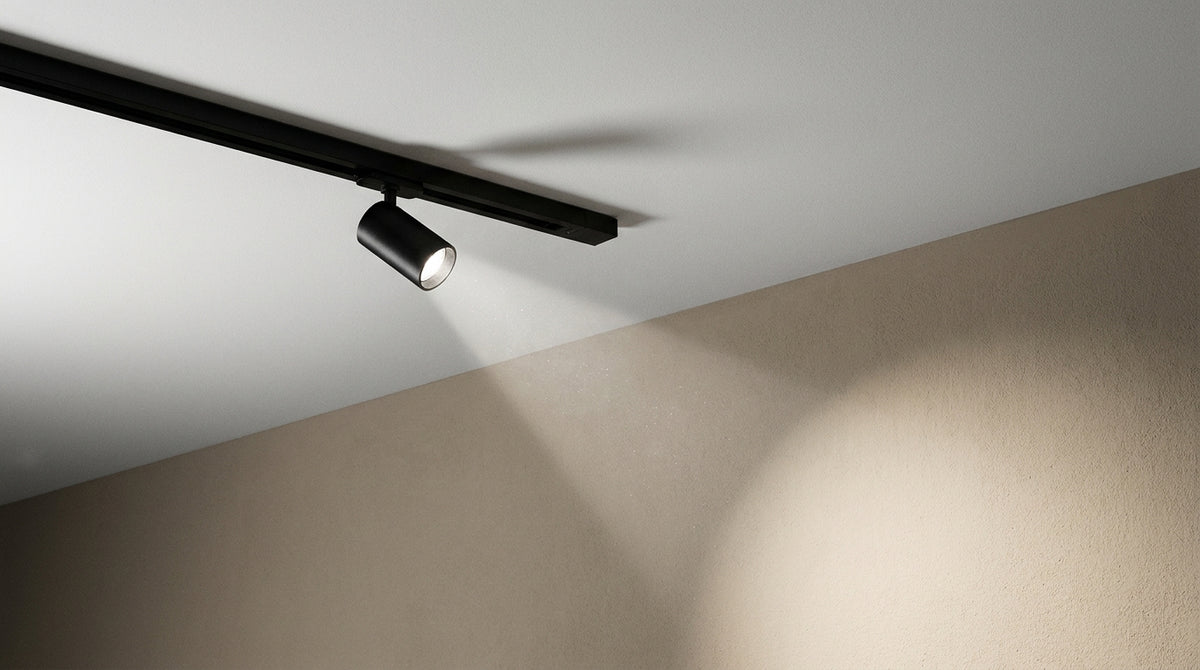
A 36° spotlight placed at 2.50 m covers a cone about 1.60 m wide; a 24° at the same height, about 1.05 m. First choose what you want to see (an object or a worktop), then the mounting height: the diameter is deduced rather than guessed.
What exactly is the beam angle of a spotlight?
The beam angle is the opening of the light cone, expressed in degrees between the two edges where the intensity falls to half its maximum value. A 24° at 2.50 m high lights 1.06 m wide, a 36° covers 1.62 m. It is this width on the floor that decides the result, not the number printed on the packaging.
The measurement at 50% intensity
The measurement takes the point where the light falls to half its maximum. Beyond that, the cone keeps falling without stopping abruptly. Two spotlights rated 36° can therefore differ by a few useful degrees, depending on the reflector depth and the position of the source. Accent lighting works precisely on this boundary between light and near-darkness.
Why two 24° spotlights do not light the same
The stated degree is a manufacturing intention, not a measurement on the floor. Four elements shift the actual cone:
- The collimator depth: a long reflector narrows the beam by a few degrees
- The source size: a wide LED spills more than a narrow LED
- The lens: a diffuser instead of a lens widens the cone without saying so
- The mounting height: the same spotlight does not cover the same surface at 2.20 m and at 3 m
Which beam angle for which room?
From 10 to 24°, the cone targets an object or a wall. From 36 to 45°, it holds a worktop. At 60° and more, it ensures circulation without creating shadow areas. The room does not choose the angle, the use chooses it: the same kitchen accepts two different cones under the same ceiling.
On an adjustable spotlight, the angle is completed by a direction. A spotlight bar in surface mounting lets each head pivot toward the surface to be lit, which a fixed recessed model never allows.
10 to 24°: the object and the wall
The tight beam creates a sharp contrast, the one that makes a material readable. It suits four very concrete situations:
- A painting or a photo, provided the spotlight is set 40 to 60 cm from the wall
- A niche or a shelf, where the light must stay contained
- A plant or a collectible, to draw a sharp shadow
- A textured wall in stone or brick, to reveal the relief
36 to 45°: the worktop
This is the everyday angle, the one that lights a table without punching a hole in the light at the centre. At 2.40 m, a 45° covers 1.99 m, a whole island. In a kitchen, it lights the cutting board and the edge of the sink in the same gesture.
To frame a real room, a kitchen lighting project is worth more than a row of spotlights placed at random: the position of the cones is drawn before drilling.
60° and more: circulation
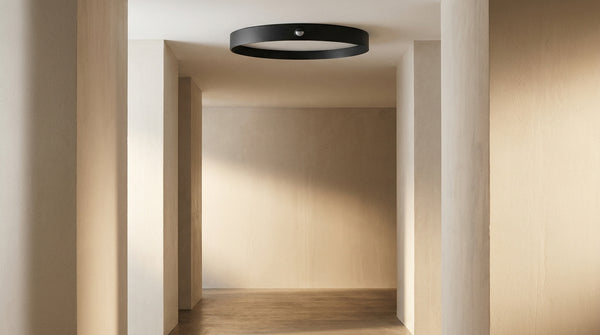
A wide cone floods the floor, without a hot spot or a patch on the furniture. It suits hallways, entrances and passages. A LED ceiling light often replaces several spotlights there, for a calmer look on the ceiling.
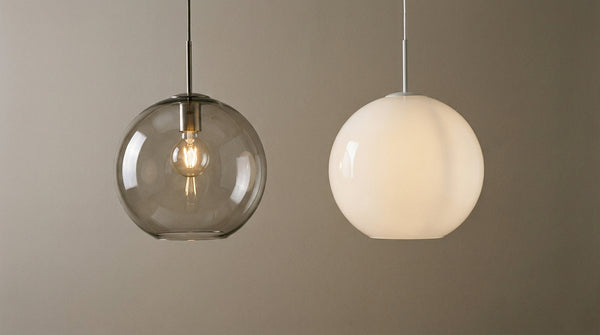
Above a table, the reasoning reverses: better a tighter cone and an assumed low point, like a dining room chandelier, than a wide wash that lights the heads and not the plates.
Which surface do you need to light first?
How to calculate the cone width according to height?
Multiply twice the mounting height by the tangent of half the angle. At 2.50 m, a 36° gives 1.62 m wide and a 24° gives 1.06 m. The calculation takes ten seconds and avoids the spotlight that spills beyond the worktop.
The formula 2 × height × tan(angle/2)
For a 36° at 2.50 m: half the angle is 18°, its tangent 0.325. Twice 2.50 m makes 5 m, which we multiply by 0.325, or 1.62 m in diameter. The same calculation at 2.40 m gives 1.56 m.
The result holds for a bare spotlight. A recessed LED downlight fitted with a diffuser often widens the cone by a few degrees, and the patch on the floor gains in softness what it loses in precision.
Three heights compared, 2.40 m ceiling included
| Angle | At 2.40 m | At 2.50 m | At 3.00 m |
|---|---|---|---|
| 24° | 1.02 m | 1.06 m | 1.28 m |
| 36° | 1.56 m | 1.62 m | 1.95 m |
| 45° | 1.99 m | 2.07 m | 2.49 m |
| 60° | 2.77 m | 2.89 m | 3.46 m |
If your ceiling drops below 2.50 m or if the room is a through-room, tell us the surface and the height: we frame the number of spotlights and the right cone before ordering. Describe your room to us.
Why does a narrow beam glare near a wall?
Because the light point hits the wall a few centimetres away and comes back toward the eye. A 24° placed 30 cm from a wall leaves a sharp and tiring patch. The glare comes from the distance to the wall as much as from the angle itself.
The setback rule
Allow at least 50 cm between the spotlight axis and the wall, and 60 cm for a 24° beam. It is the same reasoning as the spacing between spotlights: regularity avoids dark areas as well as hot spots.
Density matters as much as setback. Too many tightly spaced spotlights recreate the glare that the narrow angle was meant to avoid, and the ceiling covers itself in patches. The number is calculated, not improvised: see how many spotlights per m² before drilling.
The adjustability of the spotlight
A tiltable spotlight solves the problem without moving anything: it is aimed toward the wall to be grazed rather than toward the passage area. The right installation reflexes are detailed in this guide to install recessed spotlights in the living room.
When the wall remains too close, the wall light takes over: a LED wall light diffuses horizontally and eliminates the return of light into the eye.
Beam angle and bulb: what does the base dictate?
The base guides the choice: a GU10 often caps around 36°, an integrated LED drops to 15° or rises to 60° depending on its collimator. Out of the 31 references in our Barre de spots collection recorded on 27 November 2026, 39% declare a GU10 base and 32% an integrated LED.
GU10 base or integrated LED
The GU10 is replaceable, so the angle can be corrected afterwards by changing the bulb. It is the prudent choice when the mounting height is not yet settled. Our selection of GU10 bulbs covers several openings for the same fixture.
The integrated LED module fixes the angle, but it does it better: dedicated collimator, sharper beam, reduced bulk. The comparison GU10 or GU5.3 spotlight helps decide on the low-voltage side.
E14 and E27: what changes
In our survey, 23% of the listings declare an E14 base and 6% an E27. These sockets accept bulbs with a very wide angle, often beyond 100°, which changes the game: the cone no longer comes from the spotlight but from the bulb itself.
- IP20 on 100% of the survey: these spotlights are intended for dry rooms, not for the bathroom
- Surface mounting on 90% of the survey: the cone starts from the underside of the fixture, lower than a recessed model
- Angle rarely declared: this is precisely the information to ask for before buying
- Humidity: in a wet room, you need a waterproof spotlight and not an IP20 model
Spotlights and spotlight bars with a chosen cone


In stock · shipping costs shown at checkout · up to 30% off in your cart
Ready to turn inspiration into reality?
Tell us about your room, your style and your budget, and we will show you the pieces that truly suit your project.
Get guidance in 30 seconds →