Smart lighting: home automation that actually works
This article is also available in French: Les luminaires intelligents : la domotique au service de la lumière

Keep the wall switch, but know what it cuts off: when the power is off, a connected bulb leaves its network and no longer responds. Start with the room where the light stays on the longest, choose the bulb according to its base, and then decide how to control it. Of the 250 references in our catalogue recorded on 29 September 2026, 30% are E27.
What is a smart lighting system?
It is lighting whose switching on, brightness and sometimes colour temperature can be controlled without getting up, from a phone, a timer or a remote control. It combines a light fitting that accepts a controlled bulb, a control module, a wireless network and an interface that gives the commands.
What are the 4 pillars of home automation?
Four building blocks, of which lighting only ever uses a part.
- The control: wall button, phone, remote control or timed scenario
- The network: local radio in the home or the router's WiFi
- The actuator: the controlled bulb, or a module housed in the box
- The interface: the app that brings together rooms and scenes
Wireless home automation lighting or WiFi connected lighting?
| Criterion | Wireless home automation lighting | WiFi connected lighting |
|---|---|---|
| Getting started | One module, then a single app for the room | Bulb by bulb, without a gateway |
| Network dependency | Often local, control survives an internet outage | Every command goes through the home network |
| Wall switch-off | The module loses control | The bulb loses control |
| Scalable | Several rooms on the same protocol | Simple addition, room by room |
The choice is rarely based on technology alone, but on usage: when the light should come on, at what brightness, and for how long. That is the starting point for rethinking the lighting of a living room, even before looking at a product.
How does a smart light work?
A controlled bulb contains a small radio and a chip: it receives a command, then adjusts the power sent to the LED. The rest is a matter of network. What really decides is therefore not the bulb alone, but the complete chain, from the wall button to the app.
The wall switch that wipes out the network
Turn off the two-way switch and the bulb goes out for good. Without power, it leaves its network and no longer responds, neither to the phone nor to the timed programming. This is the most frequent discovery after purchase.
Three solutions exist: leave the button on and place a wireless control over it, replace the switch with a connected model, or give up control in that room. This detail weighs more heavily than the colour temperature, and it explains a good part of what a connected bulb changes in everyday life.
The base decides what is possible
Of the 250 references recorded in our catalogue on 29 September 2026, the base is given on 225 listings: E27 for 30%, E14 for 15%, GU10 for 11%.
- E27: the large screw base, the one used on pendants, ceiling lights and floor lamps
- E14: the small screw base, common on wall lights and bedside lamps
- GU10: two pins, for adjustable spotlights and tracks
- LED mention: 19% of the survey, the bulb cannot be replaced and only wall control remains possible
A model only fits one base. Choosing your connected bulb according to the socket therefore remains the first reflex, before comparing apps.
Which light to connect first, room by room?
The room where the light stays on the longest, and where getting up to turn it off weighs the most. Most often the living room in the evening, then the bedroom. One well-equipped room is more convincing than a whole home half done.
Choosing the object before the chip is the method we follow in the home's decor advice: we look at the room, the height, the material, and only then at what the bulb can do.
The home's light fittings to equip first
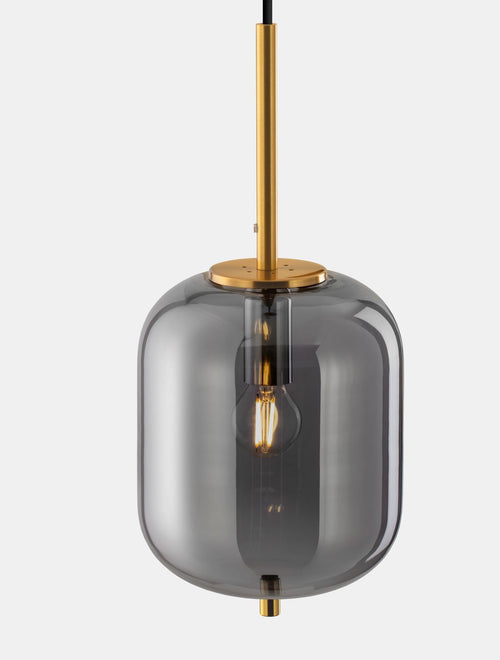
 Basic form Gold pendant light
 Basic form Gold pendant light
 Basic form Gold pendant light
 Velora Brown outdoor light
 Bobi 2-light black pendant
 Gentor 4-light white pendant
See the whole selection: Light fitting, Home lighting, Online lighting store
In your home, which room deserves to be controlled first?
Bedroom, hallway and rooms without a central point
A bedroom works well with two sources: a soft point on the ceiling, a low light near the bed. At 2700 K, the colour temperature stays warm and does not strain the eye on waking.
- At the bed: a wall light or a reading light, at shoulder height when seated
- On the ceiling: an LED ceiling light or a pendant, on an E27 or E14 bulb
- In the hallway: a wall light, which lights without dazzling at night
- On a desk: a table lamp, controlled separately from the rest
For the bedroom, the bedroom lighting collection brings together the small-base models that accept a controlled bulb.
On the wall, a wall light at shoulder height when seated replaces the bedside lamp and frees up the nightstand.
When the room has no ceiling supply, lighting a room without a ceiling light goes through the wall and the floor.
A floor lamp then provides the high point that is missing, without work or chasing.
Kitchen, dining room and outside
A kitchen pendant remains the simplest point to control: E27 bulb, permanent power supply, no module to house in the box.
Glass pendants require more attention: the material diffuses light differently, and the brightness setting changes with it.
Outside, the question is not control but weatherproofing. Of the 250 listings recorded on 29 September 2026, 94% are IP20, therefore reserved for dry interiors. An IP65 model, i.e. 4% of the survey, is required for a terrace or a facade.
How to get started with home automation without changing everything?
With a single light point, the one that annoys you the most, and with a model that accepts a replaceable bulb. Getting started requires no chasing or new cable. You then extend room by room, once the first gesture has become a reflex.
What are the disadvantages of home automation?
They are real, and they are known in advance.
- The wall switch: switching off wipes out control until power is restored
- Compatibility: two different protocols do not always talk to each other
- The network: without a connection, some remote commands fail
- Cold colour temperature: a very white light in the evening delays falling asleep
On this last point, what blue light does in the evening is worth knowing before setting a night scene.
If you are hesitating between two models on a specific plan, send us a photo of the room and the ceiling height: we will reply about the light fitting and how to control it. You can also ask us your question about a specific model directly, before buying.
Turning on the light remotely with your phone: what really works
What works: a bulb permanently powered, a stable network, an app that keeps scenes in memory. What does not work: a wall switch turned off, and a remote command on a model without local memory.
Three uses keep their promises.
- The gradual wake-up: the light rises gently in the bedroom, without a brutal alarm
- The evening scene: a living room chandelier that dims in one go, without leaving the sofa
- The general switch-off: a single gesture when leaving the house, including for a forgotten room
The result depends above all on where the network performs poorly, and that is where the method counts: turning on the light remotely with your phone is prepared before purchase, not after.
In stock · shipping costs shown at checkout · up to 30% off in your cart
Ready to turn inspiration into reality?
Tell us about your room, your style and your budget, and we will show you the pieces that truly suit your project.
Get guidance in 30 seconds →