Opal glass pendant light: the right light at the right height
This article is also available in French: Suspension verre opalin
What is an opal glass pendant light, and what kind of light does it diffuse?
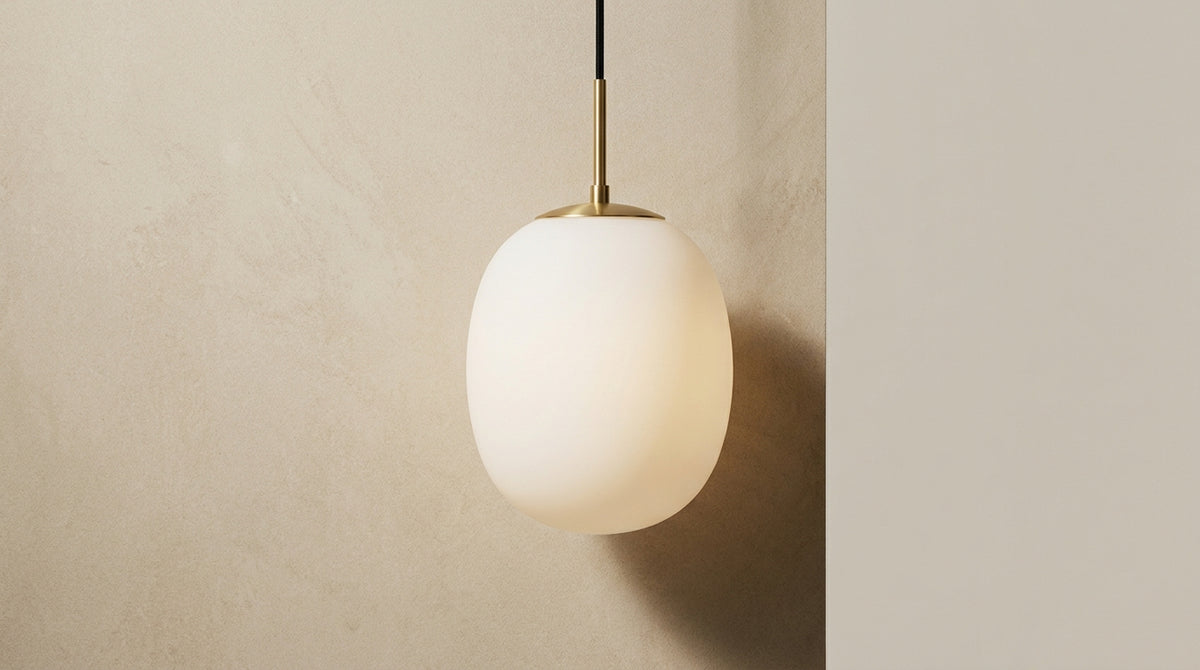
Opal glass is glass tinted through its mass, milky white and translucent. A bulb placed behind it is no longer visible: its light passes through the wall, disperses and comes out across the whole surface of the globe. The point source becomes a large source, which removes glare and softens the shadows cast on the table.
How does opal glass transform the light of a bulb?
Three effects, visible as soon as you switch it on.
- Diffusion: the filament disappears, your eye no longer meets the direct source.
- Evenness: the globe lights up entirely, with no hot spot or dark area.
- Neutrality of tones: white glass colours almost nothing, unlike amber glass which warms everything it lights.
- Absorbed output: the glass eats part of the light, so plan for a slightly more generous bulb than for an open shade.
One point that is often confused: opal glass is not frosted glass. The opacity comes from the mass, not from surface sanding. It therefore does not fade over time, whereas sanded glass can lose its texture when cleaned.
What is the difference with clear or smoked glass?
Clear glass lets you see the bulb and directs the light downwards in a sharp beam. Opal lights the whole room. In between, the smoked glass pendant light keeps a little transparency but filters cool tones and creates a cosier mood.
Which opal glass to choose: milky white, tinted or ribbed?
Milky white remains the safest choice: neutral light, a style that spans the years, easy matches with light wood as well as aged brass. Tinted glass warms the scene and colours the halo. Ribbed glass does not change the colour, it cuts the light into stripes and gives relief to the globe when switched off.
| Type of glass | Light | Mood | Ideal room |
|---|---|---|---|
| Milky white | Neutral, even | Modern, Scandinavian, minimal | Dining room, hallway |
| Cream or amber tinted | Warm, slightly coloured | Soft, retro, intimate | Bedroom, living room |
| Ribbed or pleated | Neutral, striped | Textured, decorative | Kitchen island, hallway |
When tinted glass has the advantage
In an already very bright room, cream glass warms without yellowing the walls. You simply have to accept that it tints what it touches, faces and cutlery included. To judge the result before choosing, the amber glass pendant light shows how a warm tint ages the light without darkening it.
Ribbed glass, a choice of shape as much as of light
The ribs break the flow and spread it in regular bands. The bulb becomes less readable, the globe gains a strong presence on the ceiling, which matters in a hallway or above an island. If you complete the set with a table lamp, glass shades carry the same codes without duplicating.
What height and diameter for an opal glass pendant light?
A globe of 30 to 40 cm suits a table for four to six, and the bottom of the glass sits 75 cm above the surface. Over an island, the same distance is measured from the worktop. Too high, the light is lost in the room; too low, it crushes the table and gets in the way of eye contact.
Which diameter for which table length?
- Four covers: a globe of 25 to 30 cm is more than enough.
- Six covers: 30 to 40 cm, or two smaller globes aligned along the axis.
- More than two metres: three volumes, or one large diameter pendant light held on its own.
At what height should the glass hang above the table?
Allow 75 cm between the bottom of the globe and the surface for a seated meal, a little more if the room is tall and people move around it. A height adjustable pendant light saves you cutting the cable and leaves the necessary margin. Also think about weight: glass is heavier than a fabric shade of the same size, so the fixing point must be solid. When the ceiling has to host several sources, a living room lighting project avoids stacking three fittings that fight each other.
Unsure about the diameter or height before ordering? Designix advice lets you describe your room and have your choice validated.
Which bulb shows off opal glass best?
An E27 LED of 6 to 10 W, in 2700 K or 3000 K depending on the room, gives the best result. Warm white makes milky glass sing, neutral white stays crisper above a worktop. Avoid spot bulbs: opal glass needs a source that lights in all directions.
Warm white or neutral white behind milky glass?
- 2700 K: amber halo, the right choice for a dining room and a bedroom.
- 3000 K: whiter, comfortable above an island.
- Above 4000 K: the glass turns white and loses its softness, reserve it for circulation areas.
2700 K bulbs remain the safest compromise when you hesitate between mood and readability.
Base, power and dimmer: the three points to check
- E27 base: the standard for pendant lights, check it on the model's spec sheet.
- Power: 6 to 10 W LED covers most globes, adjust to the size.
- Dimmer: a dimmable bulb transforms the evening without changing the fitting.
Which room to install an opal glass pendant light in?
Anywhere the light should bring people together: dining room, kitchen island, bedroom, hallway. Opal glass succeeds because it lights wide and low at the same time, without casting hard shadows. One reservation: a low ceiling means shortening the drop to keep the field clear.
Dining room: the large globe above the table
This is the room where the result shows fastest, because the light falls on plates and faces. A single globe is enough up to six covers, two smaller volumes take over beyond that. To frame the format, the guide to the dining room pendant light details the long table cases. If you want a dressier result, an opal glass dining room chandelier plays the same light with more material.
Kitchen: opal glass above the island
The kitchen needs useful light without glare in your eyes when you work standing. Opal glass solves this, provided you come down to 85 cm from the worktop. A well sized kitchen pendant light lights the island without dazzling the room. Two or three aligned volumes are a better replacement for a single large globe on a very wide kitchen chandelier.
Bedroom and hallway: the format that changes everything
In a bedroom, a globe of 25 to 30 cm hung high diffuses without being harsh when you wake up. A bedroom pendant light in opal glass replaces the bedside lamp when you want to read without dazzling the other person. In the hallway, the challenge is the opposite: you need visible volume from the door, which a hallway chandelier in ribbed milky glass handles.
In stock · shipping costs shown at checkout · up to 30% off in your cart
Ready to turn inspiration into reality?
Tell us about your room, your style and your budget, and we will show you the pieces that truly suit your project.
Get guidance in 30 seconds →