Small hallway ceiling light: the light that makes a space feel bigger
This article is also available in French: Plafonnier petite entrée
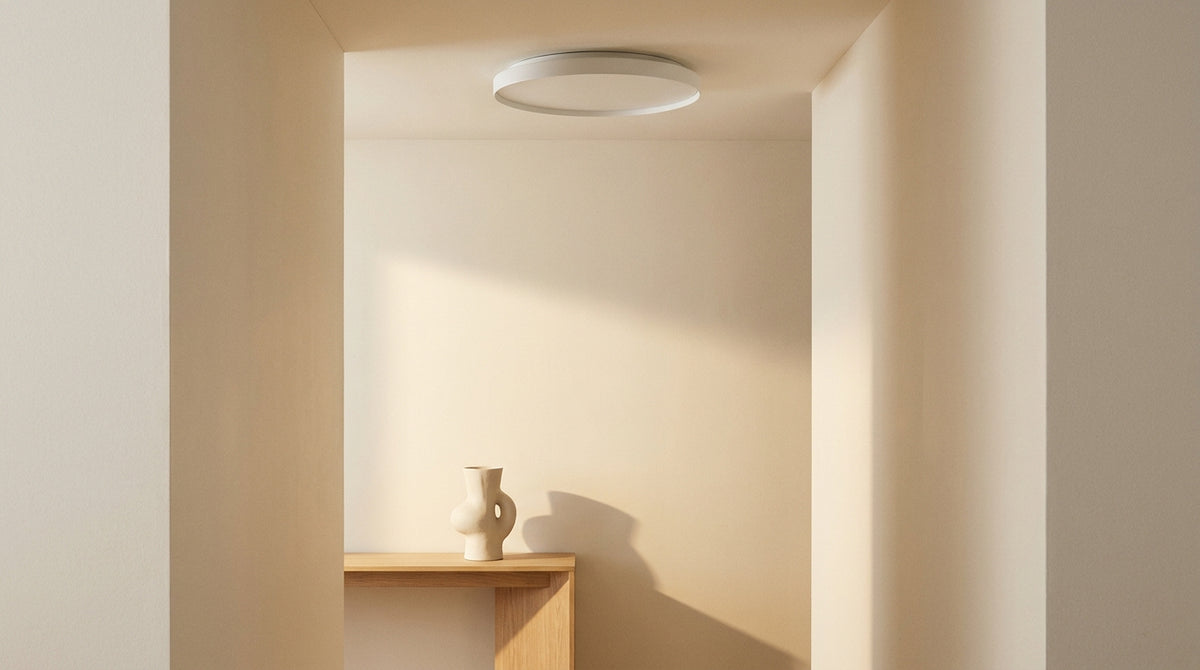
Measure floor to ceiling, then look at what hangs down: in a small hallway, aim for a projection of 5 cm maximum. A flat ceiling light of 25 to 30 cm in diameter, at 2700 K to 3000 K, lights a 1.20 m wide corridor without narrowing the walkway.
Which ceiling light for a small hallway?
A flat model 25 to 35 cm in diameter, with a projection of no more than 5 to 7 cm. That is the size that frees up the walkway without crushing the volume. Beyond that, you need a high ceiling or a wide corridor, otherwise the fixture becomes a visible obstacle and casts harsh shadows on the walls.
Sort by three dimensions before style: diameter, projection, weight. Steel and aluminium hold on a standard fixing point, glass needs a more solid support. The product pages of our designer ceiling lights give the actual projection, which a photo never shows.
The corridor is a separate case, since it does not follow the same rules: light should glide along the walls rather than fall straight down. A corridor ceiling light is judged on its side diffusion, not on its power.
Flat, surface-mounted or small pendant: what does the projection change?
Projection is the height that hangs down from the ceiling. It determines the clearance, the width of the halo and the sense of space. Three families share a hallway, and they do not suit the same ceilings.
| Format | Projection | When to choose it |
|---|---|---|
| Flat | 3 to 5 cm | Narrow corridor, low ceiling, clearance under 2.10 m |
| Surface-mounted | 10 to 20 cm | Ceiling of 2.50 m and above, wide halo |
| Small pendant | 25 cm and more | High, open hallway, never in line with a door |
Small flat ceiling light: when the ceiling should disappear
In a 1.20 m corridor, flat is the only comfortable option: it blends into the surface and lets the eye travel to the far end. The halo is wide but shallow, which suits a walkway.
- Projection of 3 to 5 cm: nothing drops into the field of view
- Diameter of 25 to 30 cm: enough to cover 3 m² without marking the ceiling
- Opal or frosted glass diffuser: no glare when you look up
- 2700 K to 3000 K: the warm light that makes you want to come in
A flat hallway light is also quicker to clean: a single flat face, no dust in the corners.
Surface-mounted ceiling light: the right choice when the ceiling is high
Above 2.60 m, a flat model leaves the room empty: the light stays glued to the ceiling and the floor remains dark. A projection of 10 to 20 cm brings the source closer to the eye, widens the halo and gives the volume its scale back.
When height is lacking and the central point crushes everything, two hallway wall lights replace the ceiling light and visually lengthen the corridor.
What diameter and height to avoid bumping your head?
Aim for 2.10 m between the floor and the lowest point of the fixture, and 30 cm maximum diameter in a 1.20 m corridor. Two dimensions are enough to avoid ducking your head and making the room look narrower than it is.
Clearance above the door
The door is the tricky point. A leaf that opens inwards sweeps an arc equal to its width. A fixture placed in that arc will always end up being hit, and even a flat model gets in the way of a ladder or a wardrobe.
Start from the floor: open the door, trace the arc, transfer it to the ceiling. In a narrow corridor, sometimes only 40 cm of usable space remains in the centre. Corridor wall lights get around the problem without touching the walkway.
Before drilling, check a dimension on a photo or a plan with someone who knows low ceilings. Asking the team avoids a crooked hole and a product return.
The measurement to take before ordering
Three measurements, one tape measure, five minutes. Take them with the door closed, then open. In a narrow corridor light, the width at the tightest point matters more than the floor area.
- Floor to ceiling in the centre of the room, never in a corner
- Corridor width at the narrowest point, furniture clearance included
- Door arc transferred to the ceiling, to rule out the impact zone
- Height of the lowest point: 2.10 m minimum to move around
If you are torn between redoing a single light point and reworking the whole hallway, the hallway and corridor lighting project sets out both options before the first drill hole.
How much light for a hallway of 2 to 4 m²?
Allow 100 lumens per m² for moving around, 150 if the hallway doubles as a storage or reading corner. Over 3 m², that gives 300 to 450 useful lumens, split between the ceiling light and a secondary source. A single powerful central point always leaves the corners in shadow.
The layered method
A hallway is composed like a room: a main layer on the ceiling, a supporting layer on a wall, a marker near the door. Each layer can stay low; it is their addition that makes the room readable.
- Main layer: the ceiling light, carrying most of the output
- Wall layer: a wall light above the console, lighting faces
- Low marker: a night light near the lock, for coming in with full hands
The exact output depends on the height and colour of the walls. The method to calculate the amount of lighting applies these ratios room by room.
G9, E27 or GU10 socket: what our catalogue shows
The socket determines the size of the bulb, and therefore the output possible in a small diffuser. It is the detail that causes the most returns when it is chosen after ordering.
| Socket | Share of the survey | What it changes |
|---|---|---|
| G9 | 43 % | Slim diffuser, compact bulb, shorter output |
| E27 | 29 % | Replaceable anywhere, wide choice of colour temperatures |
| GU10 | 18 % | Directional beam, useful for aiming at a wall |
| E14 | 4 % | Small thread, very slim fixtures |
Out of a survey of 92 references in the Hallway wall lights collection of our catalogue, as of 8 November 2026, 43 % have a G9 socket, 29 % an E27, 18 % a GU10 and 4 % an E14; 93 % are IP20 and 97 % use LED technology. The collection counts 752 references on that date, and the 5-year warranty covers 98 % of the surveyed sample.
A fixture with G9 bulbs remains the most discreet: the socket is tiny, so the diffuser can be very slim. E27 keeps the advantage of replacement, with an E27 dimmable or smart bulb screwed in within two seconds.
Then comes the choice between integrated LED and a replaceable bulb. A LED ceiling light removes the socket question: nothing to replace, nothing to customise either. A replaceable bulb leaves the choice of temperature and output, provided you stay within the diffuser's range.
No electrical supply in the ceiling: what solution?
Two families work without drilling the ceiling: rechargeable wall lights, fixed to the wall and charged by USB, and battery models for areas without a socket. The result is softer than a central point, and installation requires no cable routing.
The choice depends on whether a socket is nearby and on the height of the wall. To light a hallway without a ceiling light, the wall layer is often enough on its own.
Which style for a hallway that sets the tone?
One rule only: the light should match the room. In an older flat, a round frosted glass ceiling light spans the decades. In a contemporary interior, a matte black 30 cm square is enough to set the tone without cluttering.
A style that sets the tone without cluttering
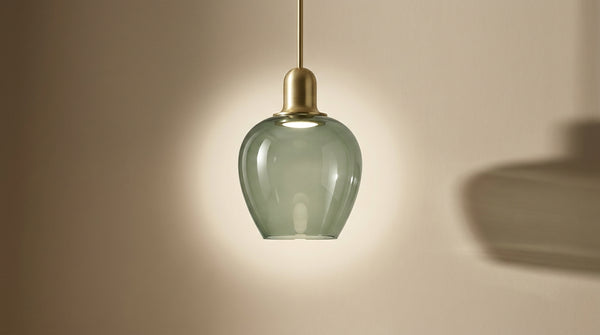
A hallway can carry one strong object, not three. A minimalist ceiling light in brass or smoked glass plays the part without competing with the moulding or the mirror.
Colour matters as much as shape: a light model blends into a white ceiling, a black model draws a line and lifts the eye. To visually enlarge a room with light, light the walls rather than the floor.
Three mistakes that make a small hallway feel cramped
- A fixture that hangs too low: it cuts the perspective and puts the ceiling at head height
- Light that is too cool: above 4000 K, the hallway becomes an office corridor
- A single central point: the corners stay dark and the room looks smaller than it is
All three can be fixed without changing the fixture: a shorter projection, a warmer bulb, a wall light as a complement.
What is the main constraint in your hallway?
Compact ceiling lights for small hallways


In stock · shipping costs shown at checkout · up to 30% off in your cart


Ready to turn inspiration into reality?
Tell us about your room, your style and your budget, and we will show you the pieces that truly suit your project.
Get guidance in 30 seconds →