Halogen pool light: switch to LED without draining
This article is also available in French: Remplacer projecteur piscine halogène par led
Switch off the circuit breaker in the technical room, then remove the optical unit: on most pools, the cable leaves enough slack in the niche to work on the coping without draining. Before ordering any lamp, note two things: the supply voltage, 12 V or 230 V, and the exact format of the removed lamp.
Do you need to drain the pool to change the light?
No. The light is removed from inside the pool, not from the technical room: one front screw, a gasket, and the unit comes out. The pool is only drained in two cases: a cracked niche, or a block sealed in resin that cannot be dismantled.
The light is just one point of light in a whole: coping, beach, terrace. Our page on balcony and terrace renovation covers this overall framing, useful when pool and surrounding work happen in the same season.
Changing a pool light without draining, step by step
- Circuit breaker off in the technical room, and check that no timer restarts the circuit during the work
- Front screw unscrewed by hand, above the coping: it easily slips into the pool
- Optical unit pulled slowly, the cable unrolls gradually in the niche
- New gasket every time you refit, never reuse the old one, even if it seems supple
The resin-sealed unit cannot be dismantled
On some older lights, the lamp is embedded in resin: no screws, no bulb to change. Replacement then concerns the whole unit, keeping the niche when its diameter allows. This is the most common case on shell pools, where the niche is moulded into the wall and cannot be replaced without structural work.
Is a halogen transformer compatible with LED lamps?
Not systematically. A ferromagnetic, wound transformer almost always powers an LED without flinching. An electronic model, however, expects a minimum load: below this threshold, the lamp flickers, buzzes or refuses to light.
How to know if the circuit is 12 V or 230 V
Measure with a multimeter, set to AC, 300 V range, on the transformer output terminals, circuit powered. Note the voltage read and the format of the removed lamp: these two data are enough to identify the compatible part.
- 12 V: a transformer in the technical room, a thin cable to the niche
- 230 V: no transformer, the lamp receives mains directly
- Unstable reading: electronic transformer dropping out, sign of too low a load
If you hesitate between changing the lamp alone and replacing the whole unit, describe your installation via the contact page: the answer avoids a back-and-forth order.
Should you keep the old transformer?
The ferromagnetic one can be kept without hesitation. The electronic one should be replaced with a model that accepts low loads, otherwise the new lamp will never have the stability of a halogen. The subject is covered in detail in our article on replacing a halogen with an LED with dimmer, useful if a dimmer is already installed on the circuit.
The connection itself requires two precautions: respect the polarity on the terminals, and house the transformer in a ventilated volume away from splashes. Our guide to wiring an LED transformer covers the complete diagram, from the circuit breaker to the niche.
Which LED to replace the halogen?
First note the format of the removed unit, then think in lumens rather than watts. A 20 W halogen is replaced by a 2 to 3 W LED. On a high-power pool bulb, add up the flux rather than compare the stated watts.
LED floodlights and outdoor lighting for the pool


What is the LED equivalent of a 20 W halogen bulb?
Allow about 250 lumens, i.e. a 2 to 4 W LED depending on the diffuser quality. Our article on LEDs to replace a halogen details these equivalences, and the one on the number of lumens for outdoor lighting helps sizing when the pool is more than a few metres.
Which colour temperature to choose?
| Use | Temperature | Rendering |
|---|---|---|
| Terrace, evening meals | 2700 to 3000 K | Warm white, flattering skin tones |
| Pool, evening swimming | 4000 K | Clear water, true blue |
| Scenic effect | RGB | Controllable colour, blending between units |
Our LED floodlights collection has 164 references as of 29 September 2026, including IP65 aluminium units: enough to withstand poolside humidity without returning every season. Waterproof models are grouped in IP65 outdoor luminaires.
What are the disadvantages of LED bulbs?
Three, and none is a dealbreaker. The entry cost, higher than halogen. Compatibility with some dimmers, which makes the lamp flicker. And a more directional light, which draws a sharp cone instead of the wide halo of a filament.
What is your situation around the pool?
What are the possible problems with my LED pool lighting?
- Aged gasket: water seeping into the unit, visible as condensation behind the glass
- Moisture in the niche: the cable stays wet, oxidation reaches the connections over the seasons
- Colour shift: a poorly cooled LED loses its white and turns green or pink
- Too low a load: flickering or delayed start on an undersized electronic transformer
For a colour rendering that changes over the evening, RGB floodlights cover another use, more scenic than functional.
How to light the terrace around the pool?
In layers, never with a single point. A pool lit from the front by a single floodlight produces a flat rendering, with black areas all around. Three levels of light are enough to give depth to the beach area and make the water's edge usable at dusk.
The three layers of light around a pool
- At ground level: low-level markers along the beach, for walking and bare feet
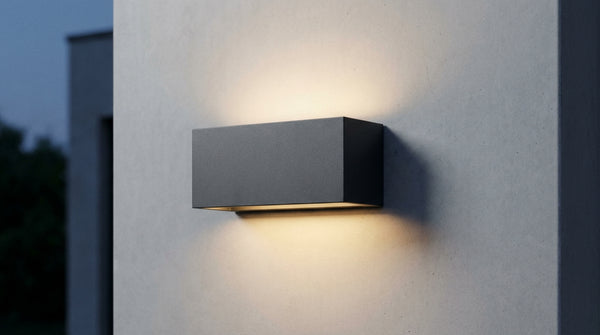
- Seating height: an outdoor wall light on the gable or boundary wall, which lights without dazzling
- Overhead: a diffused point above the table, or a pendant on a pergola, treated as terrace lighting
The first two layers work in warm white, around 2700 K. The pool itself stays on a more direct light: the contrast between clear water and an amber terrace is what gives the impression of depth. Our article on terrace lighting around the pool breaks down these three levels according to the configuration, and the one on outdoor lighting extends the reasoning to the garden and balcony.
One last point matters as much as the flux: the visibility of the source. An outdoor spotlight aimed at the wall rather than at the eye lights better and tires less. Customer feedback on our Google listing often mentions this detail, and the durability of units guaranteed for 3 years.
In stock · shipping costs shown at checkout · up to 30% off in your cart


Ready to turn inspiration into reality?
Tell us about your room, your style and your budget, and we will show you the pieces that truly suit your project.
Get guidance in 30 seconds →