Replacing a fluorescent tube with LED: a step-by-step guide
This article is also available in French: Remplacer neon par led
First, look for the starter, that small white cylinder on the side of the batten: if it is there, the fitting has a magnetic ballast. No visible starter, a flat casing and instant start means an electronic ballast. In both cases an LED tube can be fitted, but the wiring is not handled the same way.
Can you replace a fluorescent tube with an LED tube?
Yes, on almost every batten, and without changing the fitting. The LED tube reuses the fluorescent tube's cap, not its power supply: either you keep the ballast and fit a new starter, or you remove both. Neither setup is a job to improvise.
A tired batten, a yellowed reflector, a tube that buzzes: replacing the tube is no longer enough, and it is a complete light you should be looking at, chosen for the room rather than for the batten.
There are two families of tubes, and the packaging must say which one you are buying.
- Ballast tube: it works with the original ballast, provided you fit a new LED starter
- Mains tube: ballast and starter are removed, the tube receives 230 V directly
- Length: it must match the fitting, a 1200 mm tube will not fit a 900 mm batten
- Cap: G13 for standard tubes, G5 for slim cabinet tubes
Switching from one setup to the other is explained step by step in our article on replacing a fluorescent tube with an LED tube.
How do you fit an LED tube to an old batten?
Switch off the power at the breaker, twist the tube a quarter turn, then identify the ballast. Batten with a starter: the ballast stays, the starter goes. Batten with an electronic ballast: ballast removed, tube powered directly. Length and cap must match the fitting.
How do you fit an LED tube to a standard fitting?
The fitting does not need changing. The G13 sockets of a standard batten take an LED tube of the same length, locked with a quarter turn. The only useful check is the tube length to order, measured between the two sockets.
Before putting anything back, it is worth knowing how to remove a fluorescent tube properly: a fluorescent tube goes to the recycling centre, not the kitchen bin.
Magnetic or electronic ballast: how can you tell?
Four observations are enough, without dismantling the light.
- Visible starter: a removable white cylinder on the side, a sign of a magnetic ballast
- Heavy casing: a solid, humming block, same family
- Instant start: no starter, flat casing, it is electronic
- Buzzing: common on a magnetic ballast at the end of its life
The difference changes everything: an electronic ballast left in place makes most LED tubes flicker, and it has to be bypassed to power the tube directly.
Does an LED tube need a starter?
It depends on the tube, not the batten. A tube designed for a magnetic ballast needs a new LED starter. A tube designed for the mains needs none, and the old one must be removed. A fluorescent starter left in place produces a very recognisable flicker.
The doubt is settled by one question: does your batten model still need a starter, yes or no. The answer depends only on the tube you choose.
How do you wire an LED tube without a starter?
On a single batten, neutral comes in on one side, live on the other. On a double batten, each socket has two pins and the bridging changes: that is where mistakes cluster. The double wiring diagram should be prepared on paper before cutting any wires.
Removing the starter, or replacing it with a compatible model depending on the tube, is described on our page on replacing the starter.
If your batten is recessed into a low ceiling or tucked behind a worktop, the tube alone will not solve the problem: describe your installation and we will tell you what to fit.
Why doesn't the LED tube work?
Three causes cover almost every case: a starter left in place on a tube designed for the mains, an electronic ballast still powered, or a tube badly seated in a double batten. A flicker points to the first, one side dark points to the third.
Why does the LED tube flicker or hum?
Rapid flicker almost always comes from the electronic ballast left in circuit: it does not accept the tube's load and keeps cycling. A hum comes rather from a magnetic ballast at the end of its life. In both cases the batten needs reworking, as with a classic ceiling light tube.
Double batten: why does only one side light up?
The sockets are paired, one pin takes the live, the other the neutral. Swapped, they give a half-lit tube. Turn the tube half a turn before suspecting anything else.
- Blackened end: tube at the end of its life, not a wiring fault
- Intermittent lighting: dirty socket contact
- No light at all: live and neutral swapped, or ballast still in circuit
Which rooms still suit a fluorescent tube?
Kitchen, utility room, garage, cellar and workshop. The tube keeps a real advantage: a long, grazing light that covers a run without casting shadows. In a living room it does the opposite, it flattens volumes and hardens faces.
A kitchen tube: useful or dated?
Useful under a wall unit, dated on the ceiling. Under the unit, the bar lights the worktop without glare. On the ceiling of an open kitchen, a 6500 K tube cools materials and exaggerates angles.
A kitchen light set at worktop height provides the same useful lighting, without the hard line of the tube.
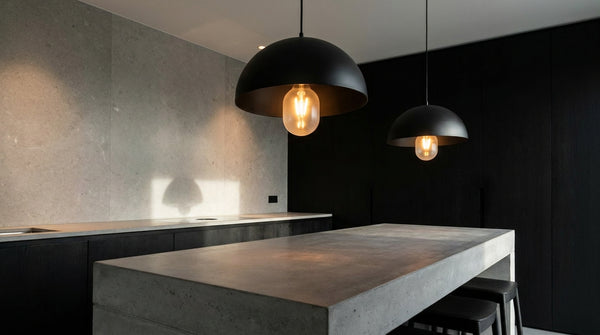
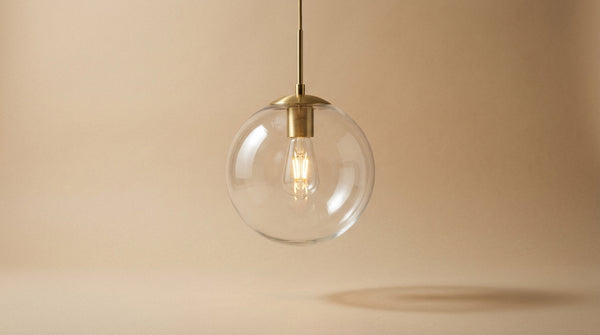
Above an island, a kitchen pendant hangs at eye level and lights the table rather than the floor.
Garage, cellar or utility room: the IP rating first?
A damp or dusty room is not treated like a hallway. Out of a sample of 246 references in our catalogue as of 5 October 2026, 89 % are IP20, a rating intended for dry rooms. For a utility room or a cellar, aim for IP44 minimum.
These rooms benefit from being reworked entirely rather than fitted with one more tube: the page on reworking the lighting of a hallway or garage details the method.
Campervans and aquariums remain two special cases, where 12 V and water resistance set their own rules. For everything else, the question comes down to what to replace a fluorescent tube with without redoing the whole installation.
Where is the tube you want to replace?
Replacing the tube with a design light: what changes
A line on the ceiling becomes a low point, and the room changes tone. You move away from bluish 6500 K towards 2700 to 3000 K, you bring the source down to working height, and the object becomes part of the decor instead of being endured.
Moving away from tubes: linear lights and LED ceiling lights


Moving away from 6500 K without losing readability
| Temperature | Rendering | Where to use it |
|---|---|---|
| 2700 K | Warm white, end-of-day light | Living room, bedroom, dining area |
| 3000 K | Slightly stronger warm white | Kitchen, hallway, entrance |
| 4000 K | Neutral white, easy to read by | Garage, workshop, technical worktop |
Lowering the temperature does not reduce readability, provided you multiply the points rather than concentrate the lumens in one place. That is the whole idea behind switching to all-LED.
The tube lights, the light composes
A tube works for efficiency, a light works for the eye. A LED ceiling light set at 2 m, a wall light at hallway height, a pendant above a table: the same amount of light, distributed differently.
Hesitating between changing the tube and changing the light is legitimate. The Designix Google listing gathers buyer feedback on the pieces we select, and each choice is commented on there by the people who fitted them.
In stock · shipping costs shown at checkout · up to 30% off in your cart


Ready to turn inspiration into reality?
Tell us about your room, your style and your budget, and we will show you the pieces that truly suit your project.
Get guidance in 30 seconds →