Neon: which size to choose for each room and use
This article is also available in French: Neon taille
First measure the pin-to-pin length, from one contact to the other, never the tube body. Then note the diameter: 26 mm for a T8, 16 mm for a T5. These two dimensions are enough to identify a 120 cm neon tube, an older model or its LED replacement.
How do you find the size of a neon tube?
A neon tube comes down to two dimensions: the pin-to-pin length and the diameter. Measure the tube in place with a tape measure, then compare it with the T8 (26 mm) and the T5 (16 mm). Length is given in centimetres, with a few formats that come up everywhere.
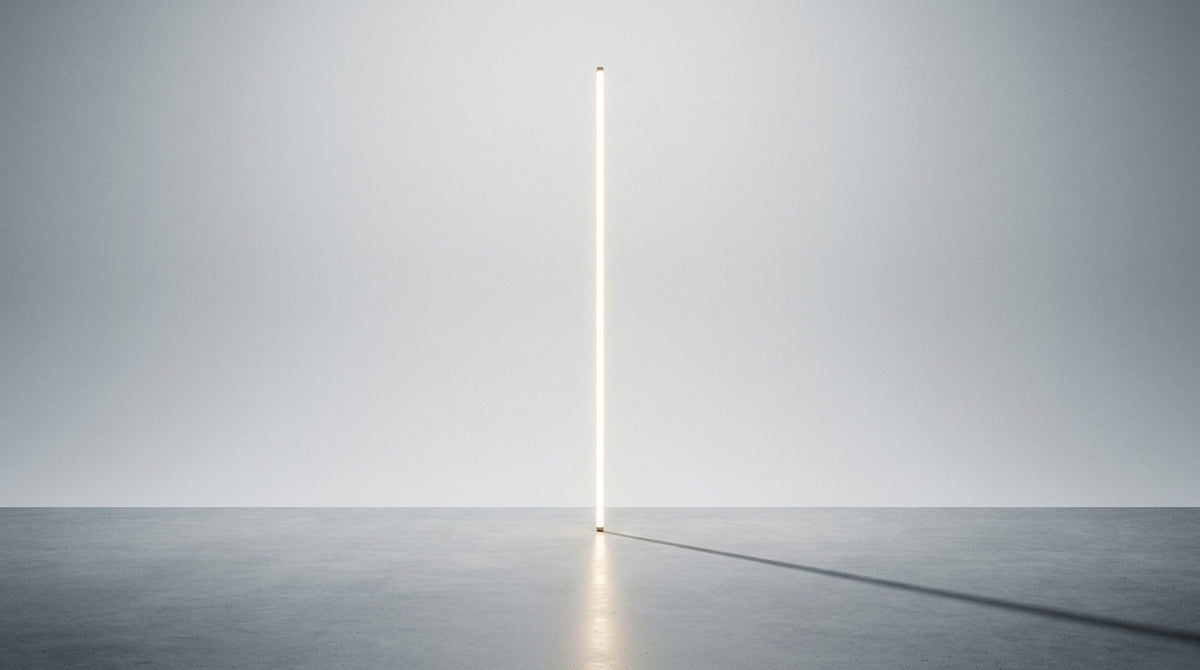
Once you have the measurement, you still have to decide whether to fit a bare tube or change approach. On a living room wall, a designer wall neon is a far better choice than a grey batten.
How to measure the length of a neon tube
The tape measure goes from one pin to the other, contacts included, not from one end of the glass to the other. A tube sold as 120 cm often measures slightly less once the sockets are in place.
- Pin to pin: the only dimension that identifies the tube
- Diameter: 26 mm for a T8, 16 mm for a T5
- Socket spacing: note it before removing the tube
- Overall length: only useful for checking available space
Even a broken tube gives you its measurement: the sockets keep their original spacing. And if the fixture is gone too, it is better to check the cap size or the socket type before ordering.
Standard neon sizes: the lengths you find everywhere
Four lengths cover almost every fixture: 60 cm, 90 cm, 120 cm and 150 cm. The 120 cm neon tube remains the most common, in kitchens as well as garages.
- 60 cm: cupboard, under-cabinet, small hallway
- 90 cm: workshop batten, utility room
- 120 cm: the format of kitchen and garage ceiling lights
- 150 cm: long runs, technical rooms
An older-model neon tube may fall outside this list. Rather than chasing a part that no longer exists, a linear light fixture takes the same place with a known measurement.
Before ordering, have your measurements checked: a few centimetres of difference are enough to change format, and the team can confirm the right model from your dimensions. Simply send us your measurements.
If you are unsure about the goods you received, the shop's Google listing is one click away and kept up to date.
What is the difference between a T5 and a T8 neon tube?
The number gives the tube diameter in eighths of an inch. A T8 measures 26 mm, a T5 measures 16 mm. Both exist in 120 cm, but they are not fitted to the same fixtures and cannot be swapped without changing the sockets.
| Criterion | T8 | T5 |
|---|---|---|
| Diameter | 26 mm | 16 mm |
| Sockets | Wide spacing | Short spacing |
| Common use | Ceiling light, batten, garage | Cornice, under-cabinet, wardrobe |
| Output | Diffuse light, living space | Grazing light, no cast shadow |
T8 neon size: the format of classic ceiling lights
The T8 is the tube of kitchens, garages and offices. Its wide socket spacing requires a precise gap: switching to T5 would mean changing the sockets, and therefore the whole fixture.
- 26 mm diameter, most often in 120 cm
- Wide sockets: do not force them when refitting
- Wattage: printed on the tube, note it before ordering
When the batten gives up, the question goes beyond the tube: changing the neon in a ceiling light means opening the diffuser without breaking the clips.
If the fixture itself is worn out, a linear ceiling light takes its place with new fixings.
And to go straight to a diode version, the LED ceiling light range covers the common formats.
The T5, slimmer: when to choose it
The T5 slips in where the T8 will not fit. Its 16 mm lets light graze a surface without casting a shadow.
- Lighting cornice: the tube disappears into the profile
- Kitchen under-cabinet: direct lighting of the worktop
- Wardrobe and bookcase: continuous light along the whole length
What is the difference between a classic neon tube and an LED neon?
A classic neon is a fluorescent tube: it needs a ballast to strike the arc and a starter to trigger ignition. An LED neon contains diodes spread along its whole length, lights instantly and needs no starter. Same length, two very different ways of working.
Ballast, starter, ignition: what changes day to day
A tube that flickers before lighting, or stays dark at the ends, often points to the starter rather than the tube. It is the simplest part of the setup: changing a starter is done with the light switched off, in one movement.
- Flickering on start-up: starter at the end of its life
- Dark bands at the ends: worn tube
- Continuous humming: magnetic ballast
- Instant start: LED tube, no starter or ballast
A classic neon does not work without a starter when it is fitted with a magnetic ballast. An LED tube no longer needs one.
How to replace an old neon with an LED neon
Choose the LED tube at the same length and diameter as the old one, then fit it into the existing sockets. There are two cases: the fixture accepts the LED tube directly, or the ballast has to be bypassed. The procedure is described step by step in replacing a neon tube with an LED tube.
Decorative neon: which length for which room?
Allow about half the width of the wall for a light line that structures the space, and 90 to 120 cm above a worktop. A neon longer than the furniture it hangs over overwhelms the room; shorter, it looks lost.
A linear light above the worktop
Between the sink and the hob, a 90 or 120 cm tube lights the working area without casting a shadow on your hands. A temperature of 4000 K renders food accurately, 2700 K warms a wooden worktop. The kitchen light is chosen to match the length of the worktop it serves.
A light line on a living room wall
On a bare wall, the right scale is a matter of proportion: the tube takes up a third to half of the available width, never the whole length. Too long, it turns the living room into a shop window.
To add relief around the line, wall lights take over where the tube ends.
And if the mood leans towards cosy, a glass light fixture spreads the same light more softly.
- 2700 K to 3000 K: warm white, living room, bedroom, reading corner
- 4000 K: neutral white, kitchen, office, workshop
- Accent colour: one colour only, on one wall only
Why the size of a fish neon has nothing to do with it
Neon tetra size refers to a small aquarium fish, not a tube. Here, we are talking about centimetres of glass and pins. The only thing they share is the word.
An LED neon in a gaming corner follows exactly the same rule of scale, with a darker background around it.
All that remains is to settle the temperature and power: choosing your type of lighting avoids buying twice.
To broaden to other shapes, a matching light fixture often completes the look better than a second tube.
Which neon do you want to light in your home?
LED neons, wall lights and linear lights


In stock · shipping costs shown at checkout · up to 30% off in your cart


Ready to turn inspiration into reality?
Tell us about your room, your style and your budget, and we will show you the pieces that truly suit your project.
Get guidance in 30 seconds →