
Picture light: illuminating your paintings effectively
This article is also available in French: L'applique picture light contemporaine sublime votre art
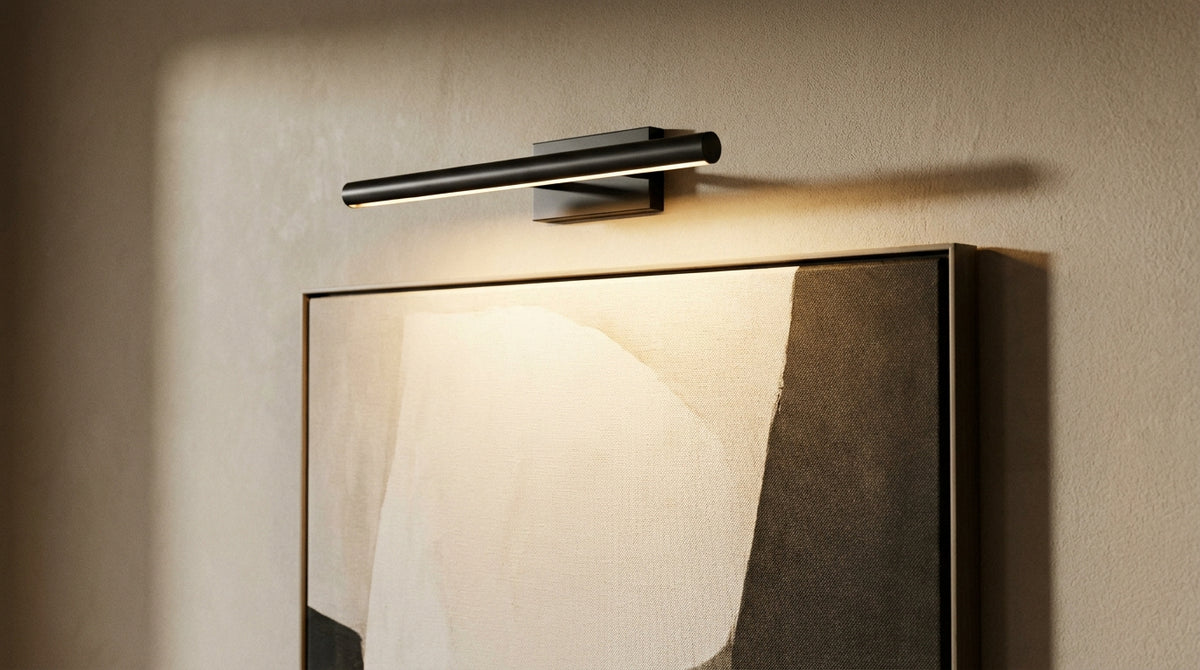
A painting hung in ordinary light loses half of its presence. Its colors fade, reflections blur the view, and the eye slides over it without stopping.
A contemporary picture light corrects this flaw: it casts a precise beam onto the artwork, instead of lighting the entire room. Here is the practical method to incorporate art into your decor and reveal it without ever damaging it.
What is a picture light and what is it used for?
A picture light is a narrow wall fixture, mounted just above a frame, which projects a downward-directed light onto an artwork. Unlike a decorative wall lamp that lights up the whole room, it isolates the painting from the wall and focuses attention on it.
This design approach has a name: accent lighting. Controlled contrast separates the illuminated object from its background, the texture of the canvas becomes legible, and the relief emerges.
A decorative wall lamp seeks atmosphere; a picture light seeks the artwork. Its arm extends from the frame to direct light onto the surface, without dazzling the viewer.
Contemporary models adopt thin, often adjustable, tubular profiles. Our designer wall lights bring together these discreet lines, designed to emphasize a frame rather than furnish a wall.
At what distance and height should a picture light be installed above a painting?
Aim for a lighting angle of about 30° between the wall and the beam: the fixture is placed above the frame, at a distance that allows the light to descend at an angle. The larger the painting, the further you should move the source from the wall to cover the entire height without shadows.
The arm must extend forward so that the beam hits the canvas, never your eyes. On a large format, a longer extension distributes the light from top to bottom.
The installation height follows that of the frame: too low, the light flattens the subject; too high, it lights the wall. Our guidelines on the ideal height for a wall light also apply here.
Before drilling, check these points:
On a fragile partition or a wall you do not wish to mark, there are solutions to mount a wall light without drilling, which are useful for rentals.
How to light a painting without reflections or glare?
Direct the beam downward at a 30° angle: the light reaches the canvas and then travels outside your field of vision, which eliminates reflections. A matte canvas or satin glass absorbs light; a varnished surface or one under glossy glass reflects it and requires finer adjustment.
For artwork under glass, slightly shift the angle and lower the intensity: reflections are caused by a beam that is too frontal or too powerful. An adjustable model corrects this in a few degrees.
On a wall with multiple frames, homogeneous light avoids hot spots. Our tips for composing a gallery wall help distribute the lights without cluttering the wall.
The spacing between frames then determines the number of sources: count one light per large format, one for two small ones.
To build this ensemble step-by-step, our guide to mounting a gallery wall establishes proportions and alignments.
Which light should you choose to avoid distorting the artwork's colors?
Choose a temperature between 2700 and 4000 Kelvin, with a high color rendering index (CRI), ideally above 90. A high CRI restores pigments faithfully; an LED source without UV or heat protects canvases and old papers.
A warm white warms the tones of an antique painting; a neutral white is better suited to a photograph or contemporary graphic art. Our guide on white or yellow light details this choice room by room.
The advantage of LED is twofold: no ultraviolet or infrared rays. In a survey of 48 fixtures in our catalog as of September 19, 2026, 94% feature an LED source, a light that is cool to the touch and does not cause pigments to yellow over time.
You now know which beam and temperature to target: find the model suitable for your artwork, or get guided in a few words by asking our team for advice.
Which contemporary picture light model should you choose for your interior?
Match the finish to the decor: matte black for a contemporary interior, brass or gold for a warm atmosphere, white to blend into the wall. Choose an adjustable, dimmable model to adjust the accent according to the time of day and the artwork.
Dimming matters more than one might think: lowering the intensity in the evening avoids an overexposed painting in a dimmed room. Among the 33 product sheets in this survey that specify this criterion, 69% include dimming.
Contemporary style does not impose monotony. As a benchmark, our Art Deco collection alone counts 462 references as of September 19, 2026, a sign of a deep choice of finishes and shapes. You can find these wall profiles in our wall lights.
Regarding reliability, all 48 fixtures in this survey feature CE certification and a two-year warranty, with wall mounting and mostly IP20 rating for dry indoor use.
The selection is commented on by buyers: its Google profile gathers their verifiable reviews, available in one click.
Our picture lights and models for paintings
 Star Wall Light | Celestial Light
 Modern Metal Bird Wall Lamp | Lind
 Designer Golden Wall Light | Ceno
 Art Deco Monkey-Shaped Wall Light | Oryn
 Ball Staircase Wall Light | Pael
 Designer LED Wall Light | Gair
See the entire selection: Art Deco Wall Light: 1920s-1930s Collection
What lighting are you looking for to enhance your art?
In stock · shipping costs shown at checkout · up to 30% off in your cart


Ready to turn inspiration into reality?
Tell us about your room, your style and your budget, and we will show you the pieces that truly suit your project.
Get guidance in 30 seconds →


